Changes in American social attitudes and behaviors since the 1970s
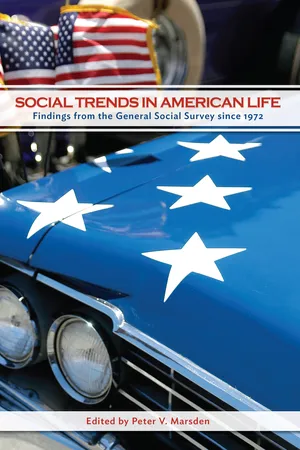
Social Trends in American Life assembles a team of leading researchers to provide unparalleled insight into how American social attitudes and behaviors have changed since the 1970s. Drawing on the General Social Survey—a social science project that has tracked demographic and attitudinal trends in the United States since 1972—it offers a window into diverse facets of American life, from intergroup relations to political views and orientations, social affiliations, and perceived well-being.
Among the book's many important findings are the greater willingness of ordinary Americans to accord rights of free expression to unpopular groups, to endorse formal racial equality, and to accept nontraditional roles for women in the workplace, politics, and the family. Some, but not all, signs indicate that political conservatism has grown, while a few suggest that Republicans and Democrats are more polarized. Some forms of social connectedness such as neighboring have declined, as has confidence in government, while participation in organized religion has softened. Despite rising standards of living, American happiness levels have changed little, though financial and employment insecurity has risen over three decades.
Social Trends in American Life provides an invaluable perspective on how Americans view their lives and their society, and on how these views have changed over the last two generations.
eBook - ePub
Social Trends in American Life
Findings from the General Social Survey since 1972
- 408 pages
- English
- ePUB (mobile friendly)
- Available on iOS & Android
eBook - ePub
Social Trends in American Life
Findings from the General Social Survey since 1972
About this book
Information
Publisher
Princeton University PressYear
2012Print ISBN
9780691155906
9780691133317
eBook ISBN
9781400845569
1
Introduction and Overview
This book reports on social trends among U.S. adults between the early 1970s and the first decade of the 21st century. Its chapters cover social and political phenomena arrayed across a wide spectrum. Some investigate and interpret changes in salient sociopolitical attitudes—regarding tolerance for free speech, black/white relationships, women’s roles, politics and government, and crime and its punishment. Others ask whether confidence in major American institutions fell, or if connections to religious groups or other persons waned. Still others study shifts in how adults assessed their well-being as economic, political, and social conditions in U.S. society underwent sometimes-dramatic change.
The 12 studies that follow rest on survey data assembled by the General Social Survey (GSS) project since 1972. The GSS regularly questions representative samples of U.S. adults about their social, political, and economic attitudes, values, self-assessments, and behaviors. As well, it collects extensive background information about demographic and social characteristics that predict differences among Americans. This now-substantial data archive facilitates studies of social trends by ensuring that both measurements and samples are comparable over time. It supports studies of aggregate change, subgroup differences at particular points in time, and variation in trends across important subsets of U.S. adults.1
Thousands of social science studies draw on the GSS surveys, examining point-in-time variations among Americans, patterned change over time, or both. Many investigate specific but quite diverse subjects; examples include abortion rights (Hout 1999), participation in the arts (DiMaggio 1996), conceptions of mental illness (Phelan, Link, Stueve, and Pescosolido 2000), and work orientations such as organizational commitment (Marsden, Kalleberg, and Cook, 1993). A few more comprehensive studies compare and contrast trends across multiple topical areas. Smith (1990) inventoried hundreds of trends measured by the GSS and other repeated surveys conducted between World War II and the late 1980s, finding that “liberal” movements outnumbered “conservative” ones during that period, but also that liberalization began to wane after the mid-1970s. Davis (1992) examined 42 trends on diverse topics tracked by the GSS, suggesting that the later 1980s saw a “liberal rebound.” Mitchell (1996) reported trends in numerous GSS survey items over two decades (1974–1994), with attention to differences between men and women, blacks and whites, older and younger adults, and the more and less educated. DiMaggio, Evans, and Bryson (1996) asked whether polarization—that is, disagreement surrounding social issues—grew over time, concluding in general that it did not (increased contention over abortion rights was an exception). Indeed, they reported that between-group differences in many social attitudes shrunk during the late 20th century.
Taken together, the chapters here offer some of the depth of single-topic studies together with the breadth of omnibus studies like Smith (1990), Davis (1992), and DiMaggio et al. (1996). The authors situate the trends they describe within—and interpret their findings with reference to—traditions of social science scholarship in their subject areas. Their topics cover much of the range of phenomena the GSS project tracks.
This introductory chapter first provides context for the studies that follow, drawing on prior research about change in the U.S. social, political, and economic landscape since the 1970s. Next comes an overview of this book’s content, including some remarks about related GSS-based trend studies on other topics. I close by briefly calling attention to the variety of approaches and explanations that the authors use when offering accounts for the patterns of change they report. No compact statement about factors that underlie recent U.S. social change emerges. The extent and direction of trends differ considerably, both within and across topical areas—as is perhaps to be anticipated for such diverse phenomena.
A Changing U.S. Social Environment
Economic, demographic, political, and cultural conditions provide a backdrop for the changes in attitudes and behaviors discussed here. Previous studies portray change in those conditions as revealed by comparisons of U.S. Census Bureau data over time (e.g., Farley 1996; Farley and Haaga 2005; Fischer and Hout 2006) or by integrating across a variety of archival sources that record developments and events during this period (e.g., Patterson 2005; Wilentz 2008).
In the early 1970s, the United States was emerging from the tumult of the 1960s: the upheavals of the civil rights movement, the optimism and interventionist impulses of Great Society initiatives, and the divisiveness and disillusionment surrounding the Vietnam War (Phillips-Fein 2011). The Watergate scandal and the first oil crisis took place just as the GSS began to follow the attitudes and behaviors of American adults.
Marked changes in the U.S. economy described by Levy (1998) were under way in the early 1970s and continued thereafter. The high productivity increases that fueled rising incomes and standards of living after World War II slowed, as did real wage growth. The poverty rate fell slightly, from 14.3% in 1969 to 10.1% by 1999 (Danziger and Gottschalk 2005, p. 55). Technological change and the onset of international competition, among other factors, contributed to deindustrialization and a loss of manufacturing jobs; employment in services and (later) information industries grew. Many newly created positions placed a premium on higher education—what Levy terms a “skill bias”; wages of well-educated workers rose much more rapidly than did those of others (Danziger and Gottschalk 2005, pp. 64–65). Many other new jobs were poorly paid, lacking health care, pension, and other workplace-linked benefits (Kalleberg 2011). Growing skill differentiation was one element behind a rapid rise in income inequality: Levy (1998, p. 199) reports that the share of income received by the top 5% of U.S. families rose from 15.6% in 1969 to 20.3% by 1996.
Among the most notable economic changes was the rising number of women engaged in paid employment. By 1994, over 75% of women aged 25–54 were in the labor force, compared to just 50% in 1970. During the same period, labor force participation among prime-working-age men dropped by 4 percentage points (Spain and Bianchi 1996, p. 82). The number of two-earner families therefore rose, allowing family incomes to grow despite stagnant wage levels (especially among men) during much of the period. A substantial gender gap in earnings narrowed somewhat during the 1980s, but women’s average pay remained substantially beneath men’s. Danziger and Gottschalk (2005, p. 67) report that this disparity remained relatively stable after 1993.
U.S. demography, family structures, and living arrangements underwent dramatic change. Birth rates fell from over 3 children per woman at the height of the baby boom years to under 2 by the mid-1980s (Fischer and Hout 2006, p. 66). Falling mortality rates accompanied lower fertility: life expectancy at birth continued its century-long rise, reaching well over 70 by 1988 (Treas and Torrecilha 1995). Together, these changes in vital rates raised the proportion of people in older age brackets and the median age in the U.S. population (Treas and Torrecilha 1995; Fischer and Hout 2006, pp. 63–66).
The same period saw notable changes in family structures and living arrangements. Among the most crucial of these were delays in the age of first marriage and rising rates of divorce (Lichter and Qian 2005). Cohabitation, childbearing outside of marriage, and childlessness rose somewhat (Spain and Bianchi 1996). These changes meant that people were married for less of their lives, leading one analyst to argue marriage became “deinstitutionalized” in the United States (Cherlin 2004). Variety in family structures grew as the number of “traditional” families composed of two married adults with children dropped. Many more adults, especially the elderly, lived alone (Fischer and Hout 2006).
A new wave of immigration commenced while these demographic shifts were under way. The percentage of foreign-born persons within the U.S. population grew from about 4% in 1970 to 11% in 2000 (Kritz and Gurak 2005, p. 269). The new immigrants came largely from Latin America and Asia—over a third of them from Mexico alone—rather than Europe and were typically younger than the native born. Their arrival added notably to U.S ethnic and cultural diversity: Hispanic Americans made up 13% of the U.S. population in 2000, slightly more than blacks (12%). Only 69% of Americans then had European origins, a substantial drop from 88% European in the early 20th century (Fischer and Hout 2006, pp. 25, 36).
Residential trends under way throughout the 1900s continued: population shifted away from the Northeast and Midwest toward the southern and western U.S. (Farley 1996), and suburban places grew. Differences between urban and suburban dwellers generally widened, while regional and rural–urban differences diminished (Fischer and Hout 2006).
One additional—and vital—20th-century sociodemographic trend was a broad expansion in education (Fischer and Hout 2006). Of those turning 21 in 1970, about 85% completed high school degrees; roughly 25% earned college degrees. On average, they completed over 13 years of schooling. These figures represented striking increases over even midcentury educational attainment levels, but they rose little further for cohorts maturing after 1970.
Political historians generally characterize this era as conservative (Wilentz 2008; Phillips-Fein 2011). Between 1969 and 2009, Republicans held the presidency for all but 12 years. Divided government was common, however: Democrats usually controlled Congress. Domestic initiatives were few by comparison with the 1960s, as politicians emphasized limiting rather than expanding government. While few social programs of the 1960s ended, economic policy favored free markets as a means toward economic growth, stressing tax reductions, deregulation, and reduced outlays for social welfare (Levy 1998; Patterson 2005).
Extensive technological changes during this period greatly expanded opportunities for Americans to contact one another (Fischer 2011). A national interstate highway network was completed, and airline travel grew. Access to telephone service broadened, and the cost of long-distance communication fell very notably. Later, the introduction and subsequent rapid development of new communication modes—cellular telephones, text messaging, electronic mail, and other Internet-mediated interaction—vastly altered the ways in which Americans interact with one another and obtain information.2
Much has been written of cultural shifts that took place during this period. A “minority rights revolution” (Skrentny 2002) led to broad diffusion and acceptance of principles of equal opportunity and nondiscrimination. With impetus from the civil rights movement that sought equal rights for African Americans, rights advocates soon extended their efforts to other groups including women, ethnic minorities, gays and lesbians, and the disabled.
Some authors wrote of falling civic engagement, loss of community, and a growing “sense of civic malaise” (Putnam 2000, p. 25). Others observed increasing individualism, worrying that aspects of it might be destructive (Bellah, Madsen, Sullivan, Swidler, and Tipton 1985). Still others (Hunter 1991) contended that cultural conflicts became reconfigured as debates between the distinct moral worldviews held by orthodox and progressive partisans. “Social issues,” many of them made salient by changes in family structure and formation—e.g., abortion rights, artistic expression, divorce, homosexuality, pornography, school curricula—served as foci for these controversies. Patterson (2005) opines that media attention amplified the volume of these “culture wars” and that liberal positions came to predominate in many of them—although conservative participants articulated their stances vigorously.
The GSS survey data examined in the studies that follow were assembled while these societal changes were unfolding. Those studies trace shifts in how typical American adults viewed some of these phenomena and in how they assessed their lives in light of them. They often indicate that broad statements about social change during this period should be qualified and contextualized.
Changing Attitudes, Connectivity, and Well-Being
The coverage of the GSS is indeed “general.” By measuring numerous broadly conceived “social indicators,” it facilitates “social reporting” about societal conditions and how they change over periods of time (Land 1983). The GSS’s attitudinal and behavioral measures touch on many spheres of life, including work, family, politics, religion, and social life, among others.
The three parts of this book discuss trends in social and political phenomena, social connectedness, and individual well-being, respectively. Chapters in the first part examine changing orientations toward key realms of sociopolitical life, centering attention on survey questions that contrast liberal and conservative conceptions of desirable social states—e.g., greater or lesser tolerance for free expression, a racially integrated society versus one partitioned along racial lines, or more and less punitive stances toward criminals. The second part analyzes changes in individual–society attachments at different levels—expressed confidence in major social institutions, links with and participation in religious groups, and informal socializing with other persons. The four studies in the final part examine over-time change and stability in subjective well-being—happiness, job and financial security—and in verbal ability.
Liberal and Conservative Movements in Sociopolitical Attitudes
Each of the first five chapters asks whether American adults grew more liberal or conservative in some way during this period. What it means to be “liberal” or “conservative” must be defined before engaging that question. This is not straightforward: Smith’s overview study of social and political trends distinguished eight forms of liberalism regarding domestic matters (Smith 1990, p. 480): a “reformist” orientation supporting change in the status quo, a “democratic” impulse toward expanded electoral rights, a “libertarian” stance favoring civil liberties, an “interventionist” position endorsing government regulation, “centralist” advocacy of federal standard setting, a “humanitarian” disposition toward social welfare and caring for the disadvantaged, an “egalitarian” inclination toward equal opportunity and (sometimes) results, and “permissive” tolerance of nontraditional lifestyles and practices.3
These distinctions are important because people may be liberal in some domains and simultaneously hold conservative or moderate views in others, as intraparty struggles over political platforms exemplify. Trends in different aspects of liberalism can and do differ. GSS evidence presented in this pa...
Table of contents
- Cover
- Title
- Copyright
- Contents
- Preface and Acknowledgments
- Contributors
- 1 Introduction and overview
- Trends in Social and Political Orientations
- Changes in Confidence and Connections
- Stability and Flux in Social Indicators
- Appendix: the General social survey Project
- Index
Trusted by 375,005 students
Access to over 1.5 million titles for a fair monthly price.
Study more efficiently using our study tools.
Frequently asked questions
Yes, you can cancel anytime from the Subscription tab in your account settings on the Perlego website. Your subscription will stay active until the end of your current billing period. Learn how to cancel your subscription
No, books cannot be downloaded as external files, such as PDFs, for use outside of Perlego. However, you can download books within the Perlego app for offline reading on mobile or tablet. Learn how to download books offline
Perlego offers two plans: Essential and Complete
- Essential is ideal for learners and professionals who enjoy exploring a wide range of subjects. Access the Essential Library with 800,000+ trusted titles and best-sellers across business, personal growth, and the humanities. Includes unlimited reading time and Standard Read Aloud voice.
- Complete: Perfect for advanced learners and researchers needing full, unrestricted access. Unlock 1.5M+ books across hundreds of subjects, including academic and specialized titles. The Complete Plan also includes advanced features like Premium Read Aloud and Research Assistant.
We are an online textbook subscription service, where you can get access to an entire online library for less than the price of a single book per month. With over 1.5 million books across 990+ topics, we’ve got you covered! Learn about our mission
Look out for the read-aloud symbol on your next book to see if you can listen to it. The read-aloud tool reads text aloud for you, highlighting the text as it is being read. You can pause it, speed it up and slow it down. Learn more about Read Aloud
Yes! You can use the Perlego app on both iOS and Android devices to read anytime, anywhere — even offline. Perfect for commutes or when you’re on the go.
Please note we cannot support devices running on iOS 13 and Android 7 or earlier. Learn more about using the app
Please note we cannot support devices running on iOS 13 and Android 7 or earlier. Learn more about using the app
Yes, you can access Social Trends in American Life by Peter V. Marsden, Peter Marsden in PDF and/or ePUB format, as well as other popular books in Social Sciences & Politics. We have over 1.5 million books available in our catalogue for you to explore.