
Mathematical Tools for Understanding Infectious Disease Dynamics
eBook - ePub

Mathematical Tools for Understanding Infectious Disease Dynamics

  1. 520 pages
  2. English
  3. ePUB (mobile friendly)
  4. Available on iOS & Android
eBook - ePub

Mathematical Tools for Understanding Infectious Disease Dynamics

About this book

Mathematical modeling is critical to our understanding of how infectious diseases spread at the individual and population levels. This book gives readers the necessary skills to correctly formulate and analyze mathematical models in infectious disease epidemiology, and is the first treatment of the subject to integrate deterministic and stochastic models and methods.

Mathematical Tools for Understanding Infectious Disease Dynamics fully explains how to translate biological assumptions into mathematics to construct useful and consistent models, and how to use the biological interpretation and mathematical reasoning to analyze these models. It shows how to relate models to data through statistical inference, and how to gain important insights into infectious disease dynamics by translating mathematical results back to biology. This comprehensive and accessible book also features numerous detailed exercises throughout; full elaborations to all exercises are provided.

  • Covers the latest research in mathematical modeling of infectious disease epidemiology
  • Integrates deterministic and stochastic approaches
  • Teaches skills in model construction, analysis, inference, and interpretation
  • Features numerous exercises and their detailed elaborations
  • Motivated by real-world applications throughout
Frequently asked questions

Yes, you can cancel anytime from the Subscription tab in your account settings on the Perlego website. Your subscription will stay active until the end of your current billing period. Learn how to cancel your subscription.
No, books cannot be downloaded as external files, such as PDFs, for use outside of Perlego. However, you can download books within the Perlego app for offline reading on mobile or tablet. Learn more here.
Perlego offers two plans: Essential and Complete
  • Essential is ideal for learners and professionals who enjoy exploring a wide range of subjects. Access the Essential Library with 800,000+ trusted titles and best-sellers across business, personal growth, and the humanities. Includes unlimited reading time and Standard Read Aloud voice.
  • Complete: Perfect for advanced learners and researchers needing full, unrestricted access. Unlock 1.4M+ books across hundreds of subjects, including academic and specialized titles. The Complete Plan also includes advanced features like Premium Read Aloud and Research Assistant.
Both plans are available with monthly, semester, or annual billing cycles.
We are an online textbook subscription service, where you can get access to an entire online library for less than the price of a single book per month. With over 1 million books across 1000+ topics, we’ve got you covered! Learn more here.
Look out for the read-aloud symbol on your next book to see if you can listen to it. The read-aloud tool reads text aloud for you, highlighting the text as it is being read. You can pause it, speed it up and slow it down. Learn more here.
Yes! You can use the Perlego app on both iOS or Android devices to read anytime, anywhere — even offline. Perfect for commutes or when you’re on the go.
Please note we cannot support devices running on iOS 13 and Android 7 or earlier. Learn more about using the app.
Yes, you can access Mathematical Tools for Understanding Infectious Disease Dynamics by Odo Diekmann,Hans Heesterbeek,Tom Britton in PDF and/or ePUB format, as well as other popular books in Biological Sciences & Applied Mathematics. We have over one million books available in our catalogue for you to explore.

Part IV

Elaborations

Chapter Sixteen

Elaborations for Part I

16.1 ELABORATIONS FOR CHAPTER 1

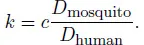
Exercise 1.1 Let c denote the number of blood meals a mosquito takes per unit of time. Suppose a human receives k bites per unit of time. Consistency requires that kDhuman = cDmosquito. Our assumption is that c is a given constant. Hence necessarily
Image
Exercise 1.2 cTmpm.
Exercise 1.3 kThph.
Exercise 1.4 Consider one infected mosquito. It is expected to infect cTmpm humans, each of which is expected to infect kThph mosquitoes. So, going full circle, we have a multiplication factor
Image
When this multiplication factor is below one, an initial infection will die out in a small number of ‘generations.’ If, however, it is above one then most likely (see Section 1.2.2 for a qualitative and quantitative elaboration of how likely this actually is) an avalanche will result.
Exercise 1.5 i) R0 = q1 + 2q2. Using q0 + q1 + q2 = 1 we can rewrite this as R0 = 1 + q2q0. If follows that R0 > 1 if q2 > q0, and that R0 ≤ 1 if q2q0.
ii) Individuals are indistinguishable, so for each the probability that its line of descent will stop equals z. By independence, the probability that both lines stop then equals z2.
iii) Consider one individual. If this individual has no offspring, its line of descent will stop with certainty. If it produces one offspring, its line of descent will stop with probability z. If it produces two offspring, its line of descent will stop with probability z2. Hence consistency requires that
z = q01 + q1z + q2z2.
iv) If we substitute q1 = 1 − q0q2 we obtain z = q0 + zq0zq2z + q2z2 and next q0(z − 1) = q2z(z − 1). From this we see that either z = 1 or that q0 = q2z.
v) We recall from i) that R0 ≤ 1 corresponds to q2q0 and hence to q0/q2 ≥ 1. As z should be a probability, we conclude that only the possibility z = 1 remains.
vi) If R0 > 1 then q2 > q0 so q0q2 < 1. We expect that in this case z = q0q2 and that with complementary probability 1 − z > 0 the line of descent of the individual will grow exponentially.
Exercise 1.6 i) Direct substitution.
ii) g(1) =
Image
and, since {qk} should be a probability distribution, we require that
Image
.
iii) By term-by-term differentiation, g′(z) =
Image
and therefore g′(1) =
Image
iv) All qk ≥ 0 (by their interpretation) and
Image
guarantee that at least one of the qk is strictly positive; the expression for g′(z) derived in 1.6-iii then implies g′(z) > 0, provided that q0 < 1.
v) g″(z) =
Image
, and the argument is now identical to that used in proving 1.6-iv. Note that if q0 + q1 = 1 then g″(z) = 0. The strict inequality g″(z) ...

Table of contents

  1. Cover
  2. Title
  3. Copyright
  4. Contents
  5. Preface
  6. I The bare bones: Basic issues in the simplest context
  7. II Structured populations
  8. III Case studies on inference
  9. IV Elaborations
  10. Bibliography
  11. Index





