An essential account of the historic subprime mortgage crisis, from the Nobel Prize–winning economist and bestselling author of Irrational Exuberance
The subprime mortgage crisis has already wreaked havoc on the lives of millions of people and now it threatens to derail the U.S. economy and economies around the world. In this trenchant book, best-selling economist Robert Shiller reveals the origins of this crisis and puts forward bold measures to solve it. He calls for an aggressive response—a restructuring of the institutional foundations of the financial system that will not only allow people once again to buy and sell homes with confidence, but will create the conditions for greater prosperity in America and throughout the deeply interconnected world economy.
Shiller blames the subprime crisis on the irrational exuberance that drove the economy's two most recent bubbles—in stocks in the 1990s and in housing between 2000 and 2007. He shows how these bubbles led to the dangerous overextension of credit now resulting in foreclosures, bankruptcies, and write-offs, as well as a global credit crunch. To restore confidence in the markets, Shiller argues, bailouts are needed in the short run. But he insists that these bailouts must be targeted at low-income victims of subprime deals. In the longer term, the subprime solution will require leaders to revamp the financial framework by deploying an ambitious package of initiatives to inhibit the formation of bubbles and limit risks, including better financial information; simplified legal contracts and regulations; expanded markets for managing risks; home equity insurance policies; income-linked home loans; and new measures to protect consumers against hidden inflationary effects.
This powerful book is essential reading for anyone who wants to understand how we got into the subprime mess—and how we can get out.
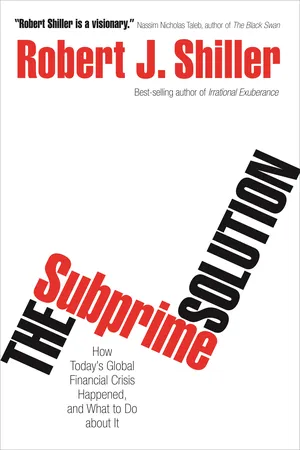
eBook - ePub
The Subprime Solution
How Today's Global Financial Crisis Happened, and What to Do about It
- 224 pages
- English
- ePUB (mobile friendly)
- Available on iOS & Android
eBook - ePub
The Subprime Solution
How Today's Global Financial Crisis Happened, and What to Do about It
About this book
Information
Publisher
Princeton University PressYear
2012Print ISBN
9780691156323
9780691139296
eBook ISBN
9781400844999
Introduction
1
The subprime crisis is the name for what is a historic turning point in our economy and our culture. It is, at its core, the result of a speculative bubble in the housing market that began to burst in the United States in 2006 and has now caused ruptures across many other countries in the form of financial failures and a global credit crunch. The forces unleashed by the subprime crisis will probably run rampant for years, threatening more and more collateral damage. The disruption in our credit markets is already of historic proportions and will have important economic impacts. More importantly, this crisis has set in motion fundamental societal changes—changes that affect our consumer habits, our values, our relatedness to each other. From now on we will all be conducting our lives and doing business with each other a little bit differently.
Allowing these destructive changes to proceed unimpeded could cause damage not only to the economy but to the social fabric—the trust and optimism people feel for each other and for their shared institutions and ways of life—for decades to come. The social fabric itself is so hard to measure that it is easily overlooked in favor of smaller, more discrete, elements and details. But the social fabric is indeed at risk and should be central to our attention as we respond to the subprime crisis.
History proves the importance of economic policies for preserving the social fabric. Europe after World War I was seriously damaged by one peculiar economic arrangement: the Treaty of Versailles. The treaty, which ended the war, imposed on Germany punitive reparations far beyond its ability to pay. John Maynard Keynes resigned in protest from the British delegation at Versailles and, in 1919, wrote The Economic Consequences of the Peace, which predicted that the treaty would result in disaster. Keynes was largely ignored, the treaty remained in force, and indeed Germany never was able to pay the penalties imposed. The intense resentment caused by the treaty was one of the factors that led, a generation later, to World War II.
A comparable disaster—albeit one not of quite the same magnitude—is brewing today, as similar concerns are hammering at our psyches. Once again, many people, unable to repay their debts, are being pursued aggressively by creditors. Once again, they often feel that the situation is not of their own making, but the product of forces beyond their control. Once again, they see once-trusted economic institutions collapsing around them. Once again, they feel that they were lied to—fed overly optimistic stories that encouraged them to take excessive risks.
It is impossible to predict the nature and extent of the damage that the current economic and social dysphoria and disorder will create. But a good part of it will likely be measured in slower economic growth for years to come. We may well experience several years of a bad economy, as occurred, for example, after the profligate mortgage lending booms in both Sweden and Mexico in the early 1990s. There could even be another “lost decade,” like that suffered by Mexico in the 1980s after its spending spree during the oil price boom, or by Japan in the 1990s after the bursting of the 1980s bubble in its stock and housing markets.
In this book I argue that the housing bubble that created the subprime crisis ultimately grew as big as it did because we as a society do not understand, or know how to deal with, speculative bubbles. Even intelligent, well-informed people—who certainly knew that there had been bubbles throughout history and could even recite examples—typically did not comprehend that an epidemic of irrational public enthusiasm for housing investments was the core of the problem. Business and government leaders did not know how to deal with this situation, nor did they establish the kinds of new financial institutions that could have managed it.
The view that the ultimate cause of the global financial crisis is the psychology of the real estate bubble (with contributions from the stock market bubble before that) has certainly been expressed before. But it would appear that most people have not taken this view to heart, and at the very least that they do not appreciate all of its ramifications. Accounts of the crisis often seem instead to place the ultimate blame entirely on such factors as growing dishonesty among mortgage lenders; increasing greed among securitizers, hedge funds, and rating agencies; or the mistakes of former Federal Reserve chairman Alan Greenspan.
It is time to recognize what has been happening and to take fundamental steps to restructure the institutional foundations of the housing and financial economy. This means taking both short-run steps to alleviate the crisis and making longer-term changes that will inhibit the development of bubbles, stabilize the housing and larger financial markets, and provide greater financial security to households and businesses, all the while allowing new ideas to drive financial innovation.
A Crisis in a Bubble
By now the whole world has heard the story of the problems in the subprime mortgage market, which began to show up in the United States in 2007 and then spread to other countries. Home prices and homeownership had been booming since the late 1990s, and investing in a house had seemed a sure route to financial security and even wealth.
U.S. homeownership rates rose over the period 1997–2005 for all regions, all age groups, all racial groups, and all income groups. According to the U.S. Census, the homeownership rate increased from 65.7% to 68.9% (which represents an 11.5% increase in the number of owner-occupied homes) over that period. The increases in homeownership were largest in the West, for those under the age of 35, for those with below-median incomes, and for Hispanics and blacks.
Encouraging homeownership is a worthy and admirable national goal. It conveys a sense of participation and belonging, and high homeownership rates are beneficial to a healthy society. Later in this chapter I trace the evolution of the systems put in place in the United States in the twentieth century to promote homeownership. But the subprime housing dilemma in the United States points up problems with over-promoting homeownership. Homeownership, for all its advantages, is not the ideal housing arrangement for all people in all circumstances. And we are now coming to appreciate the reality of this, for the homeownership rate has been falling in the United States since 2005.
What was the chain of events in the subprime crisis? Overly aggressive mortgage lenders, compliant appraisers, and complacent borrowers proliferated to feed the housing boom. Mortgage originators, who planned to sell off the mortgages to securitizers, stopped worrying about repayment risk. They typically made only perfunctory efforts to assess borrowers' ability to repay their loans—often failing to verify borrowers' income with the Internal Revenue Service, even if they possessed signed authorization forms permitting them to do so. Sometimes these lenders enticed the naïve, with poor credit histories, to borrow in the ballooning subprime mortgage market. These mortgages were packaged, sold, and resold in sophisticated but arcane ways to investors around the world, setting the stage for a crisis of truly global proportions. The housing bubble, combined with the incentive system implicit in the securitization process, amplified moral hazard, further emboldening some of the worst actors among mortgage lenders.
High home prices made it profitable to build homes, and the share of residential investment in U.S. gross domestic product (GDP) rose to 6.3% in the fourth quarter of 2005, the highest level since the pre–Korean War housing boom of 1950–51. The huge supply of new homes began to glut the market, and, despite the optimistic outlooks of national leaders, U.S. home prices began to fall in mid-2006. As prices declined at an accelerating rate, the boom in home construction collapsed.
At the same time, mortgage rates began to reset to higher levels after initial “teaser” periods ended. Borrowers, particularly subprime borrowers, began defaulting, often owing more than their homes were worth or unable to support their higher monthly payments with current incomes. Now many of the financial institutions that participated in what once seemed a brave new world of expanding homeownership and exotic financial innovation are in varying degrees of distress. The world's credit markets have shown symptoms of locking up.
We may be in for a severe economic contraction that could create hardship for millions of people, spreading far beyond the subprime borrowers at the center of the crisis. Major losses occurred in U.S. banks and brokerage firms. The heads of Citibank, Merrill Lynch, and Morgan Stanley lost their jobs. The situation remains critical.
The crisis has bled over to other sectors besides housing. Credit card and automobile loan defaults have been ominously increasing. The credit ratings of municipal bond insurers are being downgraded, creating a risk that the problem will spread to state and local government financing. The market for commercial paper has suffered a severe shock, and the market for corporate loan obligations appears troubled as well.
Nor did the subprime crisis end at America's borders. Booming real estate markets have shown signs of peaking, or at least of flattening out, in many countries. The effects of the financial crisis have also filtered into other countries, as witnessed by the failures of IKB Deutsche Industriebank AG, SachsenLB, WestLB, and BayernLB in Germany, the failure of funds sponsored by BNP Paribas in France, and the run on the Northern Rock Building Society in the United Kingdom.
Then again, these problems from outside the United States have fed back into the country, manifested in a declining dollar, a faltering stock market, and more financial failures, notably that of the venerable U.S. investment bank Bear Stearns. This grim feedback loop—with problems moving from the United States to the rest of the world and back again to the United States—has certainly not yet run its course.
The same feedback seems also at this date to be contributing to a global energy crisis and a global food crisis. Speculative enthusiasm has helped push oil prices to record levels, stimulating a demand for ethanol for fuel from grains, thus reducing the supply of grains for food. Prices of grains are shooting up so high that poor people have difficulty staving off hunger.
The same kind of speculative thinking that has propelled the stock market and housing market in the recent past seems to be at work in these markets as well. The nations of the world have had difficulty protecting themselves from these crises. A number of less developed countries have tried to protect themselves from the global food crisis by putting export controls on food grains. But they have found that such controls do not work, since prices of grains within their borders stay high after such controls, as speculative hoarding within the country responds to the high world food prices and withdraws supply from local markets. Speculative instability in the market for food may eventually result in price breaks there, but one shudders to think of the human consequences until it does.
Mend It, Don't End It
The current financial crisis is often viewed as a reason to sound retreat—to return to yesterday's simpler methods of financial dealing. This would be a mistake. On the contrary, the current situation is really an opportunity to redouble our efforts to rethink and improve our risk-management institutions, the framework that undergirds our increasingly sophisticated financial sector. Despite the present crisis, modern finance has produced historic achievements in recent decades and serves as a powerful engine of economic growth, from underwriting new businesses in the private sector to supporting vital research in the universities to building schools and hospitals in the public sector.
Every crisis contains the seeds of change. Now is the time to restructure the institutional firmament of financial activity in positive ways that will stabilize the economy, rekindle the wealth of nations, reinforce the best of financial innovation, and leave society much better off than if there had not been such a crisis.
This book is an effort to explain the current subprime crisis and lay the foundation for such an institutional rebirth. It suggests both commonsense short-run fixes and deeper long-term improvements that will serve us into the indefinite future. The book cannot consider all the proposals and counterproposals that others have offered to deal with the crisis—there are simply too many of them. But it will set forth the greater goals around which future solutions might cluster.
The book is intended for readers in countries all over the world. The subprime crisis is now a truly international event, and the solutions offered here can generally be adapted to other countries as well.
As already noted, institutional reform means providing a stronger framework within which our real estate and financial markets can operate. No matter how powerful and technologically sophisticated the train, it is only as good as the track on which it runs. Regulatory and insurance institutions are the track that carries our financial and real estate markets. But these existing risk-management institutions are old and unstable. We are running bullet trains on ancient track. Our leaders in government and in business must overhaul and replace the rails and ties. The subprime solution is all about institutional reform: the vision to see beyond short-term fixes and the courage to undertake reform at the highest levels.
Lessons from the Last Big Housing Crisis
While the implications of the subprime crisis are global, the crisis itself must be understood in its place and time of origin, twentieth-century America. Before the current problem, the last major housing crisis in the United States took place in 1925–33. Home prices fell a total of 30% over this interval, and the unemployment rate rose to 25% at the peak of the Great Depression. The crisis revealed glaring defects in the financial institutions of the period. At that time most people borrowed with short-term mortgages of five years or less, which they expected to roll over shortly before they came due. As the crisis took hold, borrowers increasingly found that they were unable to refinance their mortgages, and so they stood to lose their homes.
No public institutions were in place at the time to prevent borrowers from being evicted from their homes owing to their inability to secure new mortgages. But because concerted efforts were made by leaders to change the institutional framework, mass evictions were avoided and recovery was eventually achieved.
The policy responses to that historical crisis are an inspiration for the kind of solutions that should be promoted to address the current crisis. As the housing problems of the Depression era worsened, major innovations appeared in the private and public sectors. While history has emphasized the importance of Franklin Delano Roosevelt's New Deal, the significant changes were not simply the result of one man's policies. Rather, they reflected an effort, involving leaders from government and business alike, to try to understand the crisis and change the institutional infrastructure of the U.S. economy.
The National Association of Real Estate Boards, a precursor to today's National Association of Realtors, proposed in the early 1930s that Congress create a new home-loan banking system, parallel to the Federal Reserve System that had been legislated in 1913. Just as the Federal Reserve System had twelve regional banks, so too did the new Federal Home Loan Bank System. Just as the Federal Reserve System had the power to discount assets of its member banks, so too could the Federal Home Loan Bank System provide the same help to mortgage originators. This was large-scale thinking in response to a large-scale crisis. The Federal Home Loan Bank System has since been modified, but it is still with us today, providing assistance during the current crisis by supplying funding for mortgages.
Private-sector reforms were equally innovative. In 1932 the real estate appraisal industry pulled itself together to become a truly professional organization with the founding of the American Institute of Real Estate Appraisers, whose successor today is the Appraisal Institute. It was not formally called the Appraisal Institute until it merged with the Society of Real Estate Appraisers in 1991. Yet by the early 1930s its accredited members were already putting the initials M.A.I., for “Member, Appraisal Institute,” after their names as a credential. Under the pressure of the crisis, the newly professionalized appraisal industry began taking advantage of the latest developments in information technology, processing data on a large scale using punched cards and computing systems produced by Remington Rand and the International Business Machines Corporation. The improvements that originated in the private sector during the housing crisis of the 1930s have continued to the present day, helping prevent—or at least limit—further crises by providing a more secure valuation of homes for mortgage lenders.
A landmark change occurred on the legislative front as well, in response to the crush of foreclosures against homeowners. The U.S. Congress approved a new bankruptcy law in 1933, near the end of the administration of Herbert Hoover, which made it possible for the first time for most ordinary wage earners to avail themselves of bankruptcy protection. Thus the crisis led to reforms that not only stabilized the housing sector but further democratized the financial institutions of the day, creating public goods that made more effective financial technology available to everyone.
The reforms did not stop there. In 1933, with Roosevelt as the new president, Congress created the Home Owners' Loan Corporation (HOLC), which lent to local home-financing institutions, taking risky home mortgages as collateral, and thereby provided a government subsidy to home mortgages. But the HOLC did more than simply provide a subsidy: the organization changed the very standards of the mortgage industry. The HOLC insisted that the new mortgages it sponsored be fifteen-year loans that were both fixed-rate and self-amortizing, that is, that were paid off by steady monthly payments with no large payments due at maturity.
In 1934 Congress created the Federal Housing Administration (FHA), which was intended to promote homeownership among those who could not then afford homes. The FHA went even further than the HOLC in improving the institution of mortgages, raising maturities to twenty years and also requiring, as did the HOLC, that mortgages be fixed-rate and self-amortizing. This began a trend to the familiar fixed-rate mortgage of today; starting in the 1950s, mortgages began to be thirty-ye...
Table of contents
- Cover Page
- Title Page
- Copyright Page
- Dedication Page
- Contents
- Preface to the Paperback Edition
- Acknowledgments
- 1. Introduction
- 2. Housing in History
- 3. Bubble Trouble
- 4. The Real Estate Myth
- 5. A Bailout by any Other Name
- 6. The Promise of Financial Democracy
- 7. Epilogue
- Index
Trusted by 375,005 students
Access to over 1.5 million titles for a fair monthly price.
Study more efficiently using our study tools.
Frequently asked questions
Yes, you can cancel anytime from the Subscription tab in your account settings on the Perlego website. Your subscription will stay active until the end of your current billing period. Learn how to cancel your subscription
No, books cannot be downloaded as external files, such as PDFs, for use outside of Perlego. However, you can download books within the Perlego app for offline reading on mobile or tablet. Learn how to download books offline
Perlego offers two plans: Essential and Complete
- Essential is ideal for learners and professionals who enjoy exploring a wide range of subjects. Access the Essential Library with 800,000+ trusted titles and best-sellers across business, personal growth, and the humanities. Includes unlimited reading time and Standard Read Aloud voice.
- Complete: Perfect for advanced learners and researchers needing full, unrestricted access. Unlock 1.5M+ books across hundreds of subjects, including academic and specialized titles. The Complete Plan also includes advanced features like Premium Read Aloud and Research Assistant.
We are an online textbook subscription service, where you can get access to an entire online library for less than the price of a single book per month. With over 1.5 million books across 990+ topics, we’ve got you covered! Learn about our mission
Look out for the read-aloud symbol on your next book to see if you can listen to it. The read-aloud tool reads text aloud for you, highlighting the text as it is being read. You can pause it, speed it up and slow it down. Learn more about Read Aloud
Yes! You can use the Perlego app on both iOS and Android devices to read anytime, anywhere — even offline. Perfect for commutes or when you’re on the go.
Please note we cannot support devices running on iOS 13 and Android 7 or earlier. Learn more about using the app
Please note we cannot support devices running on iOS 13 and Android 7 or earlier. Learn more about using the app
Yes, you can access The Subprime Solution by Robert J. Shiller in PDF and/or ePUB format, as well as other popular books in Economics & Banks & Banking. We have over 1.5 million books available in our catalogue for you to explore.