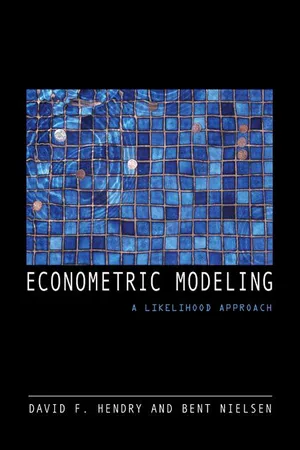
Econometric Modeling provides a new and stimulating introduction to econometrics, focusing on modeling. The key issue confronting empirical economics is to establish sustainable relationships that are both supported by data and interpretable from economic theory. The unified likelihood-based approach of this book gives students the required statistical foundations of estimation and inference, and leads to a thorough understanding of econometric techniques.
David Hendry and Bent Nielsen introduce modeling for a range of situations, including binary data sets, multiple regression, and cointegrated systems. In each setting, a statistical model is constructed to explain the observed variation in the data, with estimation and inference based on the likelihood function. Substantive issues are always addressed, showing how both statistical and economic assumptions can be tested and empirical results interpreted. Important empirical problems such as structural breaks, forecasting, and model selection are covered, and Monte Carlo simulation is explained and applied.
Econometric Modeling is a self-contained introduction for advanced undergraduate or graduate students. Throughout, data illustrate and motivate the approach, and are available for computer-based teaching. Technical issues from probability theory and statistical theory are introduced only as needed. Nevertheless, the approach is rigorous, emphasizing the coherent formulation, estimation, and evaluation of econometric models relevant for empirical research.
- 378 pages
- English
- PDF
- Available on iOS & Android
eBook - PDF
About this book
Information
Publisher
Princeton University PressYear
2012Print ISBN
9780691130897
9780691131283
eBook ISBN
9781400845651
Table of contents
- Cover
- Title Page
- Copyright Page
- Table of Contents
- Preface
- Data and Software
- Chapter 1: The Bernoulli Model
- Chapter 2: Inference in the Bernoulli Model
- Chapter 3: A First Regression Model
- Chapter 4: The Logit Model
- Chapter 5: The Two-variable Regression Model
- Chapter 6: The Matrix Algebra of Two-variable Regression
- Chapter 7: The Multiple Regression Model
- Chapter 8: The Matrix Algebra of Multiple Regression
- Chapter 9: Mis-Specification Analysis in Cross Sections
- Chapter 10: Strong Exogeneity
- Chapter 11: Empirical Models and Modeling
- Chapter 12: Autoregressions and Stationarity
- Chapter 13: Mis-specification Analysis in Time Series
- Chapter 14: The Vector Autoregressive Model
- Chapter 15: Identification of Structural Models
- Chapter 16: Non-stationary Time Series
- Chapter 17: Cointegration
- Chapter 18: Monte Carlo Simulation Experiments
- Chapter 19: Automatic Model Selection
- Chapter 20: Structural breaks
- Chapter 21: Forecasting
- Chapter 22: The way ahead
- References
- Author Index
- Subject Index
Trusted by 375,005 students
Access to over 1.5 million titles for a fair monthly price.
Study more efficiently using our study tools.
Frequently asked questions
Yes, you can cancel anytime from the Subscription tab in your account settings on the Perlego website. Your subscription will stay active until the end of your current billing period. Learn how to cancel your subscription
No, books cannot be downloaded as external files, such as PDFs, for use outside of Perlego. However, you can download books within the Perlego app for offline reading on mobile or tablet. Learn how to download books offline
Perlego offers two plans: Essential and Complete
- Essential is ideal for learners and professionals who enjoy exploring a wide range of subjects. Access the Essential Library with 800,000+ trusted titles and best-sellers across business, personal growth, and the humanities. Includes unlimited reading time and Standard Read Aloud voice.
- Complete: Perfect for advanced learners and researchers needing full, unrestricted access. Unlock 1.5M+ books across hundreds of subjects, including academic and specialized titles. The Complete Plan also includes advanced features like Premium Read Aloud and Research Assistant.
We are an online textbook subscription service, where you can get access to an entire online library for less than the price of a single book per month. With over 1.5 million books across 990+ topics, we’ve got you covered! Learn about our mission
Look out for the read-aloud symbol on your next book to see if you can listen to it. The read-aloud tool reads text aloud for you, highlighting the text as it is being read. You can pause it, speed it up and slow it down. Learn more about Read Aloud
Yes! You can use the Perlego app on both iOS and Android devices to read anytime, anywhere — even offline. Perfect for commutes or when you’re on the go.
Please note we cannot support devices running on iOS 13 and Android 7 or earlier. Learn more about using the app
Please note we cannot support devices running on iOS 13 and Android 7 or earlier. Learn more about using the app
Yes, you can access Econometric Modeling by David F. Hendry,Bent Nielsen in PDF and/or ePUB format, as well as other popular books in Economics & Econometrics. We have over 1.5 million books available in our catalogue for you to explore.