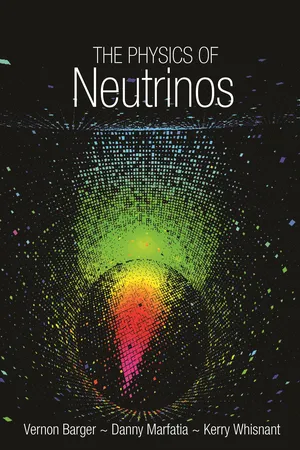
The physics of neutrinos--uncharged elementary particles that are key to helping us better understand the nature of our universe--is one of the most exciting frontiers of modern science. This book provides a comprehensive overview of neutrino physics today and explores promising new avenues of inquiry that could lead to future breakthroughs.
The Physics of Neutrinos begins with a concise history of the field and a tutorial on the fundamental properties of neutrinos, and goes on to discuss how the three neutrino types interchange identities as they propagate from their sources to detectors. The book shows how studies of neutrinos produced by such phenomena as cosmic rays in the atmosphere and nuclear reactions in the solar interior provide striking evidence that neutrinos have mass, and it traces our astounding progress in deciphering the baffling experimental findings involving neutrinos. The discovery of neutrino mass offers the first indication of a new kind of physics that goes beyond the Standard Model of elementary particles, and this book considers the unanticipated patterns in the masses and mixings of neutrinos in the framework of proposed new theoretical models.
The Physics of Neutrinos maps out the ambitious future facilities and experiments that will advance our knowledge of neutrinos, and explains why the way forward in solving the outstanding questions in neutrino science will require the collective efforts of particle physics, nuclear physics, astrophysics, and cosmology.
The unfolding of the physics of neutrinos has been a premier scientific achievement of the 20th century. The hallmark of this decades-long endeavor has been the intertwined contributions of experiment and theory in its advancement. This fascinating history has been the subject of many treatises. Our aim is to give an overview of the aggregate knowledge of neutrino physics today and to mark future pathways for still deeper understanding. In this enterprise we bring together, under one broad umbrella, what has been learned and what is now being pursued about neutrinos in a diversity of subareas–particle physics, nuclear physics, astrophysics, and cosmology. Neutrinos are of key importance in understanding the nature of our universe and there is a new synergy of these branches of physics in their study. A brief flashback to major milestones along the road of neutrino discovery is an appropriate beginning and the subject of this introduction.
The nuclear model of the atom circa 1930 was atomic electrons bound to a positive nucleus by the electromagnetic force. The nucleus was believed to be composed of both protons and electrons, in numbers such that the atomic number A and the nuclear charge Z were accounted for. A challenge to this description was that radioactive nuclei were observed to undergo spontaneous beta-decay A → A′ + e. By energy and momentum conservation, all the emitted electrons should have the same energy, but a continuous electron energy spectrum was observed. This totally unexpected phenomenon caused both Niels Bohr and Paul Dirac to consider the extreme possibility that energy was not conserved. Another apparent difficulty of the nuclear model was the “false” statistics of the 14N and 19Li nuclei. Because 14N has 7 atomic electrons, its nucleus, supposedly consisting of 14 protons and 7 electrons, should have spin-
, but scattering experiments showed it to have integer spin. Wolfgang Pauli of Eidgenössische Technische Hochschule (ETH), Zurich, saw a way out of this conundrum. He proposed, in a letter to a conference that he was unable to attend, his desperate remedy: nuclei also have very light neutral constituents of spin-
, which he called neutrons [1]. His neutrons could solve the spin-statistics problem and explain the continuous beta spectrum, since the neutrons would be emitted in conjunction with electrons, A → A′ + e + n, so the energy spectrum of the emitted electrons would not be monoenergetic. To be consistent with the observed electron energy sprectrum, the mass of his neutron had to be less than one percent of the proton mass. Pauli was embarrassed by his rash proposal because he thought that his neutron could never be detected, because of the weakness of its interaction. Pauli’s nuclear model was complex: the nucleus would consist of protons, electrons, and neutrons: e.g., 14 protons, 7 electrons, and 7 neutrons in the 14N nucleus.
In 1932 James Chadwick, then at the Cavendish Laboratory of the University of Cambridge in England, discovered the neutron [2], but it was not the weakly interacting particle emitted in beta decays. Instead, the neutron was a strongly interacting neutral companion of the proton, and the nuclear model simplified to protons and neutrons bound by the strong force: 7 protons and 7 neutrons in the 14N nucleus.
In 1934 Enrico Fermi, then at the University of Rome, reformulated Pauli’s idea that a very light neutral particle was involved in radioactive decays. He renamed it the neutrino (the “little neutral one” in Italian). In his famous theory of beta decay [3], Fermi invoked antiparticles (predicted by Dirac in 1931), Pauli’s emitted particle (the antineutrino), and quantum field theory (in which particles can be destroyed or created). In the weak interaction according to Fermi, neutrons decay to protons via a nonrenormalizable four-fermion interaction, n → p + e− +
e where
e is the electron-antineutrino. The electron and the antineutrino are created as a pair, rather than being emitted from the nucleus. Moreover, the process obtained by crossing initial and final lines in a Feynman diagram have the same strength. Thus, Fermi’s theory predicts the inverse process
e + p → e+ + n, with an interaction of the same strength as that of neutron decay. The reality of the neutrino could thus be tested by observing this inverse reaction with an intense neutrino beta decay source from reactors.
In 1955,
e scattering events were observed by Frederick Reines and Clyde Cowan, Jr., American physicists working at the Los Alamos National Laboratory, via the inverse beta decay process in an experiment at the Savannah River reactor in South Carolina [4]. The reactor provided an intense antineutrino flux of 5 × 10¹³/cm2/s. Scintillators in a tank of water were used to observe the oppositely directed gamma rays from positron annihilations and a time-delayed (by 200 μs) 2.2 MeV gamma ray from the capture of the neutron on cadmium in the water. The measured inverse beta decay cross section was later found to be consistent with the prediction, indicating that the antineutrinos had been detected.
In 1956, T. D. Lee of Columbia University and C. N. Yang, then of Brookhaven National Laboratory (BNL), interpreted the decays of two species of neutral kaons observed in experiments at BNL as a breakdown of the law of parity (P) conservation (invariance under spatial inversion) [5]. They suggested radioactive beta-decay experiments as a further test. Shortly thereafter, C. S. Wu of Columbia University carried out an experiment on the radioactive beta decays of 60Co that confirmed parity violation [6].
The idea of a maximal parity violating V−A chiral structure of the weak interaction (with vector and axial vector currents of equal strength) originated in 1957–1958 by George Sudarshan and Robert Marshak [7], of Harvard University and the University of Rochester, respectively, and by Richard Feynman and Murray Gell-Mann [8], of Caltech, at a time when some experiments favored a scalar-tensor interaction. According to the V − A theory the neutrino is left-handed and the antineutrino is right-handed. This was confirmed in 1958 by Maurice Goldhaber, Lee Grodzins, and Andrew Sunyar at BNL by studying the circular polarization and resonant scattering of gamma rays following orbital electron capture in a metastable state of 152Eu [9].
A major experimental leap forward occurred in 1962, when a team led by Leon Lederman, Melvin Schwartz, and Jack Steinberger used charged pions produced by the Alternating Gradient Synchrotron at the BNL to establish the existence of the muon-neutrino (νμ) [10]. Charged pions decay dominantly to muons and an associated neutrino. The interactions of these neutrinos in a 10-ton spark chamber were found to produce muons but not electrons.
In 1964, James Cronin and Val Fitch showed that, in the decays of the particles called neutral kaons, not only was the parity symmetry violated, but also the combination CP was violated [11], where C is the charge conjugation symmetry. This CP symmetry breaking is very small but could have created an initial asymmetry between matter and antimatter at the beginning of the universe (at the level of one part in a billion), which after matter-antimatter annihilation leads to the preponderance of matter in the known universe [12]. In the last decade, the BaBar [13] and Belle [14] experiments have shown that CP is violated in the B mesons decays, and much more strongly.
The question of whether neutrinos had mass persisted for decades. A direct probe is the energy spectrum of the electron emitted in beta decay, since a finite neutrino mass would cause a truncation of the spectrum at its endpoint. Experiments on tritium beta decays placed increasingly more restrictive upper bounds and currently restrict the neutrino mass to be less than a few electron-volts [15, 16].
The prescient idea of neutrino oscillations was made by Bruno Pontecorvo in 1957 [17], who proposed the idea of transitions between neutrinos and antineutrinos as an analogy to the
oscillations observed in the neutral kaon system. This process later became known as oscillat...
Table of contents
Cover
Half title
Title
Copyright
Dedication
Contents
Preface
1 Introduction
2 Neutrino Basics
3 Neutrino Mixing and Oscillations
4 Solar Neutrinos
5 Atmospheric Neutrinos
6 Global Three-neutrino Fits
7 Absolute Neutrino Mass
8 Long-baseline Neutrino Oscillations
9 Model Building
10 Supernova Neutrinos
11 High-energy Astrophysical Neutrinos
12 Beyond Three Neutrinos
13 Summary and Outlook
References
Index
Trusted by 375,005 students
Access to over 1.5 million titles for a fair monthly price.
Study more efficiently using our study tools.
Frequently asked questions
Yes, you can cancel anytime from the Subscription tab in your account settings on the Perlego website. Your subscription will stay active until the end of your current billing period. Learn how to cancel your subscription
No, books cannot be downloaded as external files, such as PDFs, for use outside of Perlego. However, you can download books within the Perlego app for offline reading on mobile or tablet. Learn how to download books offline
Perlego offers two plans: Essential and Complete
Essential is ideal for learners and professionals who enjoy exploring a wide range of subjects. Access the Essential Library with 800,000+ trusted titles and best-sellers across business, personal growth, and the humanities. Includes unlimited reading time and Standard Read Aloud voice.
Complete: Perfect for advanced learners and researchers needing full, unrestricted access. Unlock 1.5M+ books across hundreds of subjects, including academic and specialized titles. The Complete Plan also includes advanced features like Premium Read Aloud and Research Assistant.
Both plans are available with monthly, semester, or annual billing cycles.
We are an online textbook subscription service, where you can get access to an entire online library for less than the price of a single book per month. With over 1.5 million books across 990+ topics, we’ve got you covered! Learn about our mission
Look out for the read-aloud symbol on your next book to see if you can listen to it. The read-aloud tool reads text aloud for you, highlighting the text as it is being read. You can pause it, speed it up and slow it down. Learn more about Read Aloud
Yes! You can use the Perlego app on both iOS and Android devices to read anytime, anywhere — even offline. Perfect for commutes or when you’re on the go. Please note we cannot support devices running on iOS 13 and Android 7 or earlier. Learn more about using the app
Yes, you can access The Physics of Neutrinos by Vernon Barger,Danny Marfatia,Kerry Whisnant in PDF and/or ePUB format, as well as other popular books in Physical Sciences & Astronomy & Astrophysics. We have over 1.5 million books available in our catalogue for you to explore.