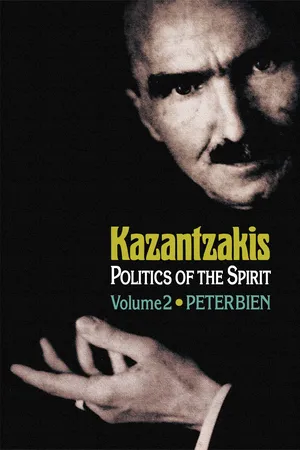
Putting Greek writer Nikos Kazantzakis's vast output into the context of his lifelong spiritual quest and the turbulent politics of twentieth-century Greece, Peter Bien argues that Kazantzakis was a deeply flawed genius--not always artistically successful, but a remarkable figure by any standard. This is the second and final volume of Bien's definitive and monumental biography of Kazantzakis (1883-1957). It covers his life after 1938, the period in which he wrote Zorba the Greek and The Last Temptation of Christ, the novels that brought him his greatest fame.
A demonically productive novelist, poet, playwright, travel writer, autobiographer, and translator, Kazantzakis was one of the most important Greek writers of the twentieth century and the only one to achieve international recognition as a novelist. But Kazantzakis's writings were just one aspect of an obsessive struggle with religious, political, and intellectual problems. In the 1940s and 1950s, a period that included the Greek civil war and its aftermath, Kazantzakis continued this engagement with undiminished energy, despite every obstacle, producing in his final years novels that have become world classics.
- 610 pages
- English
- ePUB (mobile friendly)
- Available on iOS & Android
eBook - ePub
About this book
Information
Table of contents
- Cover
- Title
- Copyright
- Contents
- Preface
- Acknowledgments
- Technical Notes
- One: Kazantzakis’S Attraction to Fascism and Nazism In The 1930S
- Two: Travel Writing
- Three: Spain
- Four: Journey to The Morea
- Five: Greek Politics, 1922–1936; Metaxas
- Six: Writings Ca. 1935–1939: Jardin Des Rochers
- Seven: Writings Ca. 1935–1939: Othello Returns
- Eight: Writings Ca. 1935–1939: Melissa
- Nine: Writings Ca. 1935–1939: Julian The Apostate
- Ten: Period 1940–1944: The Albanian Campaign and Axis Occupation
- Eleven: Buddha
- Twelve: Alexis Zorbas: A Philosophical Interpretation
- Thirteen: Alexis Zorbas: A Political Interpretation
- Fourteen: Prometheus Trilogy and Greekness
- Fifteen: Kapodistrias
- Sixteen: Constantine Palaiologos
- Seventeen: Athens, October 1944–June 1946
- Eighteen: London and Paris, 2 June 1946–2 June 1948
- Nineteen: Sodom and Gomorrah
- Twenty: The Political Comprehensiveness Of Christ Recrucified
- Twenty-One: The Fratricides
- Twenty-Two: Kouros
- Twenty-Three: Christopher Columbus: Kazantzakis’S Final Play
- Twenty-Four: O Kapetan Mihalis: An Epic ManquÉ
- Twenty-Five: Kazantzakis’S Long Apprenticeship to Christian Themes
- Twenty-Six: The Last Temptation As A Religious Novel
- Twenty-Seven: Is The Last Temptation A Religious Novel Or A Political Novel?
- Twenty-Eight: Kazantzakis’S Meta-Christian Saint Francis As A Model Of Soul-Force Creating His Own Fate
- Twenty-Nine: Report to Greco
- Appendix. Kazantzakis and Women
- Notes
- Bibliography
- Index
Trusted by 375,005 students
Access to over 1.5 million titles for a fair monthly price.
Study more efficiently using our study tools.
Frequently asked questions
Yes, you can cancel anytime from the Subscription tab in your account settings on the Perlego website. Your subscription will stay active until the end of your current billing period. Learn how to cancel your subscription
No, books cannot be downloaded as external files, such as PDFs, for use outside of Perlego. However, you can download books within the Perlego app for offline reading on mobile or tablet. Learn how to download books offline
Perlego offers two plans: Essential and Complete
- Essential is ideal for learners and professionals who enjoy exploring a wide range of subjects. Access the Essential Library with 800,000+ trusted titles and best-sellers across business, personal growth, and the humanities. Includes unlimited reading time and Standard Read Aloud voice.
- Complete: Perfect for advanced learners and researchers needing full, unrestricted access. Unlock 1.5M+ books across hundreds of subjects, including academic and specialized titles. The Complete Plan also includes advanced features like Premium Read Aloud and Research Assistant.
We are an online textbook subscription service, where you can get access to an entire online library for less than the price of a single book per month. With over 1.5 million books across 990+ topics, we’ve got you covered! Learn about our mission
Look out for the read-aloud symbol on your next book to see if you can listen to it. The read-aloud tool reads text aloud for you, highlighting the text as it is being read. You can pause it, speed it up and slow it down. Learn more about Read Aloud
Yes! You can use the Perlego app on both iOS and Android devices to read anytime, anywhere — even offline. Perfect for commutes or when you’re on the go.
Please note we cannot support devices running on iOS 13 and Android 7 or earlier. Learn more about using the app
Please note we cannot support devices running on iOS 13 and Android 7 or earlier. Learn more about using the app
Yes, you can access Kazantzakis, Volume 2 by Peter Bien in PDF and/or ePUB format, as well as other popular books in Literature & Literary Biographies. We have over 1.5 million books available in our catalogue for you to explore.