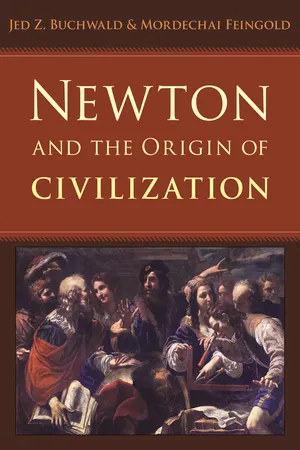
Isaac Newton's Chronology of Ancient Kingdoms Amended, published in 1728, one year after the great man's death, unleashed a storm of controversy. And for good reason. The book presents a drastically revised timeline for ancient civilizations, contracting Greek history by five hundred years and Egypt's by a millennium. Newton and the Origin of Civilization tells the story of how one of the most celebrated figures in the history of mathematics, optics, and mechanics came to apply his unique ways of thinking to problems of history, theology, and mythology, and of how his radical ideas produced an uproar that reverberated in Europe's learned circles throughout the eighteenth century and beyond.
Jed Buchwald and Mordechai Feingold reveal the manner in which Newton strove for nearly half a century to rectify universal history by reading ancient texts through the lens of astronomy, and to create a tight theoretical system for interpreting the evolution of civilization on the basis of population dynamics. It was during Newton's earliest years at Cambridge that he developed the core of his singular method for generating and working with trustworthy knowledge, which he applied to his study of the past with the same rigor he brought to his work in physics and mathematics. Drawing extensively on Newton's unpublished papers and a host of other primary sources, Buchwald and Feingold reconcile Isaac Newton the rational scientist with Newton the natural philosopher, alchemist, theologian, and chronologist of ancient history.
- 544 pages
- English
- ePUB (mobile friendly)
- Available on iOS & Android
eBook - ePub
Newton and the Origin of Civilization
About this book
Information
Topic
GeschichteSubtopic
Altertum1
Troubled Senses
In 1583, the Huguenot scholar Joseph Scaliger published his De Emendatione Temporum. There he examined the chronologies of Babylon, Egypt, and Persia, as well as those of Greece and Rome, arguing for an amended structure based in substantial part on antique reports that could be given astronomical significance, in particular eclipses, as well as on ancient calendars. Scaliger was hardly the only one to use astronomical evidence to date the past. Another Protestant, the theologian Heinrich Bünting, had employed eclipse reports with great technical proficiency in his Chronologia (1590).1 Scaliger and Bünting were followed by others in the seventeenth century who also relied on eclipses to date the past, including the Protestant Sethus Calvisius and the Jesuit Denis Petau (Petavius). Grafton calls such men “systematic” chronologers—their technical expertise plied to produce treatises on ancient and modern calendars and epochs, and so markedly different from “humanistic” chronologers, editors of ancient texts, and antiquarians.2 Calvisius, for example, remarked in 1605 that “historians frequently record eclipses, and they are often inserted into accounts of the deeds of kings and emperors, in such a way that they usually provide the most certain testimony both about the length of any given king’s reign and the true course of events. Eclipses are of infallible certainty, and they can be dated and demonstrated by astronomical computation for any period.”3
Eclipse reports from antiquity certainly raised issues of accurate reportage and textual corruption, but they seemed not to require an interpretative framework. Eclipses are after all singular events that, it seemed, could be connected to chronology by means of the technical tools of astronomy that had become available with the publication of Erasmus Rheinhold’s Prutenic Tables in 1551, which made use of the basic numerical parameters that Nicholas Copernicus had deployed in his 1543 De Revolutionibus Orbium Coelestium.4 The use of astronomy in matters chronological produced occasional antagonism, but the assimilation of singular human to singular celestial event apparently did not raise philosophical problems, at least among the technical chronologers. Even when a celestial event was granted portentous significance, its astrological meaning derived from its place in an established system of knowledge and not from its signaling a natural novelty. This raises the question of the relationship between natural and historical knowledge in the late sixteenth- and seventeenth centuries, which, in turn, brings us to consider changes in the character of natural knowledge proper during this period—an extraordinarily large and complicated issue that has garnered considerable attention.
A great deal of historical work concerns the sense in which a specifically experimental form of knowledge emerged during the seventeenth century. It has been argued that until the last half of the century, experiment-based knowledge remained suspect. When it became respectable to glean information about nature from experiment, the argument continues, specific techniques had to be invented to make the process socially and (ipso facto) intellectually acceptable.5 Three distinct but related strands wind through this argument. First and foremost, how could artificially produced experiences become accepted as foundational for proper knowledge when traditional scholastic categories sharply distinguished between the natural and the artefactual? Second, artefactual knowledge is not merely non-natural (in the sense of not being produced by unaided nature); it is also singular and specific, referring to the results of particular interventions. That too is thought to conflict with scholastic tradition, according to which proper knowledge of nature must be founded on experiences that are universal and common. Finally, how did experimentally derived knowledge, grounded in particulars, become conjoined with mathematical demonstration when the scholastics had long considered that mathematics applied only to those sciences whose objects partook in their essence of geometric qualities?
There have been various answers to these questions, but in respect to the first two, all presume that there was in fact a broadly enforced barrier between the experiment and proper knowledge. Yet even if such a division existed among some scholastics—and the claim remains controversial—it hardly follows that the boundary was effectively policed everywhere before the mid-seventeenth century; it certainly was not. Historians of alchemy have for example demonstrated that practitioners regularly and unproblematically produced and worked with laboratory-generated knowledge, and that one of the prime examples used to illustrate the novelty of the “matter-of-fact” as a privileged item, namely Robert Boyle, derived a good deal of his approach from the alchemist George Starkey.6 Much of the difficulty in developing a full understanding of the emergence of widely pursued laboratory science may derive from concentrating on methodological prescriptions rather than on actual practice, which alone reveals what was being done; prescriptive pronouncements in contrast mostly uncover reactions to activity and not its generative sources.
Though experiment-based facts were not uncommon by the sixteenth century, and probably long before that, the question of how locally produced results could be incorporated into the foundations of knowledge systems inevitably arose—as they do to this day. Novelties always generate questions when they come into contact with an existing structure, however loosely built the system may be. An event of nature, whether generated in a laboratory or out of it, certainly occurs in time and place. It is also true that in mid- to late seventeenth-century England, “natural histories” were produced that recount specific events. However, many of these—such as Boyle’s narratives concerning color of 1664—aimed to establish claims that, though limited in various ways, nevertheless transcended the place and time of their original production.
Consider the following example. At the beginning of the third part of his “history of colours,” Boyle described an experiment performed on “October the 11. About ten in the Morning.”7 He continued by providing a perfect example of an experiment specified in time, place, and circumstance. But it was done in the service of a claim that holds outside locality; Boyle did it in the first place “because that, according to the conjectures I have above propos’d, one of the most general causes of the diversity of colours in opacous bodies, is, that some reflect the light mingl’d with more, others with less of shade … I hold it not unfit to mention in the first place, the experiments that I thought to examine this conjecture.”8 Specifically local the experiments certainly were, but they were intended to be of a type that could be regenerated elsewhere.
In this respect, a historical event of the sort explored by chronologers is a very different kind of beast from knowledge about nature because it is inherently and inevitably singular: an event of history cannot be reproduced in other places and at other times unless it is taken to be exemplary of a type that transcends the specific event’s locality. Caesar’s crossing of the Rubicon in 49 BCE is unreproducible, but not simply because 49 BCE occurred only once; after all, Boyle’s October 11 experiment also occurred just once. Rather, Caesar’s incursion cannot be reproduced because the people involved and the technological, economic, political, environmental, psychological, and social circumstances irretrievably alter over time, whereas the character of the event is embedded in the complex specificities of its original occurrence. Boyle would in contrast assert that his October 11 experiment could be reproduced everywhere and by anyone—although perhaps with difficulty—precisely because he intended it to provide evidence for a locality-transcending claim. Natural events that occur without human intervention—which are of the sort that, to a pure-bred scholastic, are the only true products of nature—would constitute for Boyle an exception to the rule only in the sense that they might not be reproducible by human agency, though not because human actions might somehow step outside nature’s course. Only divine interventions and spirits (in both of which Boyle firmly believed) could do that.
The differences between historical and natural events have consequences for evaluations of novelty. In Boyle’s world, an experiment designed to substantiate a claim that does not work as expected may provide evidence against the claim and suggest alternatives to it. Laboratory novelties have locally transcendent meaning just because they may, or may not, support claims or suggest new directions. Historical events cannot provide surprises or point out new paths, which is to say that they cannot constitute proper novelties, unless they too are linked into a wider scheme of knowledge that gives them general significance. To return to the river-crossing Caesar, if we knew enough about the circumstances to fit this and subsequent events into a class of military endeavors, then we could say that the event’s significance transcends its locus and time of production—in which case the event would be an exemplar within a broader system of knowledge.
The technical chronologers of the early modern period did not produce knowledge systems in anything like this sense. They developed instead systems of concordances and sequences that located events of human history in time by means of their simultaneous occurrences with particular astronomical events, usually eclipses. Put differently, the likes of Scaliger aimed to use their collections of happenings to establish chronologies and not to uncover or demonstrate general theories about history. Neither Scaliger nor Bünting were embryonic Giambattista Vicos, who did produce just that, odd and fantastic though Vico’s scheme appears to twenty-first-century eyes.9
It is precisely here that Isaac Newton, as a chronologer, differed programatically from his predecessors: he sought to use astronomical tools to mold singular events into a system for understanding ancient history, indeed for grasping the entire development of civilization—what’s more, we shall see, a system that shared and exemplified the same evidentiary and argumentative structure deployed in his science. Consequently, Newton faced a new kind of problem—new, that is, in technical chronology. Historical remnants can be known of course only through the transmitted testimony of individuals whom no one living has ever met. Humanists had long developed methods for handling the inevitable results of corruption and fraud over the centuries. In Newton’s chronological world, the chains of transmission ran back to a period before the very existence of written records in Greek, or at least to a period when Greek literacy was in its infancy, whereas the eclipses that the technical chronologers had used all derived from literate eras. More problematic still, the remnant testimonies that reached back to that pre-literate time did not concern precise astronomical events. They described instead characteristic, but comparatively inexact, features of the heavens, and they referred to them in words that required interpretation. For unlike eclipses, which become dates via the mathematics of astronomy, the features at Newton’s disposal could not be easily transmuted into numbers. Most significant of all, even when Newton did effect his transformations, the numbers that emerged did not agree with one another.
Ultimately, Newton would produce from these discrepant numbers a determinate date that, if correct, would fundamentally alter all previous chronologies—and indeed would challenge contemporary understanding of the human past. That date did not emerge from just one among the numbers into which Newton had transformed ancient words, but from all of them together. This manufacture of harmony out of discord was not only new in historical chronology, but unprecedented in natural philosophy before Newton’s own work in optics in the late 1660s and early 1670s. He alone had developed a method that not only permitted, but actually urged, the experimental production and subsequent amalgamation of discordant numbers—a method that directly informed Newton’s historical chronology.
Newton’s career spanned nearly seven decades, a period that witnessed profound changes in the many methods, techniques, conceptions, and practices that together constitute the late period of Early Modern mathematics and natural philosophy. He himself was responsible in several ways for a good number of these changes.10 So protean a career as Newton’s, which continued to generate new results through the 1690s, can hardly be expected to exhibit a single continuous strand of development. Nevertheless, by the early 1670s the young Newton had developed the contours of method and technique, as well as a number of specific conceptions in optics and mechanics, and (especially) mathematics, that the mature scholar adopted, adapted, reworked, and deployed in subsequent decades.11 These several and disparate explorations were undertaken in the context of mid-seventeenth-century views concerning nature, mind, God, and the links among them. His own understanding of these matters evolved during his early years at Trinity College, Cambridge, which he entered in June 1661 at the age of eighteen and a hal...
Table of contents
- Cover
- Title Page
- Copyright
- Contents
- List of Illustrations
- List of Tables
- Acknowledgments
- Introduction
- 1 Troubled Senses
- 2 Troubled Numbers
- 3 Erudition and Chronology in Seventeenth-Century England
- 4 Isaac Newton on Prophecies and Idolatry
- 5 Aberrant Numbers: The Propagation of Mankind before and after the Deluge
- 6 Newtonian History
- 7 Text and Testimony
- 8 Interpreting Words
- 9 Publication and Reaction
- 10 The War on Newton in England
- 11 The War on Newton in France
- 12 The Demise of Chronology
- 13 Evidence and History
- Appendix A Signs, Conventions, Dating, and Definitions
- Appendix B Newton’s Computational Methods
- Appendix C Commented Extracts from Newton’s MS Calculations
- Appendix D Placing Colures on the Original Star Globe
- Appendix E Hesiod, Thales, and Stellar Risings and Settings
- Bibliography
- Index
Trusted by 375,005 students
Access to over 1.5 million titles for a fair monthly price.
Study more efficiently using our study tools.
Frequently asked questions
Yes, you can cancel anytime from the Subscription tab in your account settings on the Perlego website. Your subscription will stay active until the end of your current billing period. Learn how to cancel your subscription
No, books cannot be downloaded as external files, such as PDFs, for use outside of Perlego. However, you can download books within the Perlego app for offline reading on mobile or tablet. Learn how to download books offline
Perlego offers two plans: Essential and Complete
- Essential is ideal for learners and professionals who enjoy exploring a wide range of subjects. Access the Essential Library with 800,000+ trusted titles and best-sellers across business, personal growth, and the humanities. Includes unlimited reading time and Standard Read Aloud voice.
- Complete: Perfect for advanced learners and researchers needing full, unrestricted access. Unlock 1.5M+ books across hundreds of subjects, including academic and specialized titles. The Complete Plan also includes advanced features like Premium Read Aloud and Research Assistant.
We are an online textbook subscription service, where you can get access to an entire online library for less than the price of a single book per month. With over 1.5 million books across 990+ topics, we’ve got you covered! Learn about our mission
Look out for the read-aloud symbol on your next book to see if you can listen to it. The read-aloud tool reads text aloud for you, highlighting the text as it is being read. You can pause it, speed it up and slow it down. Learn more about Read Aloud
Yes! You can use the Perlego app on both iOS and Android devices to read anytime, anywhere — even offline. Perfect for commutes or when you’re on the go.
Please note we cannot support devices running on iOS 13 and Android 7 or earlier. Learn more about using the app
Please note we cannot support devices running on iOS 13 and Android 7 or earlier. Learn more about using the app
Yes, you can access Newton and the Origin of Civilization by Jed Z. Buchwald,Mordechai Feingold in PDF and/or ePUB format, as well as other popular books in Geschichte & Altertum. We have over 1.5 million books available in our catalogue for you to explore.