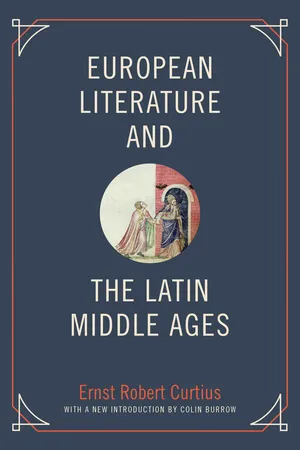
Published just after the Second World War, European Literature and the Latin Middle Ages is a sweeping exploration of the remarkable continuity of European literature across time and place, from the classical era up to the early nineteenth century, and from the Italian peninsula to the British Isles. In what T. S. Eliot called a "magnificent" book, Ernst Robert Curtius establishes medieval Latin literature as the vital transition between the literature of antiquity and the vernacular literatures of later centuries. The result is nothing less than a masterful synthesis of European literature from Homer to Goethe.
European Literature and the Latin Middle Ages is a monumental work of literary scholarship. In a new introduction, Colin Burrow provides critical insights into Curtius's life and ideas and highlights the distinctive importance of this wonderful book.
- 752 pages
- English
- ePUB (mobile friendly)
- Available on iOS & Android
eBook - ePub
European Literature and the Latin Middle Ages
About this book
Information
Publisher
Princeton University PressYear
2013Print ISBN
9780691017938
9780691099699
eBook ISBN
9781400846153
Topic
LittératureTable of contents
- Cover Page
- Title Page
- Copyright Page
- Contents
- Introduction to the 2013 Edition
- Translator’s Note
- Note of Acknowledgment
- Author’s Foreword to the English Translation
- Guiding Principles
- 1: European Literature
- 2: The Latin Middle Ages
- 3: Literature and Education
- 4: Rhetoric
- 5: Topics
- 6: The Goddess Natura
- 7: Metaphorics
- 8: Poetry and Rhetoric
- 9: Heroes and Rulers
- 10: The Ideal Landscape
- 11: Poetry and Philosophy
- 12: Poetry and Theology
- 13: The Muses
- 14: Classicism
- 15: Mannerism
- 16: The Book as Symbol
- 17: Dante
- 18: Epilogue
- Excursuses
- Appendix: The Medieval Bases of Western Thought
- Bibliographical Note
- Index
Trusted by 375,005 students
Access to over 1.5 million titles for a fair monthly price.
Study more efficiently using our study tools.
Frequently asked questions
Yes, you can cancel anytime from the Subscription tab in your account settings on the Perlego website. Your subscription will stay active until the end of your current billing period. Learn how to cancel your subscription
No, books cannot be downloaded as external files, such as PDFs, for use outside of Perlego. However, you can download books within the Perlego app for offline reading on mobile or tablet. Learn how to download books offline
Perlego offers two plans: Essential and Complete
- Essential is ideal for learners and professionals who enjoy exploring a wide range of subjects. Access the Essential Library with 800,000+ trusted titles and best-sellers across business, personal growth, and the humanities. Includes unlimited reading time and Standard Read Aloud voice.
- Complete: Perfect for advanced learners and researchers needing full, unrestricted access. Unlock 1.5M+ books across hundreds of subjects, including academic and specialized titles. The Complete Plan also includes advanced features like Premium Read Aloud and Research Assistant.
We are an online textbook subscription service, where you can get access to an entire online library for less than the price of a single book per month. With over 1.5 million books across 990+ topics, we’ve got you covered! Learn about our mission
Look out for the read-aloud symbol on your next book to see if you can listen to it. The read-aloud tool reads text aloud for you, highlighting the text as it is being read. You can pause it, speed it up and slow it down. Learn more about Read Aloud
Yes! You can use the Perlego app on both iOS and Android devices to read anytime, anywhere — even offline. Perfect for commutes or when you’re on the go.
Please note we cannot support devices running on iOS 13 and Android 7 or earlier. Learn more about using the app
Please note we cannot support devices running on iOS 13 and Android 7 or earlier. Learn more about using the app
Yes, you can access European Literature and the Latin Middle Ages by Ernst Robert Curtius in PDF and/or ePUB format, as well as other popular books in Littérature & Critique littéraire ancienne et classique. We have over 1.5 million books available in our catalogue for you to explore.