The important role of liberal ecumenical Protestantism in American history
The role of liberalized, ecumenical Protestantism in American history has too often been obscured by the more flamboyant and orthodox versions of the faith that oppose evolution, embrace narrow conceptions of family values, and continue to insist that the United States should be understood as a Christian nation. In this book, one of our preeminent scholars of American intellectual history examines how liberal Protestant thinkers struggled to embrace modernity, even at the cost of yielding much of the symbolic capital of Christianity to more conservative, evangelical communities of faith.
If religion is not simply a private concern, but a potential basis for public policy and a national culture, does this mean that religious ideas can be subject to the same kind of robust public debate normally given to ideas about race, gender, and the economy? Or is there something special about religious ideas that invites a suspension of critical discussion? These essays, collected here for the first time, demonstrate that the critical discussion of religious ideas has been central to the process by which Protestantism has been liberalized throughout the history of the United States, and shed light on the complex relationship between religion and politics in contemporary American life.
After Cloven Tongues of Fire brings together in one volume David Hollinger's most influential writings on ecumenical Protestantism. The book features an informative general introduction as well as concise introductions to each essay.
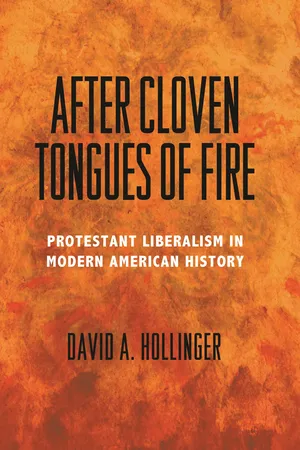
eBook - ePub
After Cloven Tongues of Fire
Protestant Liberalism in Modern American History
- 248 pages
- English
- ePUB (mobile friendly)
- Available on iOS & Android
eBook - ePub
About this book
Information
Publisher
Princeton University PressYear
2013Print ISBN
9780691166636
9780691158426
eBook ISBN
9781400845996
CHAPTER 1
The Accommodation of Protestant Christianity with the Enlightenment: An Old Drama Still Being Enacted
Commissioned for a special issue of Daedalus on “American Narratives,” this essay outlines a theme in American history so grand that it has sometimes been forgotten while scholars diligently pursue narrowly defined research topics. A common complaint about historians of the late twentieth century was that in their professional caution they were reluctant to address “big ideas,” even ideas that frame debates about the basic character of the nation and the principles that should guide its public affairs. The accommodation of Protestant Christianity with the Enlightenment is certainly one of the biggest and oldest of all such ideas and is one that, I remind us here, continues to structure the culture and politics of the nation even as visible in presidential campaigns well into the twenty-first century. Many historians have addressed this idea, including Henry F. May, whose influence on my thinking about the history of the United States I am glad to have here another opportunity to acknowledge.
I identify two closely related dynamics that propelled and gave structure to the process of accommodation. A succession of scientific developments, including the Darwinian revolution in natural history and the archaeological and linguistic study of how the Bible came to be written, caused Protestant intellectuals to reformulate the inherited faith in terms better able to meet modern standards of cognitive plausibility. In the meantime, the demographic transformation of a society of largely British and Protestant stock into one that included many Catholics, Jews, and other non-
Protestants from throughout Europe and beyond brought pressure upon inherited assumptions. Proximity to other orthodoxies raised doubts about one’s own and produced a greater willingness to entertain new ideas consistent with the ostensibly global community of secular inquiry. I invoke the writings of philosopher Charles Peirce to illustrate how the dynamic of demographic diversification worked in tandem with the advancement of science to generate liberalized versions of Christianity. Protestant liberalism is the central presence in this entire, sprawling drama. Sometimes neglected in our own era’s preoccupation with the political prominence of culturally and theologically conservative evangelicals, Protestant liberalism is in fact a huge reality in American history, and is indeed a creation of the accommodation with the Enlightenment. In the jagged, stuttering course of this accommodation, one generation after another of the most educated of Protestant intellectuals struggled not only to define and proclaim their religion but also to mobilize national, secular institutions as well as denominational fellowships in the service of that revised, ostensibly cosmopolitan faith. Along the way these liberals were routinely accused by their orthodox rivals of having become essentially secular. Hence they and their critics enacted yet again the classic contention within religious communities over what is “authentic” and what is a “corruption.” Do the orthodox cling to doctrines that had been pasted onto the essential faith at a particular historical moment, and now mistake these anachronisms for the substance rather than surface of the faith? Do the liberals chase after the worldly fashions of the moment, untrue to the still-valid faith of the fathers? Such charges and countercharges are the standard stuff of Christian history and also of the history of the United States, the population of which remains today the most Christianity-affirming of any national population in the North Atlantic West.
This essay invokes as a truism the idea that Christianity itself was a prominent influence upon the Enlightenment as the latter developed in the seventeenth and eighteenth centuries. I now wish I had underscored the point more vividly, which I hereby do. Some readers, properly concerned that the Enlightenment is sometimes treated as autochthonous rather than a historic product of many classical and Christian discourses, worry that secular scholars rush too quickly past the religious matrices out of which Locke, Gibbon, Franklin and other Enlightenment thinkers developed their ideas.
This essay was originally published in Daedalus CXLI (Winter 2012), 76–88. Its last few pages overlap with the essay that follows it in the pages of this volume, focusing on the period since World War II.
IN HIS “LETTER FROM BIRMINGHAM JAIL,” Martin Luther King Jr. invoked the Pilgrims landing at Plymouth Rock and Jefferson writing the Declaration of Independence. In that 1963 meditation on American national destiny, fashioned as a weapon in the black struggle for civil rights, King repeatedly mobilized the sanctions of both Protestant Christianity and the Enlightenment.1 Like the great majority of Americans of his and every generation, King believed that these two massive inventories of ideals and practices work together well enough. But not everyone who has shared this basic conviction understands the relation between the two in quite the same terms. And there are others who have depicted the relation as one of deep tension, even hostility. Protestant Christianity, the Enlightenment, and a host of claims and counterclaims about how the two interact with one another are deeply constitutive of American history. We often speak about “the religious” and “the secular,” or about “the heart” and “the head,” but American life as actually lived beneath these abstractions has been much more particular and demands scrutiny in its historical density.
The United States, whatever else it may have been in its entire history as a subject of narration, has been a major site for the engagement of Protestant Christianity with the Enlightenment. This engagement was—and continues to be—a world-historical event, or at least one of the defining experiences of the North Atlantic West and its global cultural extensions from the eighteenth century to the present. Still, the United States has been a uniquely conspicuous arena for this engagement in part because of the sheer demographic preponderance of Protestants, especially dissenting Protestants from Great Britain, during the formative years of the society and long thereafter. Relatively recent social transformations can easily blind contemporaries to how overwhelmingly Northern European Protestant in origin the educated and empowered classes of the United States have traditionally been. The upward mobility of Catholic and Jewish populations since World War II and the massive immigration following the Hart-Cellar Act of 1965—producing millions of non-Protestant Americans from Asia, Latin America, and the former Soviet lands—have given the leadership of American society a novel look. To be sure, there have long been large numbers of non-Protestants in the population at large, but before 1960, if you held a major leadership position and had real opportunities to influence the direction of society, you most likely grew up in a white Protestant milieu. The example of King is a reminder, moreover, that the substantial population of African Americans has long been, and remains, largely Protestant.
In the United States, the engagement of Protestant Christianity with the Enlightenment most often took the form of “accommodation.” The bulk of the men and women in control of American institutions—educational, political, and social—have sought to retain the cultural capital of the Reformation while diversifying their investments in a variety of opportunities and challenges, many of which came to them under the sign of the Enlightenment. The legacy of the Enlightenment in much of Europe, by contrast, played out in the rejection of, or indifference to, the Christianity to which the Enlightenment was largely a dialectical response, even while state churches remained fixtures of the established order. In the United States, too, there were people who rejected Protestant Christianity. But here the legacy of the Enlightenment most often appeared in the liberalization of doctrine and biblical interpretation and in the denominational system’s functioning as an expanse of voluntary associations providing vital solidarities midway between the nation, on the one hand, and the family and local community, on the other.
The sharper church-state separation in the United States liberated religiously defined affiliations to serve as intermediate solidarities, a role such affiliations could less easily perform in settings where religious authority was associated with state power. Hence in addition to orthodox, evangelical Protestants who have been more suspicious of the critical spirit of the Enlightenment, American life has included a formidable population of “liberal” or “ecumenical” Protestants building and maintaining religiously defined communities even as they absorbed and participated in many aspects of modern civilization that more conservative Protestants held at a distance. As late as the mid-1960s, membership in the classic “mainstream liberal” denominations—Methodist, Presbyterian, Episcopalian, and so on—reached an all-time high. Because educated, middle-class Americans maintained Protestant affiliations well into the twentieth century, the Enlightenment was extensively engaged within, rather than merely beyond, the churches. Had the educated middle class moved further from Protestantism, the cultural capital of the Reformation would not have been preserved and renewed to the degree that made it an object of struggle for so long.
The intensity of the Enlightenment-Protestant relationship in America resulted also from the discomforts created by the very church-state separation that encouraged the flourishing of religious affiliations. The United States is the only major nation in the world that still operates under an eighteenth-century constitution, one that, anomalously in the governance cultures of even that century, makes no mention of God. The U.S. federal government is a peculiarly Enlightenment-grounded entity, and for that reason has inspired many attempts to inject Christianity into it, or to insist that God has been there, unacknowledged, all along.2
The role of liberal religion in American history is too often missed by observers who consider the consequences of the Enlightenment only outside religion and recognize religion only when found in its most obscurantist forms.3 The fundamentalists who rejected evolution and the historical study of the Bible and have lobbied for God to be written into the Constitution receive extensive attention in our textbooks, but the banner of Protestant Christianity has also been flown by defenders of Darwin and the Higher Criticism and by critics of the idea of a “Christian America.” Quarrels within American Protestantism revolve around the feeling among more orthodox, evangelical parties that mainstream liberals are actually secularists in disguise, as well as the feeling among ecumenical parties that their evangelical co-religionists are sinking the true Christian faith with an albatross of anachronistic dogmas and alliances forged with reactionary political forces. These quarrels, shaped in part by the campaign for a “reasonable Christianity” waged by Unitarians early in the nineteenth century, continue to the present day, sharply distinguishing the United States from the historically Protestant countries of Europe. The Netherlands, the United Kingdom, and the Scandinavian nations have long been among the most de-Christianized in the world. The United States really is different. Accordingly, the copious literature on “secularization” often treats the United States as a special case.4
Never was the United States a more special case than it is today. Indeed, contemporary American conditions invite renewed attention to the historic accommodation of Protestant Christianity with the Enlightenment. An increasingly prominent feature of public life is the affirmation of religion in general and of Protestant Christianity in particular. Republican candidates for office especially have been loquacious in expressing their faith and firm in declaring its relevance to secular governance. Michele Bachmann, Mike Huckabee, Sarah Palin, Richard Perry, Mitt Romney, and Rick Santorum are among the most visible examples.5 Leaders of the Democratic Party, too, including President Barack Obama, have proclaimed their faith and have contributed to an atmosphere in which the constitutional principle of church-state separation is widely held to have been interpreted too strictly.
The Enlightenment-derived arguments of John Rawls and Jürgen Habermas, which maintain that debates over public policy should be confined to the sphere of “public reason,” are routinely criticized as naïve and doctrinaire. We are awash with confident denunciations of “the secularization thesis” (usually construed as the claim that the world becomes less religious as it becomes industrialized) and with earnest pleas to listen empathically to the testimonies—heavily Protestant in orientation—of religious yearning and experience now prevalent in popular culture. The writings of the “new atheists” revive the rationalist-naturalist critiques of religion that had largely gone into remission during the decades when religion was widely understood to have been privatized and hence less in need of refutation by skeptics. Affirmations of a secular orientation less strident than those of the new atheists provoke extensive attention, moreover, because debates about the nation and its future are so much more religion-saturated that at any time since the 1950s. In a country that has now elected a president from a member of a notoriously stigmatized ethnoracial group, atheism remains more anathema than blackness: almost half of all voters are still comfortable telling pollsters that they would never support an atheist for president. Observers disagree whether American piety has religious depth or is a largely symbolic structure controlled by worldly interests; either way, religious formations are indisputably part of the life of the United States today.6
In this contemporary setting, it is all the more important to understand how the accommodation of Protestant Christianity with the Enlightenment has taken place and how the dynamics of this accommodation continue to affect the public culture of the United States. Two processes have driven the accommodation, growing increasingly interconnected over time. One is “cognitive demystification,” or the critical assessment of truth claims in light of scientific knowledge. In this classic dynamic of “science and religion” discourse, the specific content of religious belief is reformulated to take account of what geologists, biologists, physicists, astronomers, historians, and other naturalistically grounded communities persuade religious leaders is true about the world. Normally, the religious doctrines rejected in this process are said to have been inessential to begin with. They are cast aside as mere projections of historically particular aspects of past cultures, which can be replaced by formulations that reflect the true essentials of the faith and vindicate yet again the compatibility of faith with knowledge. Sometimes, however, cognitive demystification pushes people toward nonbelief.
The second process, “demographic diversification,” involves intimate contact with people of different backgrounds who display contrasting opinions and assumptions and thereby stimulate doubt that the ways of one’s own tribe are indeed authorized by divine authority and viable, if not imperative, for other tribes, too. The dynamic here is also classical: cosmopolitanism—a great Enlightenment ideal—challenging provincial faiths. Wider experiences, either through foreign travel or, more often, through contact with immigrants, change the context for deciding what is good and true. Living in proximity to people who do not take Protestant Christianity for granted could be unsettling. Here again, the standard response is to liberalize, to treat inherited doctrines as sufficiently flexible to enable one to abide by them while coexisting “pluralistically,” or even cooperating, with people who do not accept those doctrines. Sometimes, however, awareness of the range of human possibilities results in abandoning the faith of the natal community altogether.
Philosopher Charles Peirce understood how easily the two processes can be linked. In “The Fixation of Belief,” Peirce argued that all efforts to stabilize belief will ultimately fail unless you adopt beliefs that can withstand exposure to the world at large. When you encounter other people who hold very different opinions from your own, and who can present striking evidence to support those opinions, it is harder to be sure that you are right. Your own experience and that of those around you may yield a particular set of certainties, but if another group of people moves into the neighborhood and obliges you to confront their foreign experience and the truth claims apparently vindicated by that experience, your old certainties become less so. Can ...
Table of contents
- Cover Page
- Title Page
- Copyright Page
- Dedication Page
- Contents
- Preface
- 1: The Accommodation of Protestant Christianity with the Enlightenment: An Old Drama Still Being Enacted
- 2: After Cloven Tongues of Fire: Ecumenical Protestantism and the Modern American Encounter with Diversity
- 3: The Realist–Pacifist Summit Meeting of March 1942 and the Political Reorientation of Ecumenical Protestantism in the United States
- 4: Justification by Verification: The Scientific Challenge to the Moral Authority of Christianity in Modern America
- 5: James, Clifford, and the Scientific Conscience
- 6: Damned for God’s Glory: William James and the Scientific Vindication of Protestant Culture
- 7: Communalist and Dispersionist Approaches to American Jewish History in an Increasingly Post-Jewish Era
- 8: Church People and Others
- 9: Enough Already: Universities Do Not Need More Christianity
- 10: Religious Ideas: Should They Be Critically Engaged or Given a Pass?
- Epilogue: Reinhold Niebuhr and Protestant Liberalism
- Index
Trusted by 375,005 students
Access to over 1.5 million titles for a fair monthly price.
Study more efficiently using our study tools.
Frequently asked questions
Yes, you can cancel anytime from the Subscription tab in your account settings on the Perlego website. Your subscription will stay active until the end of your current billing period. Learn how to cancel your subscription
No, books cannot be downloaded as external files, such as PDFs, for use outside of Perlego. However, you can download books within the Perlego app for offline reading on mobile or tablet. Learn how to download books offline
We are an online textbook subscription service, where you can get access to an entire online library for less than the price of a single book per month. With over 1.5 million books across 990+ topics, we’ve got you covered! Learn about our mission
Look out for the read-aloud symbol on your next book to see if you can listen to it. The read-aloud tool reads text aloud for you, highlighting the text as it is being read. You can pause it, speed it up and slow it down. Learn more about Read Aloud
Yes! You can use the Perlego app on both iOS and Android devices to read anytime, anywhere — even offline. Perfect for commutes or when you’re on the go.
Please note we cannot support devices running on iOS 13 and Android 7 or earlier. Learn more about using the app
Please note we cannot support devices running on iOS 13 and Android 7 or earlier. Learn more about using the app
Yes, you can access After Cloven Tongues of Fire by David A. Hollinger in PDF and/or ePUB format, as well as other popular books in History & North American History. We have over 1.5 million books available in our catalogue for you to explore.