The strengths and weaknesses of the presidents who led the United States to the Civil War
The United States witnessed an unprecedented failure of its political system in the mid-nineteenth century, resulting in a disastrous civil war that claimed the lives of an estimated 750,000 Americans. In his other acclaimed books about the American presidency, Fred Greenstein assesses the personal strengths and weaknesses of presidents from George Washington to Barack Obama. Here, he evaluates the leadership styles of the Civil War-era presidents.
Using his trademark no-nonsense approach, Greenstein looks at the presidential qualities of James K. Polk, Zachary Taylor, Millard Fillmore, Franklin Pierce, James Buchanan, and Abraham Lincoln. For each president, he provides a concise history of the man's life and presidency, and evaluates him in the areas of public communication, organizational capacity, political skill, policy vision, cognitive style, and emotional intelligence. Greenstein sheds light on why Buchanan is justly ranked as perhaps the worst president in the nation's history, how Pierce helped set the stage for the collapse of the Union and the bloodiest war America had ever experienced, and why Lincoln is still considered the consummate American leader to this day.
Presidents and the Dissolution of the Union reveals what enabled some of these presidents, like Lincoln and Polk, to meet the challenges of their times--and what caused others to fail.
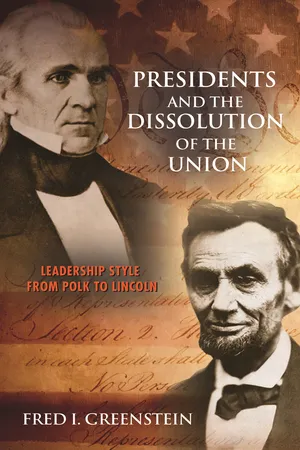
eBook - ePub
Presidents and the Dissolution of the Union
Leadership Style from Polk to Lincoln
- 200 pages
- English
- ePUB (mobile friendly)
- Available on iOS & Android
eBook - ePub
Presidents and the Dissolution of the Union
Leadership Style from Polk to Lincoln
About this book
Information
Publisher
Princeton University PressYear
2013Print ISBN
9780691166612
9780691151991
eBook ISBN
9781400846412

The Presidential Difference in the Civil War Era
It was not events alone that caused Northerners and Southerners to view each other as enemies.… Politicians … were largely responsible for the ultimate breakdown of the political process.
—Michael F. Holt, The Political Crisis of the 1850s1
THE MID-NINETEENTH CENTURY witnessed an unprecedented failure of the American political system. After two decades of increasingly bitter sectional disagreement, a disastrous war erupted between the North and the South that took the lives of roughly 2 percent of the nation’s population, left much of the South devastated, and radically remade Southern society. So much has been written on this period, it might be assumed that no more remains to be said. Nothing could be further from the truth. The Civil War era is so intellectually fertile that new ways to explore it constantly arise.
PRESIDENTIAL LEADERSHIP
In the pages that follow, I use the period from 1846 to 1865 as a stage on which a group of American presidents exhibit their strengths and weaknesses. The events of the period from the Mexican-American War to the Civil War form the background of that stage. Six chief executives—James K. Polk, Zachary Taylor, Millard Fillmore, Franklin Pierce, James Buchanan, and Abraham Lincoln—occupy its foreground. These men merit attention because of the demands placed on the chief executive in this momentous era and because they varied so greatly in the caliber of that leadership, ranging from Abraham Lincoln, who ranked first in presidential greatness in a recent poll of historians of the presidency, to James Buchanan, who ranked last.*2
This is the third in a series of books that ask what enables some American presidents to meet the challenges of their times and causes others to fail. In The Presidential Difference, I examined the White House occupants from FDR to Barack Obama. In Inventing the Job of President, I focused on the seven presidents from George Washington to Andrew Jackson.3 In all these works, my approach is straightforward. I proceed chronologically, summarizing the formative years, rise to the presidency, and administrations of the protagonists. I then conclude each chapter by assessing the strengths and weaknesses of the president in question by focusing on six realms: public communication, organizational capacity, political skill, policy vision, cognitive style, and emotional intelligence.
Why these qualities? Public communication, using what Theodore Roosevelt called the “bully pulpit,” may be thought of as the outer face of the presidency. The ability to articulate goals and rally public support for them is fundamental to presidential leadership. Organization can be viewed as the inner face of the office. The ability to organize and run an administration is vital to a successful presidency. In the smaller administrations of this period, cabinets had much greater significance than they do today. How these presidents filled their cabinets and used those officials and other advisers offers instructive comparisons.
It might be assumed that anyone able to rise to the presidency would be politically skilled, but a surprising number of chief executives has lacked either one or both of two kinds of political skill. Tactical skill is the ability to get results; strategic skill is the ability to get results that stand the test of time. But these skills alone cannot ensure success. Even a consummately skilled president may be an underachiever if he or she lacks a policy vision. At the same time, a president who advances policies that have undesirable consequences is likely to be worse off than one who lacks vision altogether.
A president also needs the appropriate cognitive style to process the torrent of advice and information that comes his or her way. But even the most cerebral of presidents may go astray in the absence of emotional intelligence, the ability to control one’s emotions and turn them to advantage rather than succumbing to disabling emotional flaws. That last, as we shall see, is a quality conspicuously lacking in some of the presidents considered in this volume.
THE CONTEXT OF THE TIMES
It remains to fill in the background against which these six presidents performed their duties. In 1845 James K. Polk entered the White House inspired by the example of his mentor Andrew Jackson to be a strong president and with the intention of accomplishing a small number of explicitly defined goals. One of those goals—the acquisition of the Mexican province of California—led to the Mexican-American War, which produced a far greater territorial growth than he had envisioned. The vast new territory gained by this war, called the Mexican Cession, gave the United States the present-day states of California, Nevada, and Utah; most of Arizona and New Mexico; and parts of Colorado and Wyoming. While a great territorial gain, the Mexican Cession gave rise to an intractable political problem: whether to allow slavery in this area.4
Some in the North wanted slavery to be barred from these lands.* Early in the war, Pennsylvania congressman David Wilmot sponsored a measure that would forbid slavery in any territory gained from Mexico. This proposal, the Wilmot Proviso, passed the House of Representatives but not the Senate, but its repeated reintroduction and possible passage was a constant worry to the South until the question was settled in 1850.
The Southern position on the Mexican Cession was staked out in 1847 by John C. Calhoun of South Carolina, who argued that any law prohibiting citizens of any state from entering a territory with their slaves would be “a violation of the Constitution.”5 This stand was the polar opposite of the Wilmot Proviso and, by promoting the spread of slavery, marked the extreme in the debate that worried many Northerners.
The political importance of whether states carved from the Mexican Cession would be open to slavery cannot be overstated. At the time, the free states enjoyed a majority of seats in the House, but the North and South had equal representation in the Senate. As a result, the South could block any bills threatening slavery in the Senate. The admission of more free states would overthrow that balance, costing the South this crucial veto power.
When Zachary Taylor became president in 1849, the question of slavery in the Mexican Cession remained unsettled. Later that year, the issue came to a head when California applied for admission as a free state. By that time, many in the South were speaking angrily of secession as the only way to protect their rights. A convention of Southerners held in Nashville in the summer of 1850 asserted the right of states to secede if they saw their rights being threatened and named passage of the Wilmot Proviso as such a threat. This convention also endorsed the idea of extending the Missouri Compromise line* to the Pacific, banning slavery to its north but allowing it to the south, but insisted that only if California was divided in accordance with this line could a free state be admitted into the Union.
In the midst of this crisis, Taylor died in office and was replaced by Vice President Millard Fillmore. The breakup of the Union was temporarily averted by passage of the Compromise of 1850, a package of provisions sponsored initially by Senator Henry Clay of Kentucky that included some measures that advanced the interests of the North and others that appealed to the South. While the compromise did not satisfy the demands of the Nashville Convention, Southern tempers were generally soothed. Across the South—though not in South Carolina—secessionist sentiment waned.
Soon, though, tension reappeared. Many in the North were outraged over the government’s enforcement of a key part of the compromise, the Fugitive Slave Act. This act made it far easier than before for Southern agents to seize African Americans from Northern cities under the claim that they were runaway slaves. Many in the North refused to comply with the law, and several Northern states passed personal liberty laws that effectively nullified the Fugitive Slave Act, infuriating Southerners.
Franklin Pierce became president in 1853 in the midst of that bitter controversy. The situation worsened when Congress passed the Kansas-Nebraska Act of 1854, repealing the Missouri Compromise line and authorizing slavery in parts of the Louisiana Territory from which it had hitherto been forbidden. The act sparked widespread anger in the North; six Northern members of Congress denounced the act as
a gross violation of a sacred pledge; … a criminal betrayal of precious rights; … part and parcel of an atrocious plot to exclude from a vast unoccupied region … free laborers … and [to] convert it into a dreary region of despotism, inhabited by masters and slaves.6
Worse, Kansas quickly erupted in bloodshed as proslavery forces based in Lecompton fought for control of the territory with antislavery forces based in Topeka.
James Buchanan entered the White House in the midst of this fighting. Within days of his 1857 inauguration, the Supreme Court’s Dred Scott decision mooted the entire debate over slavery in the territories by declaring that Congress had no power to ban the institution from any territory. While Southerners hailed the ruling, many in the North saw the decision as the work of what they called a “Slave Power conspiracy” that threatened the Union. (Chief Justice Roger B. Taney and four of the six justices joining him in the majority opinion were from slave states.)
By the 1860 election, the old Democrat and Whig two-party system had disappeared. The Whig Party had collapsed primarily over the issue of slavery. Many Northern Whigs moved to an emerging antislavery party, the Republican Party. Some Southern Whigs joined the Democratic Party, giving primacy to their sectional interests, which Democratic policy protected. Other Southern Whigs were at sea, looking for a party that would cool sectional tensions while preserving Southern interests. Many Northern Democrats, meanwhile, had grown frustrated with the increasingly hard-line positions of their Southern colleagues.
The Republicans married traditional Whig positions such as support for internal improvements and a protective tariff to a stiff opposition to the spread of slavery to the territories. Support for these policies grew quickly in the North and Midwest but was virtually nonexistent in the South. Southerners regarded the Republicans with suspicion and fear. They believed that the new party intended to abolish slavery, ending their way of life. Soon after Republican Abraham Lincoln won the 1860 presidential election strictly on Northern votes, seven Southern states seceded from the Union and formed the Confederate States of America. The Civil War began little more than a month after Lincoln was inaugurated president.
THE CAUSES OF THE CIVIL WAR
Historians have long debated the causes of the Civil War. Was it an inevitable result of competing social and economic forces, fundamental sectional differences that clashed with the growing pressure to forge a more united nation? Was slavery really the central issue in this conflict, or was it merely “a smoke-screen for concealing the basic motives”?7 What of the individuals who lived in the Civil War era? What role did they play in the steps that led to the war or the climate that produced it?
As historian Michael Holt points out in the epigraph to this chapter, American political leaders had ample opportunities to work out solutions to the issues they faced in the decade and a half from the Mexican-American War to the Civil War. They could not, however, find a sustaining one. As historian Allan Nevins concludes,
The angry issue of slavery in the Territories, settled by the great compromise of 1850 but wantonly reopened in 1854, was practically settled again by the end of 1858. But by 1858 passions had been so deeply aroused that large sections of the population could not view the situation calmly or discuss it realistically; fear fed hatred, and hatred fed fear. The unrealities of passion dominated the hour.8
Once political leaders reopened that issue, they allowed passion to dominate the hour and did not allow compromise to hold.
What role did the antebellum presidents play in that dynamic? It is important to recognize that the presidency in the 1840s, 185...
Table of contents
- Cover Page
- Title Page
- Copyright Page
- Dedication
- CONTENTS
- CHAPTER 1: The Presidential Difference in the Civil War Era
- CHAPTER 2: The Policy-Driven Political Style of James K. Polk
- CHAPTER 3: The Rough and Ready Leadership of Zachary Taylor
- CHAPTER 4: Millard Fillmore and the Compromise of 1850
- CHAPTER 5: Franklin Pierce and the Kansas-Nebraska Act
- CHAPTER 6: The Disastrous Presidency of James Buchanan
- CHAPTER 7: Abraham Lincoln: Consummate Leader
- CHAPTER 8: What Difference Did the President Make?
- APPENDIX: Background on the Civil War Era Presidents
- Notes
- Further Reading
- Acknowledgments
- Index
Trusted by 375,005 students
Access to over 1.5 million titles for a fair monthly price.
Study more efficiently using our study tools.
Frequently asked questions
Yes, you can cancel anytime from the Subscription tab in your account settings on the Perlego website. Your subscription will stay active until the end of your current billing period. Learn how to cancel your subscription
No, books cannot be downloaded as external files, such as PDFs, for use outside of Perlego. However, you can download books within the Perlego app for offline reading on mobile or tablet. Learn how to download books offline
Perlego offers two plans: Essential and Complete
- Essential is ideal for learners and professionals who enjoy exploring a wide range of subjects. Access the Essential Library with 800,000+ trusted titles and best-sellers across business, personal growth, and the humanities. Includes unlimited reading time and Standard Read Aloud voice.
- Complete: Perfect for advanced learners and researchers needing full, unrestricted access. Unlock 1.5M+ books across hundreds of subjects, including academic and specialized titles. The Complete Plan also includes advanced features like Premium Read Aloud and Research Assistant.
We are an online textbook subscription service, where you can get access to an entire online library for less than the price of a single book per month. With over 1.5 million books across 990+ topics, we’ve got you covered! Learn about our mission
Look out for the read-aloud symbol on your next book to see if you can listen to it. The read-aloud tool reads text aloud for you, highlighting the text as it is being read. You can pause it, speed it up and slow it down. Learn more about Read Aloud
Yes! You can use the Perlego app on both iOS and Android devices to read anytime, anywhere — even offline. Perfect for commutes or when you’re on the go.
Please note we cannot support devices running on iOS 13 and Android 7 or earlier. Learn more about using the app
Please note we cannot support devices running on iOS 13 and Android 7 or earlier. Learn more about using the app
Yes, you can access Presidents and the Dissolution of the Union by Fred I. Greenstein,Dale Anderson in PDF and/or ePUB format, as well as other popular books in Politics & International Relations & American Civil War History. We have over 1.5 million books available in our catalogue for you to explore.