An argument against treating our bodies as commodities
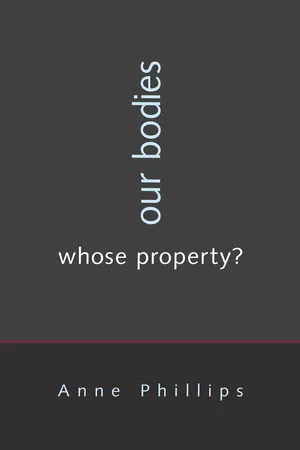
No one wants to be treated like an object, regarded as an item of property, or put up for sale. Yet many people frame personal autonomy in terms of self-ownership, representing themselves as property owners with the right to do as they wish with their bodies. Others do not use the language of property, but are similarly insistent on the rights of free individuals to decide for themselves whether to engage in commercial transactions for sex, reproduction, or organ sales. Drawing on analyses of rape, surrogacy, and markets in human organs, Our Bodies, Whose Property? challenges notions of freedom based on ownership of our bodies and argues against the normalization of markets in bodily services and parts. Anne Phillips explores the risks associated with metaphors of property and the reasons why the commodification of the body remains problematic.
What, she asks, is wrong with thinking of oneself as the owner of one's body? What is wrong with making our bodies available for rent or sale? What, if anything, is the difference between markets in sex, reproduction, or human body parts, and the other markets we commonly applaud? Phillips contends that body markets occupy the outer edges of a continuum that is, in some way, a feature of all labor markets. But she also emphasizes that we all have bodies, and considers the implications of this otherwise banal fact for equality. Bodies remind us of shared vulnerability, alerting us to the common experience of living as embodied beings in the same world.
Examining the complex issue of body exceptionalism, Our Bodies, Whose Property? demonstrates that treating the body as property makes human equality harder to comprehend.
- 216 pages
- English
- ePUB (mobile friendly)
- Available on iOS & Android
eBook - ePub
Our Bodies, Whose Property?
About this book
Information
Topic
PhilosophySubtopic
Property LawCHAPTER ONE
What’s So Special about the Body?
NO ONE THINKS IT A GOOD IDEA to treat people as if they were objects. We do not defend this even when we distrust notions of personal autonomy, or tolerate blatantly hierarchical relationships, for on any understanding of what it is to be human, people are not things. We talk of objects as inanimate or immoveable, and the power we most commonly attribute to them is that of being able to block activity. We may, of course, love our things. As Henry James warns in The Spoils of Poynton, we may come to feel more attached to the objects with which we surround ourselves than the people among whom we live. But objects remain objects, to be used, looked at, rearranged, traded, and perhaps ultimately thrown away.
Complaints about being treated as a thing have featured extensively in feminist writings, particularly as regards prostitution, pornography, and marriage, and in the analysis of advertising, the beauty industry, and film. The most persistent complaint is that women are treated as objects for someone else’s (man’s) satisfaction, or that women are “stabilised as objects,” to adopt Simone de Beauvoir’s evocative phrase.1 There is often an associated argument to the effect that women then come to see themselves in the same light, that they accept the designation as object and participate in thinking of themselves in this way. In this argument, it is not just being treated as an object, passed on like a commodity, or regarded as someone’s property that is the problem. It is that this can encourage you to think of yourself in a thing-like way.
Being an object, a commodity, and an item of property are not the same thing, and there will be some teasing apart of these different notions in the course of this book. There is a close enough connection, however, to alert us to an immediate puzzle. While no one wants to be regarded as an object, many like to think of themselves as “self-owners,” like to see themselves, that is, as in a relationship of ownership to their bodies and selves. For the devotee of self-ownership, the rights we enjoy over our bodies closely parallel the rights the archetypical owner of property has over things. The right to bodily integrity, for example, can be refigured as the right to determine who has access to the body, in ways that mimic the rights a landowner has to exclude trespassers from his property. The freedom to sell one’s labour (or, to use Karl Marx’s more precise terminology, one’s labour-power) can be treated as a version of the freedom any property owner might claim to decide for herself when and to whom to sell. For a small but growing minority, the actual body can also be regarded as an object available for trade: either the entire body, mortgaged off in anticipation of one’s future demise, or those bits of the body (spare eggs, spare kidneys) we can currently manage without. In one representative comment, “because you own yourself and your labour, you must have the right to use your body and labour in any way you see fit consistent with the rights of others. So, if you want to sell your sexual services, you have a right to do so. If you want to sell your organs, you should be free to do so. If you want to take recreational drugs, it’s your mind and body to do with as you see fit.”2 In this discourse, claiming property rights in the self is not represented as capitulation to a thing-like status. To the contrary, it is presented as protection: I am a free agent—hence the very opposite of a thing—to the extent to which I can claim ownership over myself.
We might dismiss this as a linguistic tic of right-wing philosophers, those so enraptured by the institutions of private property that they can only express their dreams of freedom and autonomy in its terms. There is, to my mind, something to this. But from John Locke onwards, claims to self-ownership have played their part in the elaboration of radical as well as conservative traditions; indeed, the quote above sums up a self-described left position, not one associated with the right.3 This is not an issue that pits egalitarians against free-market libertarians, or those concerned to establish humane terms of social coexistence against tough-minded seekers after profit. In one feminist defence of the language, Rosalind Petchesky notes the importance attached to self-propriety in eighteenth- and nineteenth-century slave writings, and the significance of those moments when the “objects of property” asserted themselves as the subjects of property too.4 If we think of self-ownership—in Ngaire Naffine’s words—as “an assertion of self-possession and self-control, of a fundamental right to exclude others from one’s very being,”5 we can readily understand its appeal to the enslaved, subordinated, or oppressed. The capacity to resist intrusions on one’s body (including through torture, rape, and forced marriage) is now enshrined as a central principle in conventions of human rights. This capacity can be, and sometimes is, formulated in ownership terms.
Does this matter? Any time we employ the possessive adjective, we are engaging casually with ownership language, but this is not to say we really think of our bodies or selves as property. The teenager who employs the rhetoric of ownership to defend her body piercing projects—“it’s my body and I’ll do what I like with it!”—does not mean she owns her body in the sense of having the right to cut it into portions and sell it to the highest bidder. The woman who says “it’s my body” when asserting her right to determine for herself whether to have an abortion does not necessarily mean (though she may also think this) that she has the right to sell her sexual services as a prostitute or her reproductive services as a surrogate mother. We sometimes use the language without at all intending a property claim, or might genuinely mean to claim ownership, but without intending particularly extensive rights over use. J. W. Harris describes a musical jingle aimed at young children that tells them to “remember your body is your own private property, your body’s nobody’s body but your own.”6 Clearly, this is not intended to convey to children that they have the absolute right to do as they wish with their “property.” The object is to warn them against inappropriate touching, and no one is suggesting they should feel free to decide for themselves which sexual favours to accord to which adult. Private property is invoked here to express the right to keep others off, not the right to invite them in.
In examples like this, we may think the choice of ownership language unhelpful, even incoherent, but might also consider this a somewhat pedantic point. Does it really matter if people employ the language of possessions to assert their rights to bodily integrity, or model their freedom on principles of private property? The visiting Martian who failed to appreciate the importance of property relations in our societies might regard this as a puzzling way to articulate notions of rights or autonomy or freedom. But given that property does play such a powerful role, should the widespread use of its language trouble us?
There is a long tradition of thinking that these ways of conceptualising the body and self do matter, some of it derived from Kantian prohibitions on treating others as mere means to ends, some from Marxist critiques of wage labour and the commodity relation, and some, more recently, from feminism. Kant was explicit about the prohibition on self-ownership: “Man cannot dispose over himself because he is not a thing; he is not his own property; to say that he is would be self-contradictory; for in so far as he is a person he is a Subject in which the ownership of things can be vested, and if he were his own property, he would be a thing over which he could have ownership.”7 Marxist critiques more commonly stress fetishism and alienation. It is not so much that owning oneself is a logical contradiction, but that thinking of oneself in this way expresses the dominance of capitalist relations, which having turned every conceivable object for human use into a tradable commodity now works to transform the very way we relate to ourselves. Writing in the 1920s, Georg Lukács saw the representation of people as owners of themselves as a final stage in self-alienation, the point where the commodity relation “stamps its imprint upon the whole consciousness of man: his qualities and abilities are no longer an organic part of his personality, they are things which he can ‘own’ or ‘dispose of’ like the various objects of the external world.”8
More recently, Carole Pateman has drawn on Marx’s analysis of wage labour to identify the “fiction” of property in the person, the way this conceals the subordination present in all labour contracts, but most starkly so when these directly engage the body.9 Talk of “owning” one’s body, body parts, or bodily capacities invokes what she terms the “masculine conception of the individual as owner, and the conception of freedom as the capacity to do what you will with your own.”10 Jennifer Nedelsky argues that thinking in terms of property encourages us to think of rights as held against others, and autonomy as achieved by building walls, and suggests that repeated use of property language can make the actual commodification of bodies more likely.11 As applied specifically to women, she sees the language of property as strengthening what is already a tendency for women to regard their bodies as objects to be adjusted, slimmed down, and variously improved, in ways that encourage their self-alienation. Margaret Radin argues that “systematically conceiving of personal attributes as fungible objects is threatening to personhood because it detaches from the person that which is integral to the person.” Like Nedelsky, she warns that “such a conception makes actual loss of the attribute easier to countenance.”12
Objectification, Commodification, and Self-Ownership
I start with some preliminary definitions. I take objectification to mean treating a person, or aspect of a person, as if it were a thing. To employ more Kantian terminology, it involves treating human beings who are ends-in-themselves as if they were mere means. In slavery, sex trafficking, and wife selling, the person becomes literally an object, though even this remains a matter of degree, for people are mostly too recalcitrant to be consistently treated as things. Outside those extremes, the objectification is pretty much always metaphorical. Martha Nussbaum has suggested seven notions involved in treating a person as a thing: instrumentality (treating someone as a tool for your own purposes); the denial of autonomy (treating someone as lacking autonomy and self-determination); inertness (treating someone as lacking agency or even activity); fungibility (treating a person as interchangeable with other people or things); violability (treating someone as lacking boundary integrity, such that it becomes legitimate to break up or into); ownership (treating someone as a possession, as something that can be bought or sold); and the denial of subjectivity (treating someone as something whose experience and feelings need not be taken into account).13
Nussbaum’s list broadly captures what we object to when we accuse someone of treating us like a thing, but we never find all the components together, and it is unlikely that any one of these could ever be experienced in full. I stress this because people sometimes try to resist accusations of objectification by pointing to some way in which the humanity of the person is still recognised even when elements of objectification are in play. It is hard, however, to conceive of human beings as totally interchangeable, totally inert, or totally lacking in autonomy. If we take objectification too literally and interpret it in too strict a way, we will too easily comfort ourselves with the belief that no one is ever objectified. The slave owner who notices that a slave has a fine singing voice, the client who is intimidated by the prostitute he has hired or, alternatively, who always asks for the same woman, are all recognising the existence of separate human beings who exist for themselves and not just as objects to serve the needs of others. Does this means there is no objectification going on? Beauty contests typically include interviews with contestants in which they are allowed to demonstrate that they are more than just a body, but are also interested in music or dancing or world peace. Does this mean there is no objectification going on? When we are dealing with people and their bodies, it is difficult not to notice, in some way, that we are dealing with people, not things. It is only in rare conditions—most notably war and even then not always—that people manage consistently to sustain an attitude of total dehumanisation. If we set the bar too low, such that the slightest recognition of another’s humanity is evidence that they are not being treated as objects, we end up accommodating too much.
I follow Margaret Radin in employing the term commodification to mean both the literal buying and selling of goods and services and a discourse of commodification that “conceives of human attributes (properties of persons) as fungible owned objects (the property of persons).”14 Radin takes the notion of fungibility from the definition of commodity employed in the US Uniform Commercial Code, where it is understood as the capacity to substitute one unit for another without any change in the value. The simplest illustration would be bank notes, which can be lent out and returned without anyone much caring whether the same note comes back, so long as it has the same denomination. Again, it would be a mistake to interpret this idea of fungibility too narrowly. Books can be commodities, and their substitutability lies in the fact that we are willing to exchange x units of books for y units of something else, or two blockbusters for one textbook, without feeling we have been shortchanged. But except in those apocryphal stories of people buying books by the metre in order to furnish their walls, we do not think just any book would do. The fact that we can conceive of swopping something does not mean it has no distinct or cherished characteristics of its own. By extension, it would not be an adequate response to accusations of commodification to note, in relation, say, to prostitution or commercial surrogacy, that clients often have strong preferences for particular types of women or strong attachments to particular individuals. Nor would it be an adequate response to criticisms of markets in body parts to claim that both buyer and seller exhibit some minimal awareness of the other’s welfare needs.
Despite obvious overlaps, commodification is not the same as objectification. Something can be an object without being a commodity (the book is not a commodity when it is borrowed from a library); and people can be treated in an object-like fashion (as when women are ranked on the basis of their body shape or the clothes they wear) without being either available for sale or conceived of as anyone’s property. We mostly talk of commodification and objectification when we think the language of commodity or object is being inappropriately applied; indeed, Stephen Wilkinson regards this as built into the meanings. “Just as it’s not possible to objectify something which really is an object, it’s not possible to commodify something which is really a commodity.”15 Both terms, in other words, carry a normative charge. This is why some say we should abandon the language altogether, for we do not describe processes we approve of as either objectification or commodification, and it might then be said we short-circuit the requirement for argument simply by our choice of term. I take this as a useful reminder that we need the argument as well. The point I would stress is that because commodificatio...
Table of contents
- Cover Page
- Title Page
- Copyright Page
- Contents
- Acknowledgements
- Introduction
- Chapter One: What’s So Special about the Body?
- Chapter Two: Property Models of Rape
- Chapter Three: Bodies for Rent? The Case of Commercial Surrogacy
- Chapter Four: Spare Parts and Desperate Need
- Chapter Five: The Individualism of Property Claims
- Notes
- Bibliography
- Index
Trusted by 375,005 students
Access to over 1.5 million titles for a fair monthly price.
Study more efficiently using our study tools.
Frequently asked questions
Yes, you can cancel anytime from the Subscription tab in your account settings on the Perlego website. Your subscription will stay active until the end of your current billing period. Learn how to cancel your subscription
No, books cannot be downloaded as external files, such as PDFs, for use outside of Perlego. However, you can download books within the Perlego app for offline reading on mobile or tablet. Learn how to download books offline
Perlego offers two plans: Essential and Complete
- Essential is ideal for learners and professionals who enjoy exploring a wide range of subjects. Access the Essential Library with 800,000+ trusted titles and best-sellers across business, personal growth, and the humanities. Includes unlimited reading time and Standard Read Aloud voice.
- Complete: Perfect for advanced learners and researchers needing full, unrestricted access. Unlock 1.5M+ books across hundreds of subjects, including academic and specialized titles. The Complete Plan also includes advanced features like Premium Read Aloud and Research Assistant.
We are an online textbook subscription service, where you can get access to an entire online library for less than the price of a single book per month. With over 1.5 million books across 990+ topics, we’ve got you covered! Learn about our mission
Look out for the read-aloud symbol on your next book to see if you can listen to it. The read-aloud tool reads text aloud for you, highlighting the text as it is being read. You can pause it, speed it up and slow it down. Learn more about Read Aloud
Yes! You can use the Perlego app on both iOS and Android devices to read anytime, anywhere — even offline. Perfect for commutes or when you’re on the go.
Please note we cannot support devices running on iOS 13 and Android 7 or earlier. Learn more about using the app
Please note we cannot support devices running on iOS 13 and Android 7 or earlier. Learn more about using the app
Yes, you can access Our Bodies, Whose Property? by Anne Phillips in PDF and/or ePUB format, as well as other popular books in Philosophy & Property Law. We have over 1.5 million books available in our catalogue for you to explore.