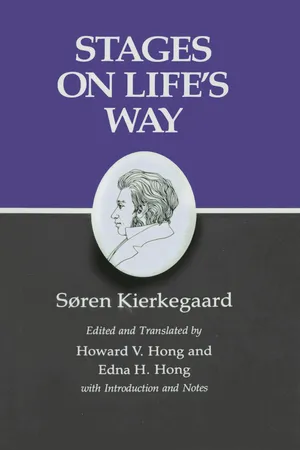
Stages on Life's Way, the sequel to Either/Or, is an intensely poetic example of Kierkegaard's vision of the three stages, or spheres, of existence: the esthetic, the ethical, and the religious. With characteristic love for mystification, he presents the work as a bundle of documents fallen by chance into the hands of "Hilarius Bookbinder," who prepared them for printing. The book begins with a banquet scene patterned on Plato's Symposium. (George Brandes maintained that "one must recognize with amazement that it holds its own in this comparison.") Next is a discourse by "Judge William" in praise of marriage "in answer to objections." The remainder of the volume, almost two-thirds of the whole, is the diary of a young man, discovered by "Frater Taciturnus," who was deeply in love but felt compelled to break his engagement. The work closes with a letter to the reader from Taciturnus on the three "existence-spheres" represented by the three parts of the book.
Stages on Life's Way not only repeats themes, characters, and pseudonymous authors of the earlier works but also goes beyond them and points to further development of central ideas in Concluding Unscientific Postscript.
?
eBook - ePub
Stages on Life's Way
- 808 pages
- English
- ePUB (mobile friendly)
- Available on iOS & Android
eBook - ePub
Stages on Life's Way
About this book
Information
Publisher
Princeton University PressYear
2013Print ISBN
9780691020495
9780691073231
eBook ISBN
9781400846986
Topic
PhilosophieSubtopic
Philosophie de la religionHISTORICAL INTRODUCTION
On the front flyleaf of the newly published work Either/Or (February 20, 1843), Kierkegaard wrote:
Some think that Either/Or is a collection of loose papers I had lying in my desk. Bravo! —As a matter of fact, it was the reverse. The only thing this work lacks is a narrative, which I did begin but omitted, just as Aladdin left a window incomplete. It was to be called “Unhappy Love.” It was to form a contrast to the Seducer.1
He later wrote in his journal:
Even while I was writing Either/Or I had it [the narrative] in mind and frequently dashed off a lyrical suggestion.2
How much of the narrative was written is not known. What Kierkegaard had in mind did, however, eventuate as Stages on Life’s Way. During the first half of 1843, even though Kierkegaard was immersed in the writing of Two Upbuilding Discourses, Fear and Trembling, Repetition, and Three Upbuilding Discourses (the first published on May 6 and the remaining three on October 16, 1843), the journal entries of that time contain seeds of most of the special interpolations3 in the second half of Stages, “‘Guilty?’/‘Not Guilty?’”
In a letter (May 25, 1843) from Berlin4 to his friend Emil Boesen, Kierkegaard mentions having finished a work, presumably Repetition, and then goes on to describe his usual day.
I have never worked as hard as now. I go for a brief walk in the morning. Then I come home and sit in my room without interruption until about three o’clock. My eyes can barely see. Then with my walking stick in hand I sneak off to the restaurant, but am so weak that I believe that if somebody were to call out my name, I would keel over and die. Then I go home and begin again. In my indolence during the past months I had pumped up a veritable shower bath, and now I have pulled the string and the ideas are cascading down upon me: healthy, happy, merry, gay, blessed children born with ease and yet all of them with the birthmark of my personality.5
Among the cascading ideas was the beginning of “ ‘Guilty?’/‘Not Guilty?’ ”6 Therefore, it appears that, like Part II of Either/Or, the second half of Stages was begun, and most likely written, first. It was not, however, intended as the second half of Stages. At the last minute, two separate works, “The Wrong and the Right”7 (consisting of “ ‘In Vino Veritas’ ” and the pseudonymous Judge William’s piece on marriage) and “ ‘Guilty?’/‘Not Guilty?’” were placed together (ostensibly by Hilarius, a bookbinder, not one of the authors or an editor) in one volume under the title Stages on Life’s Way, and the title “The Wrong and the Right” was omitted. Indeed, each of the two final manuscripts (transcribed by Israel Levin8) has its own pagination.9 The preface to “The Wrong and the Right”10 was ready but was omitted. The use of the singular “manuscript” by William Afham11 may also be a token of the original independent character of the first half of Stages, a view confirmed by Hilarius Bookbinder’s statement about publishing not one book but several.12 The initial section of Stages was the last to be completed and was difficult to write, as Kierkegaard discloses in a journal entry titled Report.13
“‘In vino veritas’” is not going well. I am constantly rewriting parts of it,14 but it does not satisfy me. On the whole I feel that I have given far too much thought to the matter and thereby have gotten into an unproductive mood. I cannot write it here in the city; so I must take a journey.15 But perhaps it is hardly worth finishing. The idea of the comic as the erotic is hinted at in The Concept of Anxiety. The Fashion Designer is a very good figure, but the problem is whether by writing such things I am not deferring more important writing. In any case it must be written in a hurry. If such a moment does not come, I will not do it. At present the productivity has miscarried and makes me constantly write more than I want to write.
August 27, 1844
The relation of Stages to the earlier pseudonymous works16 is one of continuity and contrast, epitomized in the title itself. Either/Or presents two qualitatively distinguished stages of life, the immediate or esthetic (that by which one is what one immediately is) and the ethical (that by which one becomes what one becomes17), and an intimation of the third stage, the religious, in the concluding “Ultimatum [A Final Word].” Both Fear and Trembling and Repetition center on the question of a justified exception to the ethical. In turn, Stages embodies the esthetic and the ethical and the exception to the ethical, and in the reflections of Frater Taciturnus the work delineates more expressly the religious in relation to the esthetic and the ethical.
It may seem curious, therefore, that the term “stages” is almost never used in the text of Stages. The terms “sphere” and “existence-sphere”18 are more frequent, and they are an aid to an understanding of the concept. “Stage” and “stages” may predispose one to the notion of an unbroken line of development from level to level, like childhood, adolescence, and adulthood. “Sphere” and “existence-sphere” more readily denote qualitative possibilities involving the discontinuity of a leap, reflection, and an act in freedom. Furthermore, the spheres are not discrete logical categories, and therefore the lower qualitative sphere is not annihilated but is caught up and transformed. If to a reader this understanding of “stage” and “sphere” is not clear in Stages (the diary writer in “‘Guilty?’/‘Not Guilty?’” is “in the direction of the religious”19), it becomes manifest in the next pseudonymous work, Concluding Unscientific Postscript, which uses “sphere” and “existence-sphere” more frequently than “stage” and proceeds further in distinguishing between religiousness A and religiousness B.
The most illuminating relation of Stages to the earlier signed works is to the work that appeared (April 29, 1845) just one day before the publication of Stages. Three Discourses on Imagined Occasions comprises “On the Occasion of a Confession,” “On the Occasion of a Wedding,” and “At a Graveside”—three parts, just as Stages has three parts. That the second part of each work (Judge William on marriage and the discourse at a wedding) is a counterpart of the other is readily seen. At first, Kierkegaard scholar Emanuel Hirsch considered the other parts to be related in serial order, but later he discerned that the substance in each of the others indicates a relation in reverse order of first and third: “‘Guilty?/‘Not Guilty?’” and “Confession,” and “‘In Vino Veritas’” and the discourse “At a Graveside.”20 Viewed in this way, each of the three discourses is seen to clarify and interpret the contents of the counterparts in Stages.
If the projected narrative “Unhappy Love,” which became “‘Guilty?’/‘Not Guilty?’” of Stages, is a contrast in substance to “The Seducer’s Diary,” there is also a difference in form and tone.21 Quidam’s diary is an epistolary novel, or, as Kierkegaard called it, an imaginary psychological construction [Experiment].22 An unincorporated note for Postscript states: “This imaginary construction (“ ‘Guilty?/‘Not Guilty?’ ”) is the first attempt in all the pseudonymous writings at an existential dialectic in double-reflection. It is not the communication that is in the form of double-reflection (for all the pseudonymous works are that), but the existing person himself exists in this. Thus he does not give up immediacy, but he keeps it and yet gives it up, keeps erotic love’s desire and yet gives it up.”23
In the unpublished “The Book on Adler,” Kierkegaard expands his view of the imaginary construction with reference not only to the characters but to the imaginary constructor (Frater Taciturnus) and to the intended result for the reader.
The art in all communication is to come as close as possible to actuality, to contemporaries in the role of readers, and yet at the same time to have the distance of a point of view, the reassuring, infinite distance of ideality from them. Permit me to illustrate this by an example from a later work. In the imaginary psychological construction [psychologiske Experiment] “‘Guilty?/‘Not Guilty?’” (in Stages on Life’s Way), there is depicted a character in tension in the most extreme mortal danger of the spirit to the point of despair, and the whole thing is done as though it could have occurred yesterday. In this respect the production is placed as close as possible to actuality: the person struggling religiously in despair hovers, so to speak, right over the head of the contemporaries. If the imaginary construction has made any impression, it might be like that which happens when wing strokes of the wild bird, in being heard overhead by the tame birds of the same kind who live securely in the certainty of actuality, prompt these to beat their wings, because those wing strokes simultaneously are unsettling and yet have something that fascinates. But now comes what is reassuring, that the whole thing is an imaginary construction, and that an imaginary constructor [Experimentator] stands by. Spiritually understood, the imaginatively constructed character is in a civic sense a highly dangerous character, and such people are usually not allowed to walk along without being accompanied by a pair of policemen—for the sake of public security. Thus, for the reassurance of public security, in that work an imaginary constructor is along also (he calls himself a street inspector) who very quietly shows how the whole thing hangs together, theoretically educes a life-view that he completes and rounds out, while he points interpretively to the imaginatively constructed character in order to indicate how he makes the movements according to the drawing of the strings. If this were not an imaginary construction, if no imaginary constructor were along, if no life-view were represented—then such a work, regardless of the talent it could display, would merely be debilitating.24
Inasmuch as “A First and Last Explanation” was appended in unnumbered pages to Concluding Unscientific Postscript25 and acknowledgment was thereby made of Kierkegaard’s poetic relation to the “pseudonymity or polyonymity”26 of the earlier works, Stages was the last of the works published under the veil of pseudonymity. Kierkegaard regarded Either/Or as the beginning of his authorship27 and Postscript as the concluding of his authorship. The surrounding or the accompanying of the pseudonymous works by signed works is readily apparent in the publication schedule culminating in Postscript and its appendix.
Pseudonymous Works 1843 | Signed Works 1843 | ||
Feb. 20 | Either/Or, I-II edited by Victor Eremita | May 16 | Two Upbuilding Discourses |
Oct. 16 | Repetition by Constantin Constantius Fear and Trembling by Johannes de Silentio | Oct. 16 | Three Upbuilding Discourses |
Dec. 6 | Four Upbuilding Discourses | ||
1844 | 1844 | ||
March 5 | Two Upbuilding Discourses | ||
June 8 | Three Upbuilding Discourses | ||
June 13 | Philosophical Fragments by Johannes Climacus | ||
June 17 | The Concept of Anxiety by Vigilius Haufniensis Prefaces by Nicolaus Notabene | ||
Aug. 31 | Four Upbuilding Discourses | ||
1845 | 1845 | ||
April 30 | Stages on Life’s Way published by Hilarius Bookbinder | April 29 | Three Discourses on Imagined Occasions |
1846
Feb. 27 Concluding Unscientific Postscript by Johannes Climacus, with the appended “A First and Last Explanation” by S. Kierkegaard
Feb. 27 Concluding Unscientific Postscript by Johannes Climacus, with the appended “A First and Last Explanation” by S. Kierkegaard
Even if Stages were not a pseudonymous work and a heightened example of Kierkegaard’s “indirect method,” his conception of the relation of a writer to his work and to his own experience would still apply. “An author certainly must have his private personality as everyone else has, but this must be his ἄδῡτον [inner sanctum], and just as the entrance to a house is barred by stationing two soldiers with crossed bayonets, so by means of the dialectical cross of qualitative opposites the equality of ideality forms the barrier that prevents all access.”28
No writer can totally expunge his experience from his writing, but, as Paul Sponheim observes, it would be an error to regard Stages “as an exercise in biography”29 or autobiography. Just as the creative writer transmutes whatever leaden elements of experience enter into his imaginative work, the assiduous hunter after autobiographical data tends to reverse the process from gold to lead. A better approach is given by Emanuel Hirsch, who points out that Stages is the work of one who, out of his suffering and thought, seeks to guide a reader to a personal understanding of penitence and faith.30 The distinction between recollection and memory, so splendidly and insightfully developed in the beginning of Stages (pp. 9-15), applies to the experiential element in the entire work.
In one of the few contemporary reviews of Stages (and Three Discourses on Imagined Occasions), the veil of pseudonymity was publicly drawn aside for the first time. “One would think that Mag[ister] Kierkegaard possessed a kind of magic wand by which he instantaneously conjures up his books, so incredible has his literary activity been in recent years, if we dare believe the rumor that presumably is correct in claiming him to be the author of Either/Or and the series of books that apparently comes from the same hand.”31 Kierkegaard responded obliquely by denying a rumor that attributed to him the sermon at the end of Either/Or, II, on the basis of his having once delivered a sermon at the theological seminary.32 Thereupon The Corsair [Corsaren] printed a fictional report of a fictional court case brought by Kierkegaard against the Berlingske Tidende because the latter had “respectfully praised one of the plaintiff’s unwritten books.”33
The main review of Stages, by Peder Ludvig Møller, appeared in his annual, Gæa.34 Cleverly written and marked by a polemic stance toward the writer and by a skewed perception consciously calculated to provoke, the review did achieve that purpose, and more, in Kierkegaard’s response, “The Activity of a Traveling Esthetician and How He Still Happened to Pay for the Dinner,” by Frater Taciturnus.35 The end of the piece contains the sting: Frater Taciturnus complains that he had not been abused in The Corsair, as others had, that Hilarius Bookbinder had been flattered and Victor Eremita immortalized by The Corsair—followed by the declaration: ubi P. L. Møller, ibi The Corsair [where P. L. Møller is, there is The Corsair]. This was the beginning of the most famous literary controversy in Danish history, with very important consequences for P. L. Møller, for Mei’r Goldschmidt, the editor and owner of Corsaren, and for Kierkegaard.36
Despite the unexpected publicity given to Stages, public interest in the book, as indicated by sales, was not spectacular. After twenty-six months, about 245 copies had been sold (at five rix-dollars, approximately $25.00 in 1973 money), and 280 copies were then remaindered.37 In a journal entry, Kierkegaard repeated the prediction of scant response made at the end of Stages:
The Stages will not have as many readers as Either/Or, will barely make a ripple. That is fine; in a way it rids me of the gawking public who want to be wherever they think there is a disturbance. I prophesied this myself in the epilogue to “ ‘Guilty?’/‘Not Guilty?’ ”38
In Postscript, Johannes Climacus corroborates the report and also explains that the lack of attention was perhaps because Stages did not have, as Either/Or had, “The Seducer’s Diary,” “for quite certainly that was read most and of course contributed especially to the sensation.”39
Other, later estimates diverged from the contemporary estimate expressed by indifference. Thirty-two years later Georg Brandes extolled “ ‘In Vino Veritas,’ ” as well as its counterpart in Either/Or. “In the literary sense, they are surely the most excellent things Kierkegaard has written. If they had been written in one of the main European languages, they would have made their author world famous, especially since they appeared, not isolated, but as parts in a whole contrasting spirit. . . . And if one places “ ‘In Vino Veritas’ ” alongside Plato’s Symposium, to which it was ostensibly a companion piece, one must acknowledge with amazement that it sustains the comparison as well as any modern composition could. Greater praise can hardly be given.”40 Speaking of the entire volume, Hirsch declares that Stages, despite earlier lack of attention, “has become, in Denmark as well as in Germany, Kierkegaard’s most famous and influential poetic work,” even though it is still “the most difficult to understand and the most misunderstood”41 of Kierkegaard’s works. With reference to “‘Guilty?’/‘Not Guilty?’” Kierkegaard would be in some agreement: it is “the richest of all I have written, but it is difficult to understand.”42
1 JP V 5628 (Pap. IV A 215). See “The Seducer’s Diary,” Either/Or, I, pp. 301-445, KW III (SV I 273-412).
2 JP V 5866 (Pap. VII1 B 84).
3 “A Possibility,” “A Leper’s Self-Contemplation,” “Solomon’s Dream,” and “Nebuchadnezzar.” See Supplement, pp. 502-03, 504-05, 511, 507-08 (Pap. IV A 65, 68, 105, 147, 1...
Table of contents
- Cover Page
- Title Page
- Copyright Page
- Contents
- HISTORICAL INTRODUCTION
- SUPPLEMENT
- EDITORIAL APPENDIX
- NOTES
- BIBLIOGRAPHICAL NOTE
- INDEX
Trusted by 375,005 students
Access to over 1.5 million titles for a fair monthly price.
Study more efficiently using our study tools.
Frequently asked questions
Yes, you can cancel anytime from the Subscription tab in your account settings on the Perlego website. Your subscription will stay active until the end of your current billing period. Learn how to cancel your subscription
No, books cannot be downloaded as external files, such as PDFs, for use outside of Perlego. However, you can download books within the Perlego app for offline reading on mobile or tablet. Learn how to download books offline
Perlego offers two plans: Essential and Complete
- Essential is ideal for learners and professionals who enjoy exploring a wide range of subjects. Access the Essential Library with 800,000+ trusted titles and best-sellers across business, personal growth, and the humanities. Includes unlimited reading time and Standard Read Aloud voice.
- Complete: Perfect for advanced learners and researchers needing full, unrestricted access. Unlock 1.5M+ books across hundreds of subjects, including academic and specialized titles. The Complete Plan also includes advanced features like Premium Read Aloud and Research Assistant.
We are an online textbook subscription service, where you can get access to an entire online library for less than the price of a single book per month. With over 1.5 million books across 990+ topics, we’ve got you covered! Learn about our mission
Look out for the read-aloud symbol on your next book to see if you can listen to it. The read-aloud tool reads text aloud for you, highlighting the text as it is being read. You can pause it, speed it up and slow it down. Learn more about Read Aloud
Yes! You can use the Perlego app on both iOS and Android devices to read anytime, anywhere — even offline. Perfect for commutes or when you’re on the go.
Please note we cannot support devices running on iOS 13 and Android 7 or earlier. Learn more about using the app
Please note we cannot support devices running on iOS 13 and Android 7 or earlier. Learn more about using the app
Yes, you can access Stages on Life's Way by Søren Kierkegaard, Howard V. Hong, Edna H. Hong, Howard V. Hong,Edna H. Hong in PDF and/or ePUB format, as well as other popular books in Philosophie & Philosophie de la religion. We have over 1.5 million books available in our catalogue for you to explore.