Most of the earth's terrestrial species live in the soil. These organisms, which include many thousands of species of fungi and nematodes, shape aboveground plant and animal life as well as our climate and atmosphere. Indeed, all terrestrial ecosystems consist of interdependent aboveground and belowground compartments. Despite this, aboveground and belowground ecology have been conducted largely in isolation. This book represents the first major synthesis to focus explicitly on the connections between aboveground and belowground subsystems--and their importance for community structure and ecosystem functioning.
David Wardle integrates a vast body of literature from numerous fields--including population ecology, ecosystem ecology, ecophysiology, ecological theory, soil science, and global-change biology--to explain the key conceptual issues relating to how aboveground and belowground communities affect one another and the processes that each component carries out. He then applies these concepts to a host of critical questions, including the regulation and function of biodiversity as well as the consequences of human-induced global change in the form of biological invasions, extinctions, atmospheric carbon-dioxide enrichment, nitrogen deposition, land-use change, and global warming.
Through ambitious theoretical synthesis and a tremendous range of examples, Wardle shows that the key biotic drivers of community and ecosystem properties involve linkages between aboveground and belowground food webs, biotic interaction, the spatial and temporal dynamics of component organisms, and, ultimately, the ecophysiological traits of those organisms that emerge as ecological drivers. His conclusions will propel theoretical and empirical work throughout ecology.
eBook - PDF
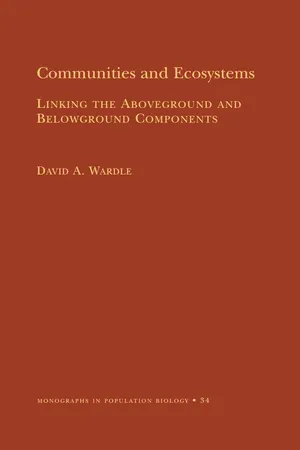
Communities and Ecosystems
Linking the Aboveground and Belowground Components
- 401 pages
- English
- PDF
- Available on iOS & Android
eBook - PDF
About this book
Information
Publisher
Princeton University PressYear
2013Print ISBN
9780691074870
9780691074863
eBook ISBN
9781400847297
Table of contents
- Cover
- Title
- Copyright
- Contents
- Acknowledgments
- 1. Introduction
- 2. The Soil Food Web: Biotic Interactions and Regulators
- 3. Plant Species Control of Soil Biota and Processes
- 4. Belowground Consequences of Aboveground Food Web Interactions
- 5. Completing the Circle: How Soil Food Web Effects Are Manifested Aboveground
- 6. The Regulation and Function of Biological Diversity
- 7. Global Change Phenomena in an Aboveground-Belowground Context
- 8. Underlying Themes
- References
- Index
Trusted by 375,005 students
Access to over 1.5 million titles for a fair monthly price.
Study more efficiently using our study tools.
Frequently asked questions
Yes, you can cancel anytime from the Subscription tab in your account settings on the Perlego website. Your subscription will stay active until the end of your current billing period. Learn how to cancel your subscription
No, books cannot be downloaded as external files, such as PDFs, for use outside of Perlego. However, you can download books within the Perlego app for offline reading on mobile or tablet. Learn how to download books offline
Perlego offers two plans: Essential and Complete
- Essential is ideal for learners and professionals who enjoy exploring a wide range of subjects. Access the Essential Library with 800,000+ trusted titles and best-sellers across business, personal growth, and the humanities. Includes unlimited reading time and Standard Read Aloud voice.
- Complete: Perfect for advanced learners and researchers needing full, unrestricted access. Unlock 1.5M+ books across hundreds of subjects, including academic and specialized titles. The Complete Plan also includes advanced features like Premium Read Aloud and Research Assistant.
We are an online textbook subscription service, where you can get access to an entire online library for less than the price of a single book per month. With over 1.5 million books across 990+ topics, we’ve got you covered! Learn about our mission
Look out for the read-aloud symbol on your next book to see if you can listen to it. The read-aloud tool reads text aloud for you, highlighting the text as it is being read. You can pause it, speed it up and slow it down. Learn more about Read Aloud
Yes! You can use the Perlego app on both iOS and Android devices to read anytime, anywhere — even offline. Perfect for commutes or when you’re on the go.
Please note we cannot support devices running on iOS 13 and Android 7 or earlier. Learn more about using the app
Please note we cannot support devices running on iOS 13 and Android 7 or earlier. Learn more about using the app
Yes, you can access Communities and Ecosystems by David A. Wardle in PDF and/or ePUB format, as well as other popular books in Biological Sciences & Biology. We have over 1.5 million books available in our catalogue for you to explore.