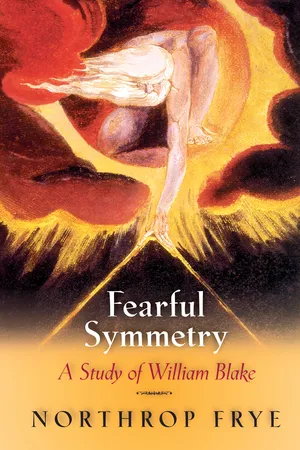
This brilliant outline of Blake's thought and commentary on his poetry comes on the crest of the current interest in Blake, and carries us further towards an understanding of his work than any previous study. Here is a dear and complete solution to the riddles of the longer poems, the so-called "Prophecies," and a demonstration of Blake's insight that will amaze the modern reader. The first section of the book shows how Blake arrived at a theory of knowledge that was also, for him, a theory of religion, of human life and of art, and how this rigorously defined system of ideas found expression in the complicated but consistent symbolism of his poetry. The second and third parts, after indicating the relation of Blake to English literature and the intellectual atmosphere of his own time, explain the meaning of Blake's poems and the significance of their characters.
- 488 pages
- English
- ePUB (mobile friendly)
- Available on iOS & Android
eBook - ePub
About this book
Information
Publisher
Princeton University PressYear
2013Print ISBN
9780691012919
9780691061658
eBook ISBN
9781400847471
PART ONE
THE ARGUMENT
GON. How lush and lusty the grass looks! how green!
ANT. The ground indeed is tawny.
SEB. With an eye of green in ’t.
ANT. He misses not much.
SEB. No; he doth but mistake the truth totally.—THE TEMPEST, ACT II, SCENE I.
1 | THE CASE AGAINST LOCKE |
THIS book offers an explanation of Blake’s thought and a commentary on his poetry. No effort has been made to deal at all adequately with Blake’s biography or with his work as painter and engraver: a study of his relation to English literature is primarily what has been attempted. The attempt is not unique, though the amount of critical writing on Blake’s poetry is perhaps not as large as it is often vaguely stated to be. After deducting the obsolete, the eccentric and the merely trivial, what remains is surely no greater in volume than a poet of such importance is entitled to. It is large enough, however, to justify a statement of what is believed to be peculiar to this study.
Many students of literature or painting must have felt that Blake’s relation to those arts is a somewhat quizzical one. Critics in both fields insist almost exclusively upon the angularity of his genius. Blake, they tell us, is a mystic enraptured with incommunicable visions, standing apart, a lonely and isolated figure, out of touch with his own age and without influence on the following one. He is an interruption in cultural history, a separable phenomenon. The historian of painting has to abandon all narrative continuity when the time comes to turn aside and devote a few words to Blake’s unique output. The historian of poetry is not quite so badly off; but even so it is only by cutting out two-thirds of Blake’s work that he will be able to wedge the rest of it in with that of the minor pre-Romantics.
For Blake is more than most poets a victim of anthologies. Countless collections of verse include a dozen or so of his lyrics, but if we wish to go further we are immediately threatened with a formidable bulk of complex symbolic poems known as “Prophecies,” which make up the main body of his work. Consequently the mere familiarity of some of the lyrics is no guarantee that they will not be wrongly associated with their author. If they indicate that we must take Blake seriously as a conscious and deliberate artist, we shall have to study these prophecies, which is more than many specialists in Blake’s period have done. The prophecies form what is in proportion to its merits the least read body of poetry in the language, and most of the more accessible editions of Blake omit them altogether, or print only those fragments which seem to the editor to have a vaguely purplish cast.
There is no a priori reason for this, apart from one or two hazy impressions which need only a passing mention. One is, that Blake wrote lyrics at the height of his creative power and that he later turned to prophecy as a sign that he had lost it. Yet his earliest book, Poetical Sketches, is evenly divided between lyrics and embryonic prophecies, and one of his last and most complicated prophecies contains his most famous lyric. Another is, that Blake is to be regarded as an ultrasubjective primitive whose work involuntarily reflects his immediate mood. The Songs of Innocence are then to be taken at their face value as the outpourings of a naïve and childlike spontaneity, and the Songs of Experience as the bitter disillusionment resulting from maturity—for when Blake engraved the latter he was no longer a child of thirty-two but a grown man of thirty-seven. It is logical inference from this that the prophecies can reflect only an ecstatic self-absorption on which it is unnecessary for a critic to intrude.
Now of course it is quite true that Blake was a neglected and isolated figure, obeying his own genius in defiance of an indifferent and occasionally hostile society; and he himself was well aware that he was “born with a different face.”1 But he did not want to be: he did not enjoy neglect, and he had what no real artist can be without, an intense desire to communicate. “Those who have been told,” he pleaded, “that my Works are but an unscientific and irregular Eccentricity, a Madman’s Scrawls, I demand of them to do me the justice to examine before they decide.”2 It is pathetic to read his letters and see how buoyant is his hope of being understood in his own time, and how wistful is the feeling that he must depend on posterity for appreciation. And it was not only recognition he wanted: he had a very strong sense of his personal responsibility both to God and to society to keep on producing the kind of imaginative art he believed in. He despised obscurity, hated all kinds of mystery, and derided the idea that poets do not fully comprehend what they are writing.3 All his poetry was written as though it were about to have the immediate social impact of a new play. Besides, if we look at some of the other poets of the second half of the eighteenth century—Smart, Cowper, Chatterton, Macpherson, Fergusson, Collins, Burns—we shall find the percentage of mental breakdowns and social maladjustments among them abnormally high. It is clear that the spiritual loneliness of Blake was not so much characteristic of him as of his age.
Therefore, as no one will deny that Blake is entitled to the square deal he asked for, we propose to adopt more satisfactory hypotheses and see what comes out of them. These are, first, that all of Blake’s poetry, from the shortest lyric to the longest prophecy, must be taken as a unit and, mutatis mutandis, judged by the same standards. This means that the longer and more difficult prophecies will have to bear the weight of the commentary. They are what a great poet chose to spend most of his time on, and they are what he hoped to be remembered for, as a poet, by posterity. He may have been mistaken in this, as poets often are about their own work, but if he was the error is too consistent and gigantic to be ignored. Second, that as all other poets are judged in relation to their own time, so should Blake be placed in his historical and cultural context as a poet who, though original, was not aboriginal, and was neither a freak nor a sport.
One of the most striking things about Blake is his genius for crystallization. He is perhaps the finest gnomic artist in English literature, and his fondness for aphorism and epigram runs steadily through his work from adolescence to old age. To produce the apparent artlessness of the lyrics he was ready to do the very considerable amount of rewriting and excision that his manuscripts show. The meticulous clarity of his engraving is as evident in the great sweep of Paolo and Francesca, in the Dante series, as in the microscopic marginal detail on the poems. It seems difficult to imagine, then, how Blake came to find an artistic satisfaction, or even relief, in writing such confused and chaotic monologues as the prophecies are generally considered to be. I quote from an intelligent and sensitive study of his painting:
By way of more than passing interest, it is worthy of note that in the garden of the house grew a grape-vine; but no grapes were enjoyed, for Blake held that it was wrong to prune the vine. Had Blake submitted that vine to pruning, he might have enjoyed its fruit; and had he submitted the luxuriant vine of his Prophetic Books to more diligent pruning, more people might have lived to enjoy their fruit also. It would be one of those strange chances with which Life is for ever teasing the children of men, that Blake should produce the larger number of his books from a house from the windows of which he could see a parable from which he was not willing to learn.4
Anyone who has glanced at the original versions of “The Tyger” or “The Fly” may perhaps wonder why the man who did the pruning of these poems should have been afraid of a grapevine. However, the story of the unpruned vine is merely one of the anecdotes that regularly go the rounds of artists’ biographies, the source of this one being probably Vasari’s Life of Piero di Cosimo; we are concerned here only with the theory of wanton luxuriance. Blake’s poetry consists of one volume of youthful work published without his co-operation, a proof copy of another poem, a few manuscripts, and a series of poems the text of which was laboriously engraved backhanded on copper plates and accompanied by a design. And when these poems were once engraved Blake seldom altered anything more fundamental than the color-scheme:
Re-engrav’d Time after Time,
Ever in their youthful prime,
My designs unchang’d remain.5
The inference is clear: the engraved poems were intended to form an exclusive and definitive canon. And in this canon there is much evidence, not only of pruning, but of wholesale transplanting and grafting. His longest poem, The Four Zoas, Blake left abandoned in a manuscript full of lively sketches and loaded with deletions and corrections. Much of its material was later used in Milton and Jerusalem, which he did engrave; but, proportionately, Blake may be said to have blotted more lines than any other important poet of English literature.
Further, Blake’s poems are poems, and must be studied as such. Any attempt to explain them in terms of something that is not poetry is bound to fail. Many students of Blake have been less interested in what he wrote than in what he read, and have examined the prophecies chiefly as documents illustrating some nonpoetic tradition such as mysticism or occultism. This, though it also ignores Blake’s vociferous assertions that he belongs to no tradition whatever except that of the creative artists, is again a perfectly logical inference from the overemphasis on his uniqueness already mentioned. If even the lyrics are so isolated in the history of literature, the prophecies can represent only a complete break with the literary tradition itself.
I am not speaking now of merely vulgar misunderstandings. No one who has read three lines of our straightforward and outspoken poet can imagine that he wished to be pursued by a band of superstitious dilettantes into the refuge of a specialized cult. Whatever Blake’s prophecies may be, they can hardly be code messages. They may need interpretation, but not deciphering: there can be no “key” and no open-sesame formula and no patented system of translation. The amateur of cabalism who accepts obscure truisms for profound truths, and sentimental platitudes for esoteric mysteries, would do well to steer clear of Blake. No: I mean the tendency to describe Blake in terms of certain stereotypes which imply that he can be fully appreciated only by certain types of mind, and which tend to scare the ordinary reader away from him. The poet who addressed the four parts of his most complicated poem, Jerusalem, to the “Public,” Jews, Deists and Christians—to anyone who cares to look at it—the poet who boasted of being understood by children,6 would have resented this treatment strongly. It is true, however, that the poet who said “Exuberance is Beauty”7 demands an energy of response. He is not writing for a tired pedant who feels merely badgered by difficulty: he is writing for enthusiasts of poetry who, like the readers of mystery stories, enjoy sitting up nights trying to find out what the mystery is.
The usual label attached to Blake’s poetry is “mystical,” which is a word he never uses. Yet “mysticism,” when the word is not simply an elegant variant of “misty” or “mysterious,” means a certain kind of religious technique difficult to reconcile with anyone’s poetry. It is a form of spiritual communion with God which is by its nature incommunicable to anyone else, and which soars beyond faith into direct apprehension. But to the artist, qua artist, this apprehension is not an end in itself but a means to another end, the end of producing his poem. The mystical experience for him is poetic material, not poetic form, and must be subordinated to the demands of that form. From the point of view of any genuine mystic this would be somewhat inadequate, and one who was both mystic and poet, never finally deciding which was to be the adjective and which the noun, might be rather badly off. If he decided for poetry, he would perhaps do better to use someone else’s mystical experiences, as Crashaw did St. Teresa’s.
I do not say that these difficulties are insurmountable, or that there are no such things as mystical poets. But they are very rare birds, and most of the poets generally called mystics might better be called visionaries, which is not quite the same thing. This is a word that Blake uses, and uses constantly. A visionary creates, or dwells in, a higher spiritual world in which the objects of perception in this one have become transfigured and charged with a new intensity of symbolism. This is quite consistent with art, because it never relinquishes the visualization which no artist can do without. It is a perceptive rather than a contemplative attitude of mind; but most of the greatest mystics, St. John of the Cross and Plotinus for example, find the symbolism of visionary experience not only unnecessary but a positive hindrance to the highest mystical contemplation. This suggests that mysticism and art are in the long run mutually exclusive, but that the visionary and the artist are allied.
Such a distinction cannot be absolute, of course, and one type blends into the other. But Blake was so completely a visionary and an artist that I am inclined to think that most true mystics would reject his attitude as vulgar and insensitive. Porphyry speaks of his master Plotinus as having four times in his life, with great effort and relentless discipline, achieved a direct apprehension of God. Blake says:
I am in God’s presence night & day,
And he never turns his face away.8
To Blake, the spiritual world was a continuous source of energy: he harnessed spiritual power as an engineer harnesses water power and used it to drive his inspiration: he was a spiritual utilitarian. He had the complete pragmatism of the artist, who, as artist, believes nothing but is looking only for what he can use. If Blake gets into the rapt circle of mystics it is only as Mercury got into the Pantheon, elb...
Table of contents
- Cover Page
- Title Page
- Copyright Page
- Dedication Page
- Preface
- Contents
- Illustrations
- Part One: The Argument
- Part Two: The Development of the Symbolism
- Part Three: The Final Synthesis
- General Note: Blake’s Mysticism
- Notes on the Illustrations
- Notes to the Text
- Index
- Other Titles in Literature Available in Princeton and Princeton/Bollingen Paperbacks
Trusted by 375,005 students
Access to over 1.5 million titles for a fair monthly price.
Study more efficiently using our study tools.
Frequently asked questions
Yes, you can cancel anytime from the Subscription tab in your account settings on the Perlego website. Your subscription will stay active until the end of your current billing period. Learn how to cancel your subscription
No, books cannot be downloaded as external files, such as PDFs, for use outside of Perlego. However, you can download books within the Perlego app for offline reading on mobile or tablet. Learn how to download books offline
Perlego offers two plans: Essential and Complete
- Essential is ideal for learners and professionals who enjoy exploring a wide range of subjects. Access the Essential Library with 800,000+ trusted titles and best-sellers across business, personal growth, and the humanities. Includes unlimited reading time and Standard Read Aloud voice.
- Complete: Perfect for advanced learners and researchers needing full, unrestricted access. Unlock 1.5M+ books across hundreds of subjects, including academic and specialized titles. The Complete Plan also includes advanced features like Premium Read Aloud and Research Assistant.
We are an online textbook subscription service, where you can get access to an entire online library for less than the price of a single book per month. With over 1.5 million books across 990+ topics, we’ve got you covered! Learn about our mission
Look out for the read-aloud symbol on your next book to see if you can listen to it. The read-aloud tool reads text aloud for you, highlighting the text as it is being read. You can pause it, speed it up and slow it down. Learn more about Read Aloud
Yes! You can use the Perlego app on both iOS and Android devices to read anytime, anywhere — even offline. Perfect for commutes or when you’re on the go.
Please note we cannot support devices running on iOS 13 and Android 7 or earlier. Learn more about using the app
Please note we cannot support devices running on iOS 13 and Android 7 or earlier. Learn more about using the app
Yes, you can access Fearful Symmetry by Northrop Frye in PDF and/or ePUB format, as well as other popular books in Literature & English Literary Criticism. We have over 1.5 million books available in our catalogue for you to explore.