In 1854, American Presbyterian missionaries arrived in Egypt as part of a larger Anglo-American Protestant movement aiming for worldwide evangelization. Protected by British imperial power, and later by mounting American global influence, their enterprise flourished during the next century. American Evangelicals in Egypt follows the ongoing and often unexpected transformations initiated by missionary activities between the mid-nineteenth century and 1967--when the Six-Day Arab-Israeli War uprooted the Americans in Egypt.
Heather Sharkey uses Arabic and English sources to shed light on the many facets of missionary encounters with Egyptians. These occurred through institutions, such as schools and hospitals, and through literacy programs and rural development projects that anticipated later efforts of NGOs. To Egyptian Muslims and Coptic Christians, missionaries presented new models for civic participation and for women's roles in collective worship and community life. At the same time, missionary efforts to convert Muslims and reform Copts stimulated new forms of Egyptian social activism and prompted nationalists to enact laws restricting missionary activities. Faced by Islamic strictures and customs regarding apostasy and conversion, and by expectations regarding the proper structure of Christian-Muslim relations, missionaries in Egypt set off debates about religious liberty that reverberate even today. Ultimately, the missionary experience in Egypt led to reconsiderations of mission policy and evangelism in ways that had long-term repercussions for the culture of American Protestantism.
eBook - ePub
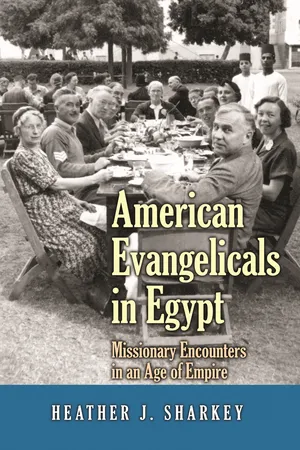
American Evangelicals in Egypt
Missionary Encounters in an Age of Empire
- 336 pages
- English
- ePUB (mobile friendly)
- Available on iOS & Android
eBook - ePub
About this book
Information
Publisher
Princeton University PressYear
2013Print ISBN
9780691168104
9780691122618
eBook ISBN
9781400837250
Topic
Theology & ReligionSubtopic
Middle Eastern HistoryCHAPTER 1
The American Missionary Encounter in Egypt
THE MISSIONARY ENCOUNTER
In 1854 American Presbyterian missionaries arrived in Egypt as part of a larger Anglo-American Protestant movement that aimed for universal evangelization. Protected by the armor of British imperial power and later by mounting American global influence, their enterprise flourished during the late nineteenth and early twentieth centuries and enabled them to establish the largest Protestant mission in the country. This book describes the massive, mutual, and ongoing transformations that their activities in Egypt set off.
In the century that stretched from 1854 until decolonization in the mid-1950s, American missionaries opened dozens of schools, medical facilities, and public libraries; initiated rural development programs to improve livestock and reduce the spread of endemic diseases; and vigorously promoted literacy campaigns, especially for the sake of Bible reading. They thought of themselves not only as Christian evangelizers but also as ambassadors for the United States and as promoters of American culture and modernity. However, despite a century of work among Egypt’s Muslim majority and indigenous Coptic Christian minority, they gained few converts. By the mid-1950s they claimed some 200 living converts from Islam within a small Evangelical Presbyterian community of just under 27,000 members, most of whom had come from Coptic Orthodoxy.1
American missionaries nevertheless exerted a significant social impact on Egypt and influenced many Muslims and Coptic Christians who resisted or rejected evangelical appeals. Missionaries dramatically expanded educational opportunities for Egyptian females, both Muslim and Christian, and contributed to a reconfiguration of gender roles and relations.2 They inadvertently mobilized anti-colonial nationalists and Islamists against a perceived cultural onslaught, galvanizing men like Hasan al-Banna, founder of the Muslim Brotherhood. By associating themselves with British colonial and American consular powers while working closely with local Christians, they planted doubts among many Muslims about the likely pro-Western sympathies of Egyptian Christians—doubts that continue to strain Egyptian intercommunal relations today. Missionaries established a new Egyptian Protestant church, called the Evangelical Church, and spurred the indigenous Coptic Orthodox Church to revise its modes of worship. They started social service projects such as youth clubs that were so popular that Egyptian Muslim and Coptic Orthodox leaders rushed to develop homegrown alternatives.3
Missionary experiences in Egypt also had repercussions for American society, confirming the notion that “nations lie enmeshed in each others’ history.”4 With counterparts in other Middle Eastern countries, missionaries in Egypt set a “founding relationship between America and the Arab world.”5 They transmitted information and opinions that influenced U.S. foreign policy toward the Middle East.6 However, they also challenged U.S. policies, particularly after 1948 vis-à-vis Israeli and Palestinian affairs, when American Presbyterians in Egypt voiced loud support for the Arab peoples.7 Discouraged by social obstacles in Egypt that hindered Muslim conversion to Christianity, missionaries led debates about religious liberty and human rights that continue to resonate in the halls of the U.S. Congress and Department of State.8 Missionaries shaped many of the underpinnings of American Orientalism—American modes of imagining, speaking about, portraying, and behaving toward the Islamic world—whether these emanated from scholars, military planners, filmmakers, or tourists. Within American universities, they helped define the field that has been variously called Oriental, Near Eastern, and Middle Eastern studies.9 (Indeed, it was a close ally of the Protestant evangelical cause, the American naval historian Alfred Thayer Mahan, who coined the term “Middle East” in 1902.)10 Missionaries also provided new models for American public philanthropy in the “developing world.”11 Finally, missionaries helped stimulate far-reaching changes in American Christianity. They forced reassessments of Christian mission that still roil American Protestantism and mobilized women within churches to an unprecedented degree, paving the way for women’s entry into the clergy.12
American missionary encounters bridged the United States to Egypt and were intensely local, global, and transnational at once. In Egypt and the United States, these encounters involved men, women, and children living in places that ranged from small farming communities to large cities. Egyptian participants in these encounters included those who attended missionary schools, sought treatment from missionary hospitals, and read missionary literature in Arabic or English; they even included those who railed against missionaries from the distance of a mosque pulpit or newspaper column. The American base of participation went beyond missionaries, too, to include above all the churchgoers who looked to a popular literature of Christian journals, travelogues, and storybooks for news and views of the Middle East. Individually, or as congregations, these rank-and-file churchgoers gave the money that kept missions afloat. The most dedicated and financially able gave funds to sponsor specific missionaries, institutions, or scholarships. In this manner, for example, financial bonds and special projects linked Presbyterians in Keokuk, Iowa, and Lyndhurst, New Jersey, to Assiut and Zagazig in Egypt.13 Donations to missions could also be incidental and small-scale—as simple as putting coins in one of the envelopes that churches distributed during worship services, and then checking off a box to mark the money for “home” or “foreign” missions.14 If nineteenth- and early twentieth-century Britain was a country of “absent-minded imperialists,”15 then the United States in this same period was a country of “absent-minded evangelists.” Americans could stay seated in their pews and send pennies to Egypt, or support work among Indians, whether of the Punjabi (“foreign mission”) or Navajo (“home mission”) variety.
As part of a Western colonial “visitation,” missionary activity prompted reciprocal migrations. That is, Americans in Egypt helped issue the call—the cultural, political, and economic beckoning—that prompted Egyptian visits to the United States in the form of emigration and settlement.16 The first members of the mission-sponsored Evangelical Church to make this move appear to have been a woman named Warda Barakat and her husband, Girgis Malaik, who left Egypt in 1882 and settled in Monmouth, Illinois, where there was a large United Presbyterian community.17 In the twentieth century, Egyptian Evangelicals in the United States helped plant hybrid Arabic-speaking Presbyterian congregations in Pasadena, California, and elsewhere.18 Many other immigrants were Egyptian Muslims and Copts who came to the United States to study after honing their English in schools that missionaries founded.
The American Presbyterians in Egypt also belonged to a global Protestant missionary order. They exchanged letters and information with missionaries in northern India, the Sudan, and Ethiopia who shared the same sponsor in the United Presbyterian Church, and communicated across denominational boundaries to missionaries arrayed throughout the Muslim world from Algiers to Jakarta. Leaders of the American mission in Egypt participated in conferences with missionaries from British, Dutch, German, Scandinavian, and other American organizations—and met in places like New York and Edinburgh, Jerusalem and Lucknow. In this way they helped foster a movement of Christian ecumenism or solidarity among Protestants. In the Middle East, this Protestant ecumenical movement took shape in the interwar era in the form of the Near East Christian Council (NECC), an organization that evolved in the early 1960s to become the Near East Council of Churches (also NECC), led by the indigenous Middle East churches. This organization evolved further in 1974 to become the Middle East Council of Churches (MECC) and included, by 1980, Protestant, Orthodox, and Catholic members. The inclusion of Middle Eastern Catholic churches in what had originally been a Protestant organization reflected improvements in Protestant-Catholic relations that followed the Suez Crisis of 1956 and the Second Vatican Council of 1962–65, when the Roman Catholic Church opened windows to intersectarian and interfaith dialogue.19
During their first century in Egypt, American missionaries helped Egyptian church members travel to places like Brazil and India for church conferences and study, and, more rarely, for employment. In this way Egyptian Protestants participated in the burgeoning ecumenical and missionary movements and in the global diffusion of Christian cultures. For example, in 1897, the chronicler of the American mission in Egypt proudly noted that one of its converts from Islam, a man named Ahmed Fahmy, was serving with the London Missionary Society (LMS) as a medical missionary in “Chang Chew” (Zhangzhou), southern China.20 In another case, in 1911, the Americans sought employment for an Egyptian convert from Islam by placing him with a Danish mission in Aden.21
The British Empire and Britons were important to the American Presbyterians in Egypt. The Americans looked to British authorities in Egypt for protection and advice but, more important, developed close ties to British missionaries that led them to strategize and, increasingly by the 1930s, to commiserate together. The American missionaries’ connections to the British in Egypt, and to American and global networks of Protestant evangelism, make their experiences a case study in the ambiguity of power. The American Presbyterians enjoyed power because they could marshal financial and political resources—above all, donations from the church at home, and protection from British and American consular authorities on the ground. After the British Occupation of 1882, the American missionaries also qualified for protection under the Capitulations—the set of legal and fiscal perquisites, enshrined in treaties, that Western powers had extracted from Ottoman authorities. Endowed with these advantages, missionaries were able to buy property, build schools, travel along the Nile, and distribute Christian tracts for free or at subsidized prices. For many years they even qualified for reduced-fare tickets on Egyptian railways.22 Missionaries, in short, had the wherewithal to make their message heard up and down the country. Yet in the century after 1854 they often felt, by their own account, vulnerable—when budgets were cut, when converts recanted, or—increasingly in the twentieth century—when the Egyptian government, supported by Muslim nationalists, worked to curtail their activities. Indeed, the power of the American missionaries fluctuated and eventually waned with British influence in Egypt, and this in itself suggests the intricate relationship of missionary activity to imperial power.
Americans had launched their mission in Egypt in 1854 with the expectation or hope that universal evangelization would be possible. They did not expect everyone to convert, but they did presume that Egyptian men and women would be able to exercise individual free choice. They thought that missionaries would be free to deliver a Christian message and that Egyptians would then be free to accept it or not. But in his chronicle of the mission published in 1897, Andrew Watson claimed that when the Americans began work in Egypt, “They found Islam utterly opposed to the idea of religious liberty.”23 He meant that Islamic courts and government authorities favored Muslims over non-Muslims, and that Islamic law, reinforced by Egyptian Muslim social convention, maintained strong deterrents against leaving Islam. (Deterrents included disinheritance, loss of child custody, unilateral divorce for a man, marriage by proxy for a woman, and possibly death.)24 Yet Andrew Watson believed that Egypt might be changing such that deep-rooted laws and practices might give way to what he expected would be Christianity’s advantage. As the twentieth century opened, Andrew Watson’s son, the educator Charles R. Watson, was even more sanguine in thinking that modern conditions, reinforced by international diplomacy, might lead to a form of religious liberty that would enable Egyptian Muslims to embrace Christianity and profess it in public.25 However, the conditions for which Andrew and Charles Watson hoped did not materialize. This was partly because Egyptian Muslims felt beleaguered in the face of Western imperial encroachment and therefore mistrusted the motives of Christian missionaries who clamored for a form of religious liberty that served evangelical interests.26
In the history of the American mission in Egypt, the most acute disappointment that the Presbyterians faced was that the Egyptian government (confirming Egyptian Muslim social sentiments at large) never accepted the principle that the exercise of religious liberty and freedom might legitimately allow individuals to renounce Islam. By the mid-twentieth century, some American mission leaders were acknowledging that to be a Christian in Egypt was to live with a social debility, that attempting to evangelize among Muslims was dangerous for Egyptian Christians to do (as Egyptian Evangelical pastors had been claiming since the nineteenth century), and that conversion out of Islam—the religion of state, the religion of power—would be an unlikely choice for a Muslim.27
For missionaries, working in an age of empire had its disadvantages. One unintended impact that American missionaries had on Egypt was to trigger a backlash among Muslim nationalists and activists, who detected in the rare cases of Muslim conversion to Christianity, and in the broad influence of missionary schools, orphanages, and medical clinics, a threat to an Egyptian Muslim public order. By the early 1930s, Christian missionary activities had spurred Egyptian Muslim nationalists to press the government to promote and protect Islam as Egypt’s religion of state, particularly by regulating mission schools; their activities also prompted Muslim activists to organize social services as a way of steering Muslims away from Christian missionaries. Anti-missionary agitation ultimately sharpened the lines dividing Muslim and Christian communities in Egypt and pushed missionaries toward a model of evangelism that either focused on the well-being of Christi...
Table of contents
- Cover Page
- Title Page
- Copyright Page
- Dedication Page
- Contents
- List of Illustrations
- Acknowledgments
- Abbreviations
- Note on Transliteration, Translation, and Spelling
- Chapter 1: The American Missionary Encounter in Egypt
- Chapter 2: The American Mission, Coptic Reform, and the Making of an Egyptian Evangelical Community, 1854–82
- Chapter 3: The Colonial Moment of the American Mission, 1882–1918
- Chapter 4: Egyptian Nationalism, Religious Liberty, and the Rethinking of the American Mission, 1918–45
- Chapter 5: The Mission of the American University in Cairo
- Chapter 6: Turning to the Life of the Church: American Mission in an Age of Egyptian Decolonization and Arab-Israeli Politics, 1945–67
- Conclusion: Conversions and Transformations
- Notes
- Bibliography
- Index
Trusted by 375,005 students
Access to over 1.5 million titles for a fair monthly price.
Study more efficiently using our study tools.
Frequently asked questions
Yes, you can cancel anytime from the Subscription tab in your account settings on the Perlego website. Your subscription will stay active until the end of your current billing period. Learn how to cancel your subscription
No, books cannot be downloaded as external files, such as PDFs, for use outside of Perlego. However, you can download books within the Perlego app for offline reading on mobile or tablet. Learn how to download books offline
Perlego offers two plans: Essential and Complete
- Essential is ideal for learners and professionals who enjoy exploring a wide range of subjects. Access the Essential Library with 800,000+ trusted titles and best-sellers across business, personal growth, and the humanities. Includes unlimited reading time and Standard Read Aloud voice.
- Complete: Perfect for advanced learners and researchers needing full, unrestricted access. Unlock 1.5M+ books across hundreds of subjects, including academic and specialized titles. The Complete Plan also includes advanced features like Premium Read Aloud and Research Assistant.
We are an online textbook subscription service, where you can get access to an entire online library for less than the price of a single book per month. With over 1.5 million books across 990+ topics, we’ve got you covered! Learn about our mission
Look out for the read-aloud symbol on your next book to see if you can listen to it. The read-aloud tool reads text aloud for you, highlighting the text as it is being read. You can pause it, speed it up and slow it down. Learn more about Read Aloud
Yes! You can use the Perlego app on both iOS and Android devices to read anytime, anywhere — even offline. Perfect for commutes or when you’re on the go.
Please note we cannot support devices running on iOS 13 and Android 7 or earlier. Learn more about using the app
Please note we cannot support devices running on iOS 13 and Android 7 or earlier. Learn more about using the app
Yes, you can access American Evangelicals in Egypt by Heather J. Sharkey in PDF and/or ePUB format, as well as other popular books in Theology & Religion & Middle Eastern History. We have over 1.5 million books available in our catalogue for you to explore.