Bestselling novelist Alexander McCall Smith's charming account of how the poet W. H. Auden has helped guide his life—and how he might guide yours, too
When facing a moral dilemma, Isabel Dalhousie—Edinburgh philosopher, amateur detective, and title character of a series of novels by best-selling author Alexander McCall Smith—often refers to the great twentieth-century poet W. H. Auden. This is no accident: McCall Smith has long been fascinated by Auden. Indeed, the novelist, best known for his No. 1 Ladies Detective Agency series, calls the poet not only the greatest literary discovery of his life but also the best of guides on how to live. In this book, McCall Smith has written a charming personal account about what Auden has done for him—and what he just might do for you.
Part self-portrait, part literary appreciation, the book tells how McCall Smith first came across the poet's work in the 1970s, while teaching law in Belfast, a violently divided city where Auden's "September 1, 1939," a poem about the outbreak of World War II, strongly resonated. McCall Smith goes on to reveal how his life has related to and been inspired by other Auden poems ever since. For example, he describes how he has found an invaluable reflection on life's transience in "As I Walked Out One Evening," while "The More Loving One" has provided an instructive meditation on unrequited love. McCall Smith shows how Auden can speak to us throughout life, suggesting how, despite difficulties and change, we can celebrate understanding, acceptance, and love for others.
An enchanting story about how art can help us live, this book will appeal to McCall Smith's fans and anyone curious about Auden.
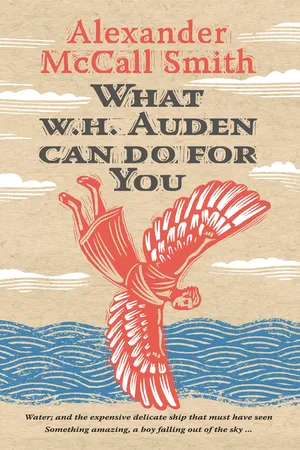
- 152 pages
- English
- ePUB (mobile friendly)
- Available on iOS & Android
eBook - ePub
What W. H. Auden Can Do for You
About this book
Information
Publisher
Princeton University PressYear
2013Print ISBN
9780691234533
9780691144733
eBook ISBN
9781400847976
1
Love Illuminates Again …
In the early months of 1940, with Europe embarking on what was to prove the greatest conflict of the twentieth century, W. H. Auden, a celebrated—and controversial—English poet who had recently moved to the United States wrote a gravely beautiful poem. It took him some time, as this was no brief ode dashed off in a moment of inspiration—this was over one thousand lines, carefully and studiously constructed. Its title was “New Year Letter,” and it was addressed to Elizabeth Mayer, a refugee from the depredations of Nazi Germany, a translator, and a close friend. Like many of his works, this poem is conversational in tone but contains within it a complex skein of ideas about humanity and history, about art, civilization, and violence. At the end of the letter, though, there occur lines that are among the most beautiful he wrote. Addressing his friend, he draws attention to what she brings to the world through her therapeutic calling:
We fall down in the dance, we makeThe old ridiculous mistake,But always there are such as youForgiving, helping what we do.O every day in sleep and labourOur life and death are with our neighbour,And love illuminates againThe city and the lion’s den,The world’s great rage, the travel of young men.
These lines are about the person to whom the poem is addressed but when we read them today could be about Auden himself. He would never compliment himself, of course, but I believe that he is clearly one who is forgiving, who helps what we do, and if there is anything to be learned from his own work, it is precisely this message: that every day in sleep and labor, our life and death are indeed with our neighbor. And yes, in reading his poetry we see love illuminating our world.
It is this view of Auden’s work that has prompted me to write an entirely personal book about the poet, about the influence he has had on my life, and about what this poet can mean for somebody who comes fresh to his work. I believe that if you read this poet, and think about what he has to say to you, then in a subtle but significant way you will be changed. This happened to me, and it can happen to you.
This small book does not purport to be a work of criticism. It does not claim to shed new light on a body of work that has already been extensively examined. It is simply an attempt to share an enthusiasm with others who may not have yet discovered, or may not have given much thought to the work of Wystan Hugh Auden, generally known as W. H. Auden, the man whom many consider to be one of the greatest poets of the twentieth century. It is not a hagiography—it recognizes that Auden has been taken to task for trying to be too clever, for using words for effect and without real regard to their meaning, and for being juvenile. There are other charges against him: in particular, he was famously criticized by the poet Philip Larkin for turning his back on political and social engagement in favor of the self-indulgent and the frivolous—a criticism that has lingered and is still occasionally encountered.
Some of these charges—particularly the ones that accuse him of using language for effect—have some basis, but those of frivolity are certainly not justified. It is true that he deliberately turned his back on the leadership role to which English intellectuals had elected him in the years before the Second World War—the Auden age, as some called it—but he by no means sought refuge in private reflection. His later poetry, although not overtly political, was very much concerned with the question of how we are to live and by no means evades profound issues. Of course some of the poems are better than others, and we can all agree that there are some that should never have seen the light of day, but what poet or novelist has not done at least something that is best forgotten? “We fall down in the dance.…” Some writers have written whole books over which they, and sometimes their readers, would prefer to draw a veil. None of us is perfect, and Auden was a self-critical man who was in many cases his own severest judge, describing some of his poems as meretricious and worthless. Interestingly enough, even poems he rejected have, in the minds of his readers, survived this disowning. He wrote a poem called “Spain” that he considered dishonest, and yet it is still read—and appreciated—in spite of its exclusion from the official canon. Similarly, “September 1, 1939” has survived its author’s judgment that it was a poem that he was ashamed to have written. This raises complex questions about aesthetics and the genuine. If a work of art gives pleasure in spite of the insincerity—at the time—of its maker, then does that detract from its value?
That question arises only in relation to a small number of Auden’s poems, but it illuminates a larger point about Auden’s work. Auden was a poet who changed. It may seem trite to say that his life was a journey—whose life isn’t?—but in his case we can see his poetry respond to the salient challenges of his times. This is enlightening, not the least for anybody who feels—as many of us perhaps do—that we are living in a time of heightened flux and crisis. How should we respond to the challenges that this provokes? Most of us want to lead a good life—however that is defined. Auden wanted that too, and the solution he found might help us today. But what was it?
2
Who Was He?
Many of us can point, I believe, to a particular artist—whether he or she be an author, a painter, or a musician—and say: This person’s work means a very great deal to me. Sometimes, indeed, we might go further and say: This person has changed my life. Alain de Botton has written a book called How Proust Can Change Your Life, a title that I suspect was devised with at least some tongue in cheek but that speaks, nonetheless, to a very real possibility of personal transformation. The title of this book is in a way lighthearted homage to de Botton’s remarkable book. But something that is lighthearted can be very serious in its intention. I believe that reading the work of W. H. Auden may make a difference to one’s life. Of course we can be changed by reading or listening to something that moves us deeply, that makes us see ourselves or the world in a different light. It may be a poem that has this effect, or it may be the contemplation of a great painting; it may even be the great Proustian novel itself. In any event the work of art we are confronted with unlocks within us the recognition of something that had escaped us before. We are changed because we now understand something that we did not understand before.
For me, the person who has had this effect is Auden. Who was he? One of his poems begins: “A shilling life will give you all the facts.” Well, here are the facts, in even less detail than one might expect from a shilling life. Auden was the son of an English doctor. The family tradition was that the name was of Icelandic origin, although this has been the subject of dispute. When you look at a photograph of the poet as a young boy, though, he looks the part—large-boned, with a shock of light-colored hair, and that almost translucent skin that one sees in many Scandinavians. He was born into a comfortable home in which scientific inquisitiveness was always present. He grew to like rocks and old machinery, and the words that went with such things. The atmosphere in the home was one of tolerance—at least on his father’s side. His mother was less accepting of her son’s ways, complaining of his untidiness and, in one splendid attack on his “intemperate ways,” his habit of eating any food he came across. She herself was described by some who knew her as an unattractive and domineering personality in contrast to the milder and more accepting nature of Dr. Auden. There may be no book on the mothers of poets, or artists in general, but it might one day be written and would be, I think, an enlightening read.
As was common in those days—and still is, to an extent, in his particular class of English society—he was sent off to boarding school. Gresham’s School is in a small town called Holt, in Norfolk, a remote part of rural England. Unlike many boarding schools of the day, the regime in this school was reasonably liberal and did not involve the cruelties in which the English educational system of the time excelled. These could be profoundly distorting: how many lives were ruined by a harsh regime of relentless conformity, enforced by physical punishment; how many young men were sent out into the world emotionally crippled by a system designed to produce a stiff upper lip and an acceptance of hierarchy. The English were unwittingly cruel to their children, which is something the Italians, to think of one example, have never been. Auden did not have to contend with the traditional boarding school ethos—Gresham’s was no Eton—even if he felt that the Gresham’s honor culture had the curious effect of creating what he considered an atmosphere of distrust. It was a good atmosphere, perhaps, for the production of spies, and indeed Auden was a near contemporary at Gresham’s of Donald Maclean, one of the so-called Cambridge spies (along with Blunt, Burgess, and Philby). Another contemporary was the composer Benjamin Britten, with whom Auden was later to collaborate. Both of those names—Maclean and Britten—can be seen today on the boards in the hall at Gresham’s that list those who won prizes. Auden’s name was added much later, recording the fact of his appointment as professor of poetry at Oxford.
It was while he was at school that he began to write. He had gone for a walk in the countryside with a boy called Robert Medley, an independent spirit for whom Auden felt undeclared love. They had become involved in a discussion about religion when Medley suddenly said to Auden: “Tell me, do you write poetry?” We can picture the scene: two boys walking in a Norfolk field, when one asks the other whether he writes poetry, and the other suddenly realizes that this is what he wants to do. This may reasonably be seen as one of the great, crucial moments in the arts, akin, perhaps, to the moment when it was suggested to Shakespeare—as it might well have been—that he might care to write a play about a prince of Denmark; or when Picasso’s attention was drawn to the bombing of a small Spanish village called Guernica; or when Leonardo da Vinci asked his model to smile—enigmatically, if you wish, but please smile. Fortunately, Auden acted upon the suggestion, and shortly afterward he had a poem accepted for Public School Verse, his first publication and the beginning of an output that was to produce numerous volumes over the years.
He went on to university, to Oxford, to Christ Church, where he was the clever undergraduate, the center of a circle of like-minded bright young men impatient with their elders—as bright young men have to be—and eager to become part of the new intellectual climate that was emerging in post–First World War Europe. It was a time of intellectual and artistic ferment, and in the eyes of his contemporaries at Oxford, Auden was very much in the vanguard of all this. He was also extremely promiscuous, picking up other young men with undisguised enthusiasm, even succeeding, as one of his biographers reports, in making conquests on the short train journey between Oxford and London. But if the world seemed bright and full of possibilities, there was a snake in the garden, and this would soon make its presence known in an unambiguous fashion.
Auden was not involved in politics at Oxford—his interest in the subject was really kindled only after he left the university and went to Berlin. But many of his contemporaries were becoming deeply involved in political debate: the future they envisaged was one in which justice and freedom would be secured by the enlightened reform of society on rational principles, while material needs would be catered for by scientific progress. It was a fairly conventional left-wing vision, and it had all the confidence that such views of the world usually have. For some, such as the British intellectuals who famously traveled to Moscow, the Soviet Union became the embodiment of their hopes (“We have seen the future—and it works,” enthused the fashionable social theorists Sidney and Beatrice Webb of their carefully stage-managed visit to Russia); for others the battle was a more domestic one, to be fought through unions and internal reform. For all of them, though, the greatest threat was fascism, which was threatening the very basis of European civilization. It was against this backdrop of political threat that Auden spent the years immediately following his graduation from Oxford.
In 1928 he went to Berlin, where he stayed until the spring of the following year. This was a very important experience for him in terms of political education and personal discovery—the equivalent, perhaps, of a dramatic gap year today. Christopher Isherwood, his close friend, recorded that period very strikingly in his Goodbye to Berlin, a book that was so successfully and atmospherically translated to stage and film. Later he went to Spain, another focal point of the battle between European left and right, intending to drive an ambulance in the Spanish Civil War. (Auden was not a good driver at all, and the fact that he did not actually drive an ambulance was probably a good thing for those whom he might have conveyed.) One of his great poems, subsequently disowned, was “Spain,” in which he explores—meretriciously, he later said—the significance of Spain to his generation. There was a visit to China with Isherwood to record the implications of the Japanese invasion, and a journey to Iceland with the Northern Irish poet Louis MacNeice. Several volumes of poetry were published—to considerable critical acclaim. As a poet, Auden was feted. His was a new and exciting voice that seemed to capture the hopes—and anxieties—of the time.
In January 1939 Auden and Isherwood went to the United States, leaving behind an England on the brink of war. Their departure at such a critical time was the subject of adverse comment, with some regarding it as an act of retreat, of personal cowardice. In Auden’s case, it was probably not cowardice: those who knew him are firm in their rejection of that charge. When war broke out, Auden did contact the British Embassy and offered to return, to be told that only skilled people were needed. Yet for some reason that remains unclear, he did not respond to the subsequent urgings of friends who encouraged him to help with the British war effort. In his defense, it must be said that he did not go to America specifically to escape Hitler, nor did he preach appeasement. His decision to emigrate was based on a combination of factors, including the desire to be part of a society that was still in the process of creating itself. He also wanted to earn his living by writing—something that he felt would be more achievable in the United States. And that proved to be the case: Auden always worked hard for...
Table of contents
- Cover Page
- Series Page
- Title Page
- Copyright Page
- Contents
- Author’s Note
- 1. Love Illuminates Again …
- 2. Who Was He?
- 3. A Discovery of Auden
- 4. Choice and Quest
- 5. The Poet as Voyager
- 6. Politics and Sex
- 7. If I Could Tell You I Would Let You Know
- 8. What Freud Meant
- 9. A Vision of Agape
- 10. That We May Have Dreams and Visions
- 11. And Then There Is Nature
- 12. Auden as a Guide to the Living of One’s Life
Trusted by 375,005 students
Access to over 1.5 million titles for a fair monthly price.
Study more efficiently using our study tools.
Frequently asked questions
Yes, you can cancel anytime from the Subscription tab in your account settings on the Perlego website. Your subscription will stay active until the end of your current billing period. Learn how to cancel your subscription
No, books cannot be downloaded as external files, such as PDFs, for use outside of Perlego. However, you can download books within the Perlego app for offline reading on mobile or tablet. Learn how to download books offline
Perlego offers two plans: Essential and Complete
- Essential is ideal for learners and professionals who enjoy exploring a wide range of subjects. Access the Essential Library with 800,000+ trusted titles and best-sellers across business, personal growth, and the humanities. Includes unlimited reading time and Standard Read Aloud voice.
- Complete: Perfect for advanced learners and researchers needing full, unrestricted access. Unlock 1.5M+ books across hundreds of subjects, including academic and specialized titles. The Complete Plan also includes advanced features like Premium Read Aloud and Research Assistant.
We are an online textbook subscription service, where you can get access to an entire online library for less than the price of a single book per month. With over 1.5 million books across 990+ topics, we’ve got you covered! Learn about our mission
Look out for the read-aloud symbol on your next book to see if you can listen to it. The read-aloud tool reads text aloud for you, highlighting the text as it is being read. You can pause it, speed it up and slow it down. Learn more about Read Aloud
Yes! You can use the Perlego app on both iOS and Android devices to read anytime, anywhere — even offline. Perfect for commutes or when you’re on the go.
Please note we cannot support devices running on iOS 13 and Android 7 or earlier. Learn more about using the app
Please note we cannot support devices running on iOS 13 and Android 7 or earlier. Learn more about using the app
Yes, you can access What W. H. Auden Can Do for You by Alexander McCall Smith in PDF and/or ePUB format, as well as other popular books in Letteratura & Biografie nell'ambito delle scienze sociali. We have over 1.5 million books available in our catalogue for you to explore.