An intimate portrait of the Big Apple
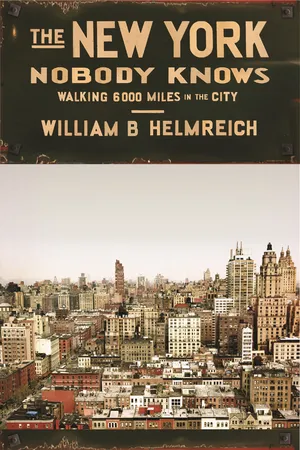
As a child growing up in Manhattan, William Helmreich played a game with his father called "Last Stop." They would pick a subway line, ride it to its final destination, and explore the neighborhood. Decades later, his love for exploring the city was as strong as ever.
Putting his feet to the test, he decided that the only way to truly understand New York was to walk virtually every block of all five boroughs—an astonishing 6,000 miles. His journey took him to every corner of Manhattan, Brooklyn, Queens, the Bronx, and Staten Island. Helmreich spoke with hundreds of New Yorkers from every part of the globe and all walks of life. He finds that to be a New Yorker is to struggle to understand the place and to make a life that is as highly local as it is dynamically cosmopolitan.
Truly unforgettable, The New York Nobody Knows will forever change how you view the world's greatest city.
- 480 pages
- English
- ePUB (mobile friendly)
- Available on iOS & Android
eBook - ePub
About this book
Information
Publisher
Princeton University PressYear
2013Print ISBN
9780691169705
9780691144054
eBook ISBN
9781400848317
1
INTRODUCTION
The ultimate aim of this book is to present a picture of the inner life, heart, and soul of New York City, to apprehend its spirit and make it come alive for the reader. I set out to do this by learning how the residents of the city experience their lives as people and as New Yorkers. The essence of the city is its people. By their actions and interactions they determine the shape it assumes, the flow of its daily life, and the aspirations and dreams it has. The relationships between those who live here, the joys and disappointments they experience and share, as well as the work they do and how they spend their leisure time, all constitute the lifeblood of the city itself.
But a city is not a static unit. It’s a dynamic and constantly changing environment, adapting to the needs of its residents. And when that city has more than eight million inhabitants who come from every part of the globe, understanding how it works is a daunting challenge. New York City’s immense size and scope and the tremendous variety of its people make it impossible to reduce it to a set of empirically verifiable observations and conclusions as one would do with a clearly defined neighborhood—any attempt to do so cannot succeed. Rather, New York must be viewed as a broad portrait in which the sum is indeed far greater than its parts. And the stories of the city’s people and how they negotiate their lives are the vehicles that make it possible for us to enter and begin to comprehend this amazing world.
Walking New York City, block by block, brought into sharp focus a reality that I always knew was there but had never really articulated, because it was so much a part of me that I never felt a need to express it. It emerged time and time again as I spoke and interacted with people from every walk of life. To sum it up, New York is a city with a dynamic, diverse, and amazingly rich collection of people and villages whose members display both smalltown values and a high degree of sophistication. This stems from living in a very modern, technologically advanced, and world-class city that is the epitome of the twenty-first century. That is both the major theme and conclusion of this intense and detailed journey to every corner of the five boroughs that constitute the city.
While these qualities reach a high level of expression here, they are by no means unique to New York City. They characterize people in other major cities too—Paris, London, Shanghai, New Delhi, and, in this country, Los Angeles, Chicago, and Boston. While these cities each have their own unique identity, all of them are places infused by new arrivals from everywhere who blend in with longtime residents, who are in turn energized and reshaped by the churning mix resulting from such contacts. This outlook on life and the patterns of behavior that emerge from such exposure are not expressed or realized to the same extent by all New Yorkers, yet they are present in varying degrees among the vast majority of its inhabitants. And this book is devoted to an exploration of that reality—how it reaches its full potential and how it informs the city as a whole.
Other important findings arose from this project, all of which are summarized in the concluding chapter. These include the critical ways in which gentrification and immigration have changed New York; the permanent impact of 9/11 on the city; the longterm trend toward ethnic assimilation as well as the creation of hybrid identities; and the broad sympathy toward undocumented immigrants.
New York City has never been scientifically studied as a whole by sociologists. In fact, none of the city’s boroughs has even been investigated as a unit. What we have are many fine studies of communities.1 I once mused aloud about this to a colleague. His response was, “Well, it’s a huge topic. Maybe no one was crazy enough before you did it to walk the whole city.” Perhaps he’s right. You do have to be a little crazy to explore the city as I did, though not so much if you see it as healthy, fun, interesting, and as a challenge. It’s also a matter of context. No one thinks of runners in New York City’s marathon as crazy, because it’s an accepted concept. They run about forty miles a week when training for the marathon, and as Abigail Meisel reports in the New York Times, growing numbers of cyclists are commuting from twenty to forty miles daily from the suburbs. But at least walking in Gotham is seen as an accepted form of activity. When I walked in Los Angeles, I almost never met anyone doing the same. For Angelinos, exercise meant only going to the gym, jogging, or swimming.
But the experience of walking the city is far more than that. Walking is critical to the task because it gets you out there and lets you get to know the city up close. However, you cannot merely walk through a city to know it. You have to stop long enough to absorb what’s going on around you. And the only way to do that is to immerse yourself in it—spending as much time as possible in the streets; hanging out where others gather; attending meetings, concerts, sporting events, and the like; in short, doing what those who live there do. That is why the ethnographic method—direct observation, and sometimes even participation in whatever was going on—became the primary approach of this project.
My initial plan was to walk twenty representative streets of the city from end to end and use them as a basis for the book. But I soon realized that there was no way any particular twenty or even one hundred streets could claim to represent a city as large as New York. To do it right I would simply have to walk the entire city, a daunting but eminently worthwhile project. If nothing else, it would be great exercise!
This decision was crucial, for I now had hundreds of examples from what I observed to write about. The many stories and vignettes presented in this book were selected either because they were typical of phenomena I saw over and over again in many parts of the city or because their uniqueness enables us to learn something interesting about the city. When there is so much to choose from, you can pick the very best examples to make your points. Obtaining a general understanding of the entire city ultimately means you won’t be able to present in-depth portraits of every neighborhood, but the benefits of getting a broader picture are well worth that limitation.
I ended up walking about 6,000 miles, the distance between New York City and Los Angeles and back to New York (4,998 miles), and then from New York City to St. Louis. I covered almost every block in Queens, Manhattan, Staten Island, Brooklyn, and the Bronx, including seldom-traversed industrial sections of the city. At the end of each walk I wrote down the number of miles I had traveled, as measured by my Omron pedometer. I averaged about 32 miles a week over four years, starting with Little Neck, Queens, in June 2008 and ending with Greenpoint, Brooklyn, in June 2012. This came to a grand total of 6,048 miles, an average of 1,512 miles a year, 126 miles a month, or 120,960 city blocks (twenty blocks equals one mile). I wore out nine pairs of San Antonio Shoes (SAS), the most comfortable and durable shoes I’ve ever owned. And all of the outer boroughs turned out to be much more interesting than I’d anticipated.
As I walked, I interviewed—you could also call them conversations because of their largely spontaneous nature—hundreds of people whom I met, and this too was critical to my efforts. Speaking directly with the city’s residents was the second critical approach to my undertaking. Hardly anyone refused to talk with me. I asked no one their full names, so as not to invade their privacy, but quite a few people volunteered them anyway, and when they appear in this book, it’s with their permission. Although I have changed a few minor details, most names and places are accurate.
Most of the time I did not tell anyone what I was doing unless they asked, because I wanted their answers to be spontaneous and relaxed. In keeping with that goal, I never began an interview with a standard: “Excuse me, could I ask you some questions about this community?” Instead I would say something like: “How come you’re dressed like this?” or “Is this neighborhood safe?” or “What’s a horse doing in that guy’s backyard?” (That really happened, in Gerritsen Beach, Brooklyn.) Before they knew it (and most of them never did), they were being interviewed.2
I used a tape recorder whenever possible, and when asked why, I told people I wanted to remember what they were saying. Most of them didn’t mind, and some were flattered that their words were worth recording. In situations when I thought taping wasn’t a good idea, I summarized the conversation by speaking into my recorder as soon it was over. Many of these casual interviews yielded insights on a number of levels. Here’s a good example of one. I approached a stocky, youngish Honduran man who was waving a plastic orange flag outside a Lower Manhattan garage, signaling drivers that the garage had space for their cars.
“Do you find this job boring?” I asked.
“This is not my main job.”
“What’s your main job?”
“Menten,” he said in his limited English.
“What’s that?”
“Menten.”
Figuring I would understand what he meant if I asked him to describe his work, I countered with, “What do you do when you do menten?”
“I clean the garage, throw the garbage away, sweep up.”
“You mean maintenance?”
“Yeah, menten.”
Suddenly seized by inspiration, I asked, “Can I wave your flag for a minute? I wanna see what it feels like.”
“Are you okay?” he asked, a worried tone creeping into his voice.
“It’s all right. I’m a professor.”
Of course, my line of work had nothing to do with my qualifications for this task, but I had learned that many people don’t pay close attention to what you say as long as you say something. I would ask someone if I could use their bathroom because I was going to a wedding immediately after our interview, or I would ask if I could make a copy of something because I was leaving for a vacation. It made no sense, but the answer was often yes anyway.
Sure enough, the Honduran man said, “Okay.”
And then a weird thing happened. After waving it for a minute, the flag curled up tightly around the stick and I could no longer wave it. Feeling sheepish, I handed it back to him. I learned from this that the simplest task can be difficult for those who don’t know how to execute it.
My reverie was abruptly interrupted when he exclaimed, “I know who you are! You’re the boss!”
I don’t know whether he’d seen the CBS reality program Undercover Boss, where a boss goes among his workers incognito to see how they’re doing their jobs, but I did take note that he wasn’t in the least bit bothered by this possibility. In fact, after I responded enigmatically with, “You never know,” he simply laughed and said, “Be good, my friend.”
One important lesson from this episode was the realization that we have become a surveillance society. People accept with equanimity, it seems, the idea that others may be spying on them. Independent confirmation of this view came from many other interviews. Another lesson was that New Yorkers from every walk of life are, by and large, a friendly and open lot. That too was substantiated many times over.
I also conducted a number of formal interviews with key leaders in the city, those who headed community boards, religious organizations, and the like. The goal here was to address issues that my walking and impromptu conversations did not fully explain. Of particular interest were my interviews with former mayors Ed Koch, David Dinkins, Rudy Giuliani, and the current mayor, Michael Bloomberg. All were open and forthcoming and spoke about their role in the city and their thoughts about its needs and challenges from the perspectives of both history and hindsight. All of these people are identified by name in the narrative.
Normally sociologists take a more removed view of their work, even though they clearly have feelings and thoughts about it. However, since the research for this book consisted mostly of walking and engaging people personally, I felt it was important to tell what I was thinking as I did so. Thus, at many points I try to explain how I felt as I strolled through the streets. Maybe it would be good if researchers did more of that in general, but that’s obviously not for me to decide.
This is an exploratory study, a first effort to understand the city. It does not pretend to be exhaustive or comprehensive. My hope is that other researchers will use it as a basis for doing more detailed work on the many aspects and topics introduced here. When you’re the first one on the block, you have to be careful not to assume too much. This is especially true of ethnography, which is a qualitative, often intuitive approach that is most fruitful in providing insights and deeper understanding as opposed to statistical conclusions.
There are many ways to analyze the city of New York. One approach is to use its geographical division into boroughs and neighborhoods and carefully examine each of them. Another approach is to think of the city in terms of categories—Asians, whites, New Yorkers, Brooklynites, organizations, small stores, sports, seniors, children. The city can also be evaluated in terms of issues—immigration, gentrification, crime, and education. Yet another method is to look at New York City as a patchwork of physical spaces. These include streets, buildings, walls, statues, playgrounds, and memorials. All of these lines of inquiry are employed in this book, because each one helps us to better comprehend this complex metropolis.
The chapter topics were chosen because of their importance and because they were particularly suitable for observation. Immigrants have long been central to New York’s history, as well as that of the United States, and walking gave me many opportunities to meet and engage them. Since the city is made up of many different communities, examining each of them from up close was a natural choice, as was looking at how New Yorkers spend their free time. It was also important to look at the city as a space, because how city dwellers use it speaks volumes for what the city means to them. Understanding the gentrification process was critical because it is the single most effective vehicle for learning about how New York City has been transformed over the last four decades into a vibrant and exciting place, both residentially and commercially. Finally, how people do or do not identify ethnically tells us much about issues that go to the core of who they are and where they’re heading, both personally and collectively. Throughout the book an effort has been made to consider how the city has changed since it hit rock bottom financially in 1975.
This was clearly a highly labor-intensive project, involving thousands of hours of hard, even grueling, work. Most of the time I walked by myself, with no research assistants to help me. There were times when I was willing to travel one and a half hours by public transportation in order to walk a neighborhood for two hours. You have to grab time whenever you have it. In the fall and the spring, summer and winter, weather permitting, you walk the streets. Then you listen to the tapes and transcribe what you need on rainy or very cold days. You also use that time to read, interview, write, and think. No time can be wasted. Otherwise, you can spend ten years doing a book of this size and still not be finished.
The end game—namely, writing the book—requires an ability and willingness to sit in a chair and work for twelve to fourteen hours straight, day in and day out. Single-minded focus is essential, so there’s no checking your email five times a day. And if you’re sick, you must do everything in your power to get well quickly. My body held up surprisingly well, and I suffered almost no health problems. I daresay that because of th...
Table of contents
- Cover Page
- Title Page
- Copyright Page
- Dedication Page
- Contents
- Preface
- Acknowledgments
- Maps
- 1 Introduction
- 2 Selling Hot Dogs, Planting Flowers, and Living the Dream: The Newcomers
- 3 Diners, Love, Exorcisms, and the Yankees: New York’s Communities
- 4 Dancing the Bachata, Playing Bocci, and the Chinese Scholars’ Garden: Enjoying the City
- 5 Tar Beaches, Sidewalk Carvings, Irish Freedom Fighters, and Superman: Spaces in the Big Apple
- Illustrations following page
- 6 From Washington Heights to Hudson Heights, from Soho to Soha: Gentrification
- 7 Assimilation, Identity, or Something Else: The Future of Ethnic New York
- 8 Conclusions
- Notes
- Neighborhood Glossary
- Bibliography
- Index
Trusted by 375,005 students
Access to over 1.5 million titles for a fair monthly price.
Study more efficiently using our study tools.
Frequently asked questions
Yes, you can cancel anytime from the Subscription tab in your account settings on the Perlego website. Your subscription will stay active until the end of your current billing period. Learn how to cancel your subscription
No, books cannot be downloaded as external files, such as PDFs, for use outside of Perlego. However, you can download books within the Perlego app for offline reading on mobile or tablet. Learn how to download books offline
Perlego offers two plans: Essential and Complete
- Essential is ideal for learners and professionals who enjoy exploring a wide range of subjects. Access the Essential Library with 800,000+ trusted titles and best-sellers across business, personal growth, and the humanities. Includes unlimited reading time and Standard Read Aloud voice.
- Complete: Perfect for advanced learners and researchers needing full, unrestricted access. Unlock 1.5M+ books across hundreds of subjects, including academic and specialized titles. The Complete Plan also includes advanced features like Premium Read Aloud and Research Assistant.
We are an online textbook subscription service, where you can get access to an entire online library for less than the price of a single book per month. With over 1.5 million books across 990+ topics, we’ve got you covered! Learn about our mission
Look out for the read-aloud symbol on your next book to see if you can listen to it. The read-aloud tool reads text aloud for you, highlighting the text as it is being read. You can pause it, speed it up and slow it down. Learn more about Read Aloud
Yes! You can use the Perlego app on both iOS and Android devices to read anytime, anywhere — even offline. Perfect for commutes or when you’re on the go.
Please note we cannot support devices running on iOS 13 and Android 7 or earlier. Learn more about using the app
Please note we cannot support devices running on iOS 13 and Android 7 or earlier. Learn more about using the app
Yes, you can access The New York Nobody Knows by William B. Helmreich in PDF and/or ePUB format, as well as other popular books in Social Sciences & North American History. We have over 1.5 million books available in our catalogue for you to explore.