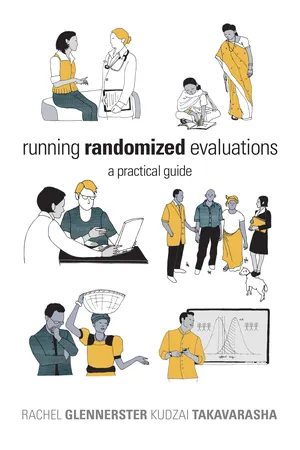
Running Randomized Evaluations
eBook - ePub

Running Randomized Evaluations

A Practical Guide

  1. 480 pages
  2. English
  3. ePUB (mobile friendly)
  4. Available on iOS & Android
eBook - ePub

Running Randomized Evaluations

A Practical Guide

About this book

A comprehensive guide to running randomized impact evaluations of social programs in developing countries

This book provides a comprehensive yet accessible guide to running randomized impact evaluations of social programs. Drawing on the experience of researchers at the Abdul Latif Jameel Poverty Action Lab, which has run hundreds of such evaluations in dozens of countries throughout the world, it offers practical insights on how to use this powerful technique, especially in resource-poor environments.

This step-by-step guide explains why and when randomized evaluations are useful, in what situations they should be used, and how to prioritize different evaluation opportunities. It shows how to design and analyze studies that answer important questions while respecting the constraints of those working on and benefiting from the program being evaluated. The book gives concrete tips on issues such as improving the quality of a study despite tight budget constraints, and demonstrates how the results of randomized impact evaluations can inform policy.

With its self-contained modules, this one-of-a-kind guide is easy to navigate. It also includes invaluable references and a checklist of the common pitfalls to avoid.

  • Provides the most up-to-date guide to running randomized evaluations of social programs, especially in developing countries
  • Offers practical tips on how to complete high-quality studies in even the most challenging environments
  • Self-contained modules allow for easy reference and flexible teaching and learning
  • Comprehensive yet nontechnical

Frequently asked questions

Yes, you can cancel anytime from the Subscription tab in your account settings on the Perlego website. Your subscription will stay active until the end of your current billing period. Learn how to cancel your subscription.
No, books cannot be downloaded as external files, such as PDFs, for use outside of Perlego. However, you can download books within the Perlego app for offline reading on mobile or tablet. Learn more here.
Perlego offers two plans: Essential and Complete
  • Essential is ideal for learners and professionals who enjoy exploring a wide range of subjects. Access the Essential Library with 800,000+ trusted titles and best-sellers across business, personal growth, and the humanities. Includes unlimited reading time and Standard Read Aloud voice.
  • Complete: Perfect for advanced learners and researchers needing full, unrestricted access. Unlock 1.4M+ books across hundreds of subjects, including academic and specialized titles. The Complete Plan also includes advanced features like Premium Read Aloud and Research Assistant.
Both plans are available with monthly, semester, or annual billing cycles.
We are an online textbook subscription service, where you can get access to an entire online library for less than the price of a single book per month. With over 1 million books across 1000+ topics, we’ve got you covered! Learn more here.
Look out for the read-aloud symbol on your next book to see if you can listen to it. The read-aloud tool reads text aloud for you, highlighting the text as it is being read. You can pause it, speed it up and slow it down. Learn more here.
Yes! You can use the Perlego app on both iOS or Android devices to read anytime, anywhere — even offline. Perfect for commutes or when you’re on the go.
Please note we cannot support devices running on iOS 13 and Android 7 or earlier. Learn more about using the app.
Yes, you can access Running Randomized Evaluations by Rachel Glennerster,Kudzai Takavarasha in PDF and/or ePUB format, as well as other popular books in Economics & Development Economics. We have over one million books available in our catalogue for you to explore.

Table of contents

  1. Cover Page
  2. Title Page
  3. Copyright Page
  4. Contents
  5. Preface
  6. Abbreviations and Acronyms
  7. 1: The Experimental Approach
  8. 2: Why Randomize?
  9. 3: Asking the Right Questions
  10. 4: Randomizing
  11. 5: Outcomes and Instruments
  12. 6: Statistical Power
  13. 7: Threats
  14. 8: Analysis
  15. 9: Drawing Policy Lessons
  16. Appendix
  17. Glossary
  18. Index