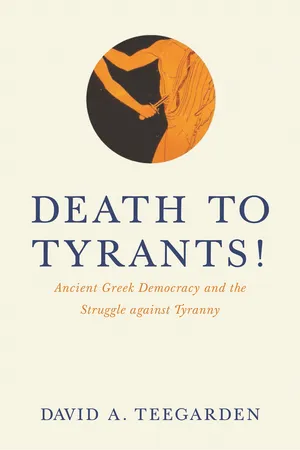
Death to Tyrants! is the first comprehensive study of ancient Greek tyrant-killing legislation--laws that explicitly gave individuals incentives to "kill a tyrant." David Teegarden demonstrates that the ancient Greeks promulgated these laws to harness the dynamics of mass uprisings and preserve popular democratic rule in the face of anti-democratic threats. He presents detailed historical and sociopolitical analyses of each law and considers a variety of issues: What is the nature of an anti-democratic threat? How would various provisions of the laws help pro-democrats counter those threats? And did the laws work?
Teegarden argues that tyrant-killing legislation facilitated pro-democracy mobilization both by encouraging brave individuals to strike the first blow against a nondemocratic regime and by convincing others that it was safe to follow the tyrant killer's lead. Such legislation thus deterred anti-democrats from staging a coup by ensuring that they would be overwhelmed by their numerically superior opponents. Drawing on modern social science models, Teegarden looks at how the institution of public law affects the behavior of individuals and groups, thereby exploring the foundation of democracy's persistence in the ancient Greek world. He also provides the first English translation of the tyrant-killing laws from Eretria and Ilion.
By analyzing crucial ancient Greek tyrant-killing legislation, Death to Tyrants! explains how certain laws enabled citizens to draw on collective strength in order to defend and preserve their democracy in the face of motivated opposition.
eBook - ePub
Death to Tyrants!
Ancient Greek Democracy and the Struggle against Tyranny
- 280 pages
- English
- ePUB (mobile friendly)
- Available on iOS & Android
eBook - ePub
Death to Tyrants!
Ancient Greek Democracy and the Struggle against Tyranny
About this book
Information
I
The Invention of Tyrant-Killing Legislation
1
The Decree of Demophantos
Introduction
The history of democratic governance in Athens nearly ended in 404. In the spring of that year, the Athenians surrendered to the Spartans, thereby losing both the lengthy Peloponnesian War (431–404) and their naval empire. During the following several months, enterprising anti-democrats diligently worked within their network of conspiratorial clubs in order to overthrow the Athenian democracy and establish a politeia inspired by the Spartan system.1 The conspiracy of the oligarchs culminated in late summer 404, during a notorious meeting of the Athenian assembly wherein the dēmos, under strong pressure from the Spartan admiral Lysander, ratified a decree establishing a board of thirty men to “draw up the ancestral laws according to which they would govern” (Xen. Hell. 2.3.2).2 Those thirty men, known to history as the Thirty Tyrants, subsequently dominated the polis. With help from a Spartan garrison, they controlled the council and other magistrates and restricted citizenship to three thousand men; those excluded from citizenship—if not executed—were disarmed and scattered. Athens thus became an oligarchic, Spartan client state.
That democratic rule in Athens did not permanently end in 404 must be attributed in large part to the fact that individuals opposed to the rule of the Thirty Tyrants successfully mobilized to reinstate the recently overthrown democracy. The pro-democracy movement began in the winter of 404/3 when Thrasyboulos and perhaps as few as thirty men set out from Thebes and secured Phyle, a hill approximately twenty kilometers north of the Athenian acropolis.3 Within a month or so, the rebels’ numbers swelled to seven hundred, then to a thousand, then to well over twelve hundred.4 Eventually, Thrasyboulos had a sufficient number of men and the necessary confidence to march to the Piraeus, where he was joined by the “whole dēmos” (Ath. Pol. 38.3). The rebels fought two pitched battles in the Piraeus. In the first, the battle of Mounichia, they defeated the Thirty’s forces, killing over seventy of their men, including Kritias, that regime’s most prominent member (Xen. Hell. 2.4.11–22). They fought their second battle against a force led by Pausanias, a Spartan king. The fighting in that battle was particularly fierce, with Thrasyboulos’s forces taking most of the casualties: 150 were killed (Xen. Hell. 2.4.30–35). Nevertheless, the rebel force’s performance convinced the Spartans to withdraw their support from the Thirty and accept democratic rule in Athens: it simply would have been too costly to prop up an oligarchy in the face of an obviously coordinated and motivated majority who opposed it.
The successful mobilization in defense of Athens’s democracy is so familiar to students of the city’s history that it is easy to overlook just how surprising an accomplishment it actually was. Why, for example, did Thrasyboulos and his thirty-odd supporters think that it was worth taking the risk to launch a direct and conspicuous attack against the Thirty? And why did so many other individuals subsequently follow them? Everybody must have known that the Thirty and their allies would easily crush the rebellion, if the democratic forces remained small. What, then, convinced individuals that, should they join in the movement, a sufficient number of other individuals would follow them and that the rebellion might thus actually succeed? That is a very important question, the answer to which may provide insight into the sociopolitical basis of the remarkable refoundation of the Athenian democracy.
This chapter accounts for the successful mobilization in defense of Athens’s democracy. I begin by exploring the collective response by citizens in Athens to the coup of the Four Hundred (411), an experience that taught the Athenians important lessons about mobilization in defense of their democracy. Two significant points emerge from that discussion. First, individuals in Athens did not respond to the coup initially because they had what I call a “revolutionary coordination problem”: many wanted to oppose the coup, but, because of the great risk that that involved, each individual waited for others to act before he did. Thus nobody acted. Second, the conspicuous assassination of Phrynichos, a prominent figure in the regime of the Four Hundred, set in motion a “revolutionary bandwagon”: that public act of defiance encouraged others to oppose the regime, which, in turn, encouraged yet others to act.5 As a result, the previously quiescent individuals were able to mobilize en masse against the regime of the Four Hundred.
The second part of this chapter examines the consequence of the fact that all Athenians swore the oath of Demophantos—an oath mandated by the very first decree promulgated by the dēmos after they regained control of the city in (probably) June 410. I argue that, by swearing the oath of Demophantos, the Athenians greatly increased the likelihood that, should the Athenian democracy be overthrown once again, pro-democrats would not be paralyzed by a revolutionary coordination problem; instead, somebody would commit a conspicuous act of defiance that would set in motion a revolutionary bandwagon and thus enable a large-scale mobilization in defense of the democracy. This interpretation thus strongly suggests that the Athenians did, in fact, learn about the dynamic of revolutionary action from their experience with the coup of the Four Hundred and thus prepared themselves for similar events in the future. And that leads to the chapter’s third and final section wherein I demonstrate that the successful mobilization against the Thirty Tyrants should be attributed, in part, to the fact that all Athenians swore the oath of Demophantos.
The Coup of the Four Hundred
I begin with two questions about the collective response of individuals in Athens to the coup of the Four Hundred. First, why were the citizens then in Athens initially unable to work together in order to oppose the coup? Subsequent events demonstrate that the vast majority of those individuals wanted to do so. And if they all just did what they all wanted to do, they easily would have overwhelmed the Four Hundred. Yet they did nothing, and the oligarchs dominated Athens for four months (roughly June 411–September 411). Second, why were those formerly quiescent individuals eventually able to work together to overthrow the Four Hundred? Something must have radically altered the calculus of decision for each individual and thus the underlying operative macro-dynamic, for when the people rose up, they did so remarkably quickly and the Four Hundred surrendered immediately.
In order to answer those two questions, I analyze Thucydides’s account of the coup of the Four Hundred in light of a theory of revolutionary action developed by the social scientist Timur Kuran.6 Thucydides himself offered important sociological analysis to account for the events he described: his emphasis on the paralyzing effect of fear compounded with ignorance, for example, is an important case in point. Kuran’s theoretical insights, however, provide the historian even better insight into the underlying causes of significant group action and inaction during that coup. In particular, the theory explains how the behavior of one individual affects the behavior of other individuals and thus the behavior of an entire group. And that, in turn, will help account for the paradoxical acquiescence and sudden resistance to the Four Hundred by the citizens in Athens.7
COORDINATION PROBLEM
The movement that eventually overthrew the Athenian democracy originated in the late fall of 412 among influential Athenians stationed with the Athenian fleet on the island of Samos.8 Thucydides, a primary source for the coup and its accompanying intrigue, wrote that those influential men received a message from Alcibiades, the infamous Athenian then in exile and likely residing with Tissaphernes (the Persian satrap of Sardeis): He desired to return to Athens, he apparently told them, but only if that city were governed by an oligarchy and not the “base democracy” that had exiled him three years earlier. He also hinted at the possibility of securing for Athens the friendship—and thus financial support—of Tissaphernes. The Athenian aristocrats at Samos, who were already set on overthrowing the Athenian democracy, then secretly traveled to meet with Alcibiades in person. In that meeting, Alcibiades apparently promised to secure Persian assistance (even that of the king himself) for the Athenian war against the Spartans, but, again, only if Athens was no longer governed democratically. The men, no doubt delighted with the news, then returned (without Alcibiades) to Samos and formed a conspiracy to overthrow the Athenian democracy (Thuc. 8.47.2–48.2).
The members of the newly formed conspiracy, after successfully manipulating the Athenian naval rank and file stationed at Samos, sent Peisandros along with some other men to Athens to work for the recall of Alcibiades and the “overthrow of the dēmos” (Thuc. 8.49). After he arrived in the city, Peisandros addressed the Athenian assembly, presenting a logical, yet ultimately disingenuous argument. According to Thucydides (8.53), he asserted that the war against the Spartans threatened the very existence of the Athenian state, that the Athenians currently did not have enough resources to defend themselves, and that the Persian king would provide such resources, but only if the Athenians recalled Alcibiades and instituted a “different type of democracy.” The logical consequence of the argument, of course, is that the Athenians should choose not to govern themselves democratically at all: the survival of the polis is prior to the form of its politeia. There were vocal skeptics, but Peisandros managed to persuade the assembly as a whole—at least to the extent that the dēmos decided to send him and ten other men to meet with Alcibiades and Tissaphernes in order to learn the details (Thuc. 8.54.2).9
Before he left Athens to meet with Alcibiades, Peisandros organized other oligarchic sympathizers residing in Athens into an underground network aimed at overthrowing the democracy. Specifically, Thucydides wrote (8.54.4) that he “visited all of the xynomosiai which chanced previously to exist in the city for the control of courts and officials and exhorted them to unite, and by taking common counsel to overthrow the democracy.” Before Peisandros’s initiative, the xynomosiai were secret clubs whose members swore to work together within the democratic system in order to accomplish various legal and political objectives. The members of one xynomosia apparently did not work in concert with the members of another. After Peisandros’s initiative, however, the members of Athens’s xynomosiai did work in concert and with the goal of overthrowing the democratic system.10
While Peisandros was in Asia Minor (likely Magnesia) meeting with Alcibiades, the members of the newly coordinated and revolutionized xynomosiai made important, preliminary moves of the coup d’état. As described by Thucydides, they implemented a two-pronged plan. The first part of the plan, carried out in secret, was to intimidate the population. That was accomplished, most notably, by the assassination of Androkles, “the foremost leader of the dēmos” and a man that rank-and-file democrats would have looked to for guidance in such uncertain times. He was not the conspirators’ only victim, however: Thucydides wrote that they killed anyone deemed to be “inconvenient.” The second part of the plan was to spread political propaganda. One of the goals of that propaganda, of course, was to remind citizens that, if a “different type” of democracy governed Athens, the Athenians would receive Persian financial support. But they also openly floated, perhaps in assembly speeches, a specific proposal: only those serving in the war should be paid by the state, and no more than five thousand men—those who could serve as hoplites and/or financial backers—should have control of the affairs of state (Thuc. 8.65).
According to Thucydides, the Athenians who were then in Athens and supported the democracy were unable to counter the campaign of intimidation and propaganda waged by the conspirators. His description of and explanation for their inability is very important for the present argument.
And no one of the others any longer spoke against them, through fear and because it was seen that the conspiracy was widespread; and if any one did oppose, at once in some convenient way he was a dead man. And no search was made for those who did the deed, nor if they were suspected was any legal prosecution held; on the contrary, the populace kept quiet and were in such consternation that he who did not suffer any violence, even though he never said a word, counted that a gain. Imagining the conspiracy to be much more widespread than it actually was, they were cowed in mind, and owing to the size of the city and their lack of knowledge of one another they were unable to find out the facts. For the same reason it was also impossible for any man that was offended to pour out his grievances to another and thus plot to avenge himself, for he would discover any person to whom he might speak to be either a stranger or, if an acquaintance, faithless. (Thuc. 8.66)
Thucydides describes the “official” overthrow of the Athenian democracy immediately after the passage just quoted. There were two important contributing events. The first event occurred during a meeting of the assembly—held, notoriously, not in the Pnyx, but a few kilometers away in the deme of Kolonos—wherein the dēmos ratified a motion, made by Peisandros: there were to be all new magistrates who would work without pay; four hundred men would be chosen to rule as they saw fit; those four hundred would convene a council of five thousand when it seemed advisable. Thucydides, using words that recall the dynamic of silence and intimidation described earlier, wrote that those measures were adopted “with no one objecting.” The second important event occurred soon after the meeting at Kolonos when the newly appointed Four Hundred, accompanied by 120 youths, burst into the Bouleuterion and ordered the bouleutai to lea...
Table of contents
- Cover Page
- Title Page
- Copyright Page
- Dedication Page
- Contents
- List of Illustrations
- Preface
- List of Abbreviations
- Introduction
- Part I The Invention of Tyrant-Killing Legislation
- Part II Tyrant-Killing Legislation in the Late Classical Period
- Part III Tyrant-Killing Legislation in the Early Hellenistic Period
- Conclusion
- Appendix: The Number and Geographic Distribution of Different Regime Types from the Archaic to the Early Hellenistic Periods
- Bibliography
- Index
Trusted by 375,005 students
Access to over 1.5 million titles for a fair monthly price.
Study more efficiently using our study tools.
Frequently asked questions
Yes, you can cancel anytime from the Subscription tab in your account settings on the Perlego website. Your subscription will stay active until the end of your current billing period. Learn how to cancel your subscription
No, books cannot be downloaded as external files, such as PDFs, for use outside of Perlego. However, you can download books within the Perlego app for offline reading on mobile or tablet. Learn how to download books offline
Perlego offers two plans: Essential and Complete
- Essential is ideal for learners and professionals who enjoy exploring a wide range of subjects. Access the Essential Library with 800,000+ trusted titles and best-sellers across business, personal growth, and the humanities. Includes unlimited reading time and Standard Read Aloud voice.
- Complete: Perfect for advanced learners and researchers needing full, unrestricted access. Unlock 1.5M+ books across hundreds of subjects, including academic and specialized titles. The Complete Plan also includes advanced features like Premium Read Aloud and Research Assistant.
We are an online textbook subscription service, where you can get access to an entire online library for less than the price of a single book per month. With over 1.5 million books across 990+ topics, we’ve got you covered! Learn about our mission
Look out for the read-aloud symbol on your next book to see if you can listen to it. The read-aloud tool reads text aloud for you, highlighting the text as it is being read. You can pause it, speed it up and slow it down. Learn more about Read Aloud
Yes! You can use the Perlego app on both iOS and Android devices to read anytime, anywhere — even offline. Perfect for commutes or when you’re on the go.
Please note we cannot support devices running on iOS 13 and Android 7 or earlier. Learn more about using the app
Please note we cannot support devices running on iOS 13 and Android 7 or earlier. Learn more about using the app
Yes, you can access Death to Tyrants! by David Teegarden,David E Teegarden,David E. Teegarden in PDF and/or ePUB format, as well as other popular books in History & Greek Ancient History. We have over 1.5 million books available in our catalogue for you to explore.