Lawmaking is crucial to American democracy because it completely defines and regulates the public life of the nation. Yet despite its importance, political scientists spend very little time studying the direct impact that the politics surrounding a particular issue has on lawmaking. The Substance of Representation draws on a vast range of historical and empirical data to better understand how lawmaking works across different policy areas. Specifically, John Lapinski introduces a theoretically grounded method for parsing policy issues into categories, and he shows how policymaking varies in predictable ways based on the specific issue area being addressed.
Lapinski examines the ways in which key factors that influence policymaking matter for certain types of policy issues, and he includes an exhaustive look at how elite political polarization shifts across these areas. He considers how Congress behaves according to the policy issue at hand, and how particular areas--such as war, sovereignty issues, and immigration reform--change legislative performance. Relying on records of all Congressional votes since Reconstruction and analyzing voting patterns across policy areas from the late nineteenth to late twentieth centuries, Lapinski provides a comprehensive historical perspective on lawmaking in order to shed light on current practices.
Giving a clear picture of Congressional behavior in the policymaking process over time, The Substance of Representation provides insights into the critical role of American lawmaking.
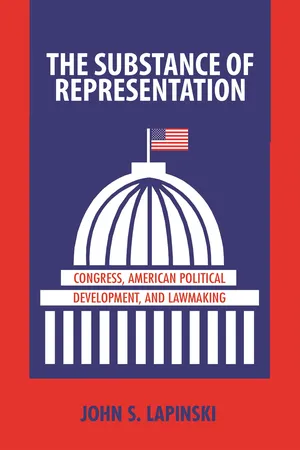
eBook - ePub
The Substance of Representation
Congress, American Political Development, and Lawmaking
- 192 pages
- English
- ePUB (mobile friendly)
- Available on iOS & Android
eBook - ePub
The Substance of Representation
Congress, American Political Development, and Lawmaking
About this book
Information
Publisher
Princeton University PressYear
2013Print ISBN
9780691137827
9780691137810
eBook ISBN
9781400848638
_______________Chapter I_______________
Policy Issue Substance and the Revitalization of Legislative Studies
WHEN LEGISLATIVE STUDIES EXPLODED in the 1960s and 1970s, many scholars took seriously the idea that policy issue substance was theoretically and empirically a very important consideration. During this earlier moment, scholars such as Theodore Lowi (1964, 1970, 1972), Aage Clausen (1967, 1973), David Mayhew (1966), and a young aspiring PhD candidate (and future Congress member and vice president), Richard Cheney (Clausen and Cheney 1970) were curious about how the types and content of issues under discussion shape political behavior and how lawmaking subsequently produces particular policy outputs.1 At the outset of this fertile period for legislative studies—which would produce tremendous advances in systematic studies of Congress—work privileging policy issue content seemed poised for prominence, perhaps even predominance, within the subfield. The situation would quickly change, however, for reasons explored in this book. By the mid-1980s the substance-centered line of research was nearly nonexistent, and by the 2000s it seemed to have donned a cloak of invisibility.
The complete disappearance of issue substance from the study of policy-making and Congress by Congress scholars leads to two natural questions. First, what was the reason for this disappearance? And second, does it matter? In other words, has the removal of policy issue substance from our study of Congress hindered progress in our understanding of how the lawmaking and policymaking processes work in the United States?
In attempting to answer the second question—which is the central focus of this book—I demonstrate repeatedly, through both theoretical and empirical exercises, that the removal of policy issue substance from our study of Congress has mattered very much and indeed has been extremely costly.
The cost of omitting policy substance takes two primary forms. The first is mischaracterization of the policymaking process. Specifically, I show that we often make incorrect inferences about lawmaking when we neglect policy substance. Sometimes these mistakes in assessing theories of lawmaking and/or policymaking lead us to lump laws together by issue area in our analyses rather than considering them separately. For example, an empirical regularity that we believe to be true (and that therefore might serve as a cornerstone for future theory building) may be contingent on aggregating all policy types together; that “regularity” changes or even disappears once we disaggregate policies by issue type. A concrete example can be found in the literature on congressional polarization, which is built around two empirical findings that are now treated as facts: that polarization has been increasing since the 1970s, and that polarization has followed a U-shaped form across the last 130 years of American history (McCarty, Poole, and Rosenthal 2006). These two empirical findings have driven theoretical and empirical research on polarization, but as I show later in this book, they do not hold across policy issue areas. In reality, the polarization story is a much more complex one after policy issue substance is introduced into the equation.
There are consequences for getting it only partially right, or even wrong. In the case of the polarization literature, introducing a more accurate picture of how polarization behaves across policy issue areas could reshape the theoretical literature on the topic. I show here that domestic politics is almost always highly polarized, but that the pattern changes in the realm of international relations and sovereignty policy. These divergent findings call for a rethinking of polarization. This point is not, of course, confined to the study of elite polarization.2 Regardless of whether our efforts are aimed at testing theories or empirically attempting to understand patterns in policymaking, not taking policy issue substance into consideration repeatedly leads us into making incorrect inferences and statements about lawmaking. Simply put, omitting policy substance makes us get it wrong, and getting it wrong is extremely costly for many reasons, given what is at stake. Fifteen years ago, Charles Jones (1995, 1) made this point about the costs of getting lawmaking wrong in his presidential address to the American Political Science Association:
Lawmaking is the core decision-making process of a democratic state. It is the means for defining, promoting, and regulating community life and, accordingly, is spectacularly interesting and highly relevant to our purposes as political scientists.
Thus, a critical endeavor for political scientists is to arrive at clear and accurate understandings, characterizations, and explanations of the lawmaking process. The lessons of Jones’s address are no less relevant today than when he delivered it. I argue throughout this book that we will never get lawmaking right without seriously bringing policy issue substance into our study of it.
The second cost of omitting policy issue substance as a topic of study is less obvious and also more difficult to prove. I argue that this omission has sequestered congressional studies from other subfields—particularly American political development (APD) and to a lesser extent policy studies—primarily because both are interested directly in what Congress scholars for the most part no longer study: issue-specific policy outputs.3 I also suggest that this sequestering of the Congress subfield is an important reason why it has lost its place as the most theoretically and empirically interesting area of political science. This is not to say that the Congress subfield is not still producing interesting research. Instead, I argue that policy issue substance is the key for the subfield to make another significant advancement in our understanding of how Congress behaves as well as how lawmaking works. Policy issue substance is the key to new progress.
Although there are certainly many reasons why the Congress subfield is not directly engaged with the APD subfield and policy studies, and vice versa, the omission of policy issue substance is probably the most important reason (see Katznelson and Lapinski 2006a). The direct cost of not having Congress scholars engaged with APD and policy studies is, of course, impossible to fully determine. How do we determine what we would know about policymaking if there was synergy between these subfields? Fortunately, this question is one that can be partially set aside: it is axiomatic that having three diverse and talented groups of scholars attempting to better understand policymaking would lead to a much better overall understanding. This question must not, however, be fully avoided. The next section considers not only the contribution of APD and policy studies to congressional studies, but also the potential revitalization of these two subfields by restoring to them the study of policy issue substance in lawmaking.
Before discussing the path by which we might bring policy substance back into the study of Congress and lawmaking—with the goal of providing better inferences and predictions about lawmaking while building synergy between Congress, APD, and policy scholars—I take a closer look at why policy substance is no longer a part of congressional studies, what has been lost as a result, and why we need to bring it back.
WHY WE NEED TO RESTORE POLICY ISSUE SUBSTANCE TO CONGRESSIONAL STUDIES
There is, of course, no single explanation for why policy substance is no longer an important consideration in our study of Congress. One explanation points to the rising prominence of deductive theory within congressional studies: behavior work on policy substance dwindled as scholars began to think of it as limited to descriptive objectives (Katznelson and Lapinski 2006a). In a related development, the powerful work of Keith Poole and Howard Rosenthal (1985; 1991; 1997) has demonstrated empirically that roll call voting in the U.S. Congress appears to be largely unidimensional. An even more important finding of Poole and Rosenthal’s for the disappearance of policy substance from the study of Congress is that members’ preferences measured through roll call voting do not vary much issue by issue. Although Poole and Rosenthal’s work on this specific topic is limited, the mountain of empirical findings they have produced on the low dimensionality of the political issue space has encouraged most Congress scholars to conflate low dimensionality with the idea that policy issue substance is inconsequential. Why is it so unfortunate that their forceful results have provided a mistaken empirical foundation to the argument that studying policy issue substance is not necessary to understand the behavior of members of Congress or policymaking in the United States? Because low dimensionality does not imply that members’ preferences across issue areas are more or less the same. I insist throughout the book that these two issues, low dimensionality and policy issue substance, should be separated.
It is somewhat paradoxical to argue that the omission of policy substance from our congressional studies has been costly when that omission coincides with a remarkably fertile period in the history of such studies. From roughly the mid-1980s until a pinnacle in the early 2000s, congressional studies produced important and rigorous findings that have fundamentally changed our understanding of Congress. The bulk of this period’s work focused on why institutions, rules, and procedures are formed and how they influence collective choice. The theory building in congressional studies during this period was supplemented by careful empirical evaluations, and the majority of the hypotheses derived or constructed made empirical predictions that related to political behavior, not to policy outputs.4
The study of Congress through roll call votes has a long and rich history in political science. There is certainly nothing wrong with studying the political behavior of members of Congress, and there is no question that roll call voting records provide an excellent way to do so. However, with so many scholars engaged in this institutionally based work on Congress, the direct study of policy outputs has been left to others. Moreover, the study of political behavior with no counterbalancing focus on outputs may have been unhealthy for both the study of lawmaking and the subfield of Congress studies.
This began to change after the publication of David Mayhew’s Divided We Govern (1991). Mayhew demonstrated the importance of moving beyond an orientation toward rules, institutions, and procedures in studying the behavior of members of Congress and focusing instead on explaining what government does. His seminal work brought the study of policy outputs back into congressional studies, spurring the creation of a small cottage industry that assesses the legislative performance of Congress.5 This work has collectively increased our understanding of the determinants of lawmaking (see Adler and Lapinski 2006; Binder 1999, 2003; Coleman 1999; McCarty, Poole, and Rosenthal 2006), although it has remained silent on the question of whether policy substance is an important causal factor in lawmaking.
Even though we know more today about the determinants of lawmaking than ever before, much remains unknown. This limited understanding has been attributed by some to the near-invisibility of policy issue substance in our research (Katznelson and Lapinski 2006b; Lapinski 2008; Rohde 1991).6 Evidence that the omission of policy substance is hindering rather than helping our understanding of lawmaking can be found in some fine recent empirical assessments of theoretical models of lawmaking in the United States.
The two most prominent models of this type are the “pivotal politics” model of lawmaking (Brady and Volden 1998; Krehbiel 1998) and the “party cartel” model (Cox and McCubbins 2005).7 The pivotal politics model of lawmaking predicts that policy change occurs when status-quo policies are extreme relative to the preferences of members of Congress. More specifically, a gridlock interval can be constructed by examining key “pivots” in the separation-of-powers system. These pivots are defined by the filibuster in the Senate (the cloture pivot) and the presidential veto.8 Policy change occurs precisely when the status quo of an existing policy is extreme relative to the gridlock interval. Like the pivotal politics model, the party cartel model of lawmaking also constructs a gridlock interval, but it differs in that the gridlock interval depends on the preferences of the median members of the majority party and the chamber median.9 In both models, policy change is determined by the location of status-quo policies relative to the preferences of critical members of Congress.
As mentioned, empirical assessments of these formal models of lawmaking have been less than stellar. For example, in a well-executed test of the pivotal politics, party cartel, and median voter models of lawmaking, Keith Krehbiel, Adam Meirowitz, and Jonathan Woon 2005 summarize their overall findings as “painfully inconclusive.”10 They propose two possible explanations for their lackluster empirical results: either the theoretical models were wrong or the empirical tests were flawed. A lack of attention to policy substance may play a large role in either explanation.
The first possible explanation for why theoretical models of lawmaking do not receive strong empirical affirmation may be rooted in policy content. This would be the case if the mechanisms underlying policymaking vary by policy issue substance (Lapinski 2008; Rohde 1991). The idea here is that different processes explain lawmaking across policy issue domains. The task therefore is to identify how mechanisms vary according to policy substance.11 To understand how these mechanisms work, we need to get a firm grasp on the empirical regularities of lawmaking across policy issues and time periods. This understanding, in turn, will allow us to determine the strengths and weaknesses of our theoretical models.
The second explanation proposed by Krehbiel and his colleagues (2005) for the poor fit between theory and data, the issue of measurement, is also linked to policy substance. Scholars believe that inconclusive empirical results stem from improperly measuring the induced preferences of members of Congress that are needed to assess existing models. In other words, problematic empirical results are not a result of poor models, but of the poor measures used to test the models. This is the explanation favored by Krehbiel and his colleagues for the lackluster results of their study. They believe that the empirical results for their pivotal politics model of lawmaking would improve if the induced preferences of members of Congress were measured by policy issue area. Their belief, in short, is that induced policy preferences vary by policy issue domain. Not accounting for variation by policy substance leads to measurement error and therefore attenuated (weak) results.12
This book contends that policy issue substance is at the center of the poor results found by Krehbiel and his colleagues. Assessing their idea in more detail, we can examine how the assumptions underlying these two models of lawmaking might interact with policy issue substance. Empirical evaluations of the pivotal politics and party cartel models make specific implicit assumptions to produce testable predictions for legislative accomplishment across time. Many of the nonformal theories of lawmaking discussed earlier also make these assumptions, which have to do with the desire and opportunity to pass legislation.
The first assumption is that all legislative regimes are equally interested in legislating. At least one scholar has made the case that not all legislative regimes are alike. John Coleman (1999) argues that Democrats are more likely than Republicans to enact new legislation when they control government. This type of assumption is not fully explored in most preference-based models of lawmaking. Instead, most scholars assume that lawmakers would like to enact or move policies closer to their ideal points regardless of their ideological positioning.13
The second assumption about the opportunity to pass legislation is particularly critical for models of lawmaking that construct gridlock intervals. Empirical assessments of such models require that gridlock intervals, which have been constructed from electoral and roll call data, be highly correlated with the number of movable status quos. The usual assumption is that the distribution of movable status-quo points is uniform across the policy space. A uniform distribution is highly desirable because it ensures that change in pre...
Table of contents
- Cover
- Title Page
- Copyright
- Contents
- Preface
- Chapter I: Policy Issue Substance and the Revitalization of Legislative Studies
- Chapter II: Bringing Policy Issue Substance Back In
- Chapter III: Political Polarization and Issues: A New Perspective
- Chapter IV: The Case Studies: Policy Issue Substance and the Political Behavior of Members of Congress (with David Bateman)
- Chapter V: Legislative Accomplishment and Policy Issue Substance
- Chapter VI: Explaining Lawmaking in the United States, 1877–1994
- Chapter VII: At the Crossroads: Policy Issue Substance, Congress, and American Political Development
- Bibliography
- Index
Trusted by 375,005 students
Access to over 1.5 million titles for a fair monthly price.
Study more efficiently using our study tools.
Frequently asked questions
Yes, you can cancel anytime from the Subscription tab in your account settings on the Perlego website. Your subscription will stay active until the end of your current billing period. Learn how to cancel your subscription
No, books cannot be downloaded as external files, such as PDFs, for use outside of Perlego. However, you can download books within the Perlego app for offline reading on mobile or tablet. Learn how to download books offline
Perlego offers two plans: Essential and Complete
- Essential is ideal for learners and professionals who enjoy exploring a wide range of subjects. Access the Essential Library with 800,000+ trusted titles and best-sellers across business, personal growth, and the humanities. Includes unlimited reading time and Standard Read Aloud voice.
- Complete: Perfect for advanced learners and researchers needing full, unrestricted access. Unlock 1.5M+ books across hundreds of subjects, including academic and specialized titles. The Complete Plan also includes advanced features like Premium Read Aloud and Research Assistant.
We are an online textbook subscription service, where you can get access to an entire online library for less than the price of a single book per month. With over 1.5 million books across 990+ topics, we’ve got you covered! Learn about our mission
Look out for the read-aloud symbol on your next book to see if you can listen to it. The read-aloud tool reads text aloud for you, highlighting the text as it is being read. You can pause it, speed it up and slow it down. Learn more about Read Aloud
Yes! You can use the Perlego app on both iOS and Android devices to read anytime, anywhere — even offline. Perfect for commutes or when you’re on the go.
Please note we cannot support devices running on iOS 13 and Android 7 or earlier. Learn more about using the app
Please note we cannot support devices running on iOS 13 and Android 7 or earlier. Learn more about using the app
Yes, you can access The Substance of Representation by John S. Lapinski in PDF and/or ePUB format, as well as other popular books in Politics & International Relations & Public Law. We have over 1.5 million books available in our catalogue for you to explore.