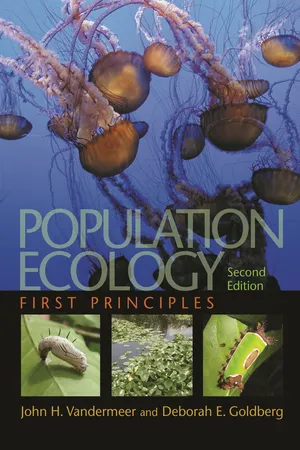
Population Ecology
eBook - PDF

Population Ecology

First Principles - Second Edition

  1. 288 pages
  2. English
  3. PDF
  4. Available on iOS & Android
eBook - PDF

Population Ecology

First Principles - Second Edition

About this book

The essential introduction to population ecology—now expanded and fully updated

Ecology is capturing the popular imagination like never before, with issues such as climate change, species extinctions, and habitat destruction becoming ever more prominent. At the same time, the science of ecology has advanced dramatically, growing in mathematical and theoretical sophistication. Here, two leading experts present the fundamental quantitative principles of ecology in an accessible yet rigorous way, introducing students to the most basic of all ecological subjects, the structure and dynamics of populations.

John Vandermeer and Deborah Goldberg show that populations are more than simply collections of individuals. Complex variables such as distribution and territory for expanding groups come into play when mathematical models are applied. Vandermeer and Goldberg build these models from the ground up, from first principles, using a broad range of empirical examples, from animals and viruses to plants and humans. They address a host of exciting topics along the way, including age-structured populations, spatially distributed populations, and metapopulations.

This second edition of Population Ecology is fully updated and expanded, with additional exercises in virtually every chapter, making it the most up-to-date and comprehensive textbook of its kind.

  • Provides an accessible mathematical foundation for the latest advances in ecology
  • Features numerous exercises and examples throughout
  • Introduces students to the key literature in the field
  • The essential textbook for advanced undergraduates and graduate students
  • An online illustration package is available to professors

Frequently asked questions

Yes, you can cancel anytime from the Subscription tab in your account settings on the Perlego website. Your subscription will stay active until the end of your current billing period. Learn how to cancel your subscription.
At the moment all of our mobile-responsive ePub books are available to download via the app. Most of our PDFs are also available to download and we're working on making the final remaining ones downloadable now. Learn more here.
Perlego offers two plans: Essential and Complete
  • Essential is ideal for learners and professionals who enjoy exploring a wide range of subjects. Access the Essential Library with 800,000+ trusted titles and best-sellers across business, personal growth, and the humanities. Includes unlimited reading time and Standard Read Aloud voice.
  • Complete: Perfect for advanced learners and researchers needing full, unrestricted access. Unlock 1.4M+ books across hundreds of subjects, including academic and specialized titles. The Complete Plan also includes advanced features like Premium Read Aloud and Research Assistant.
Both plans are available with monthly, semester, or annual billing cycles.
We are an online textbook subscription service, where you can get access to an entire online library for less than the price of a single book per month. With over 1 million books across 1000+ topics, we’ve got you covered! Learn more here.
Look out for the read-aloud symbol on your next book to see if you can listen to it. The read-aloud tool reads text aloud for you, highlighting the text as it is being read. You can pause it, speed it up and slow it down. Learn more here.
Yes! You can use the Perlego app on both iOS or Android devices to read anytime, anywhere — even offline. Perfect for commutes or when you’re on the go.
Please note we cannot support devices running on iOS 13 and Android 7 or earlier. Learn more about using the app.
Yes, you can access Population Ecology by John H. Vandermeer,Deborah E. Goldberg in PDF and/or ePUB format, as well as other popular books in Biological Sciences & Ecology. We have over one million books available in our catalogue for you to explore.

Table of contents

  1. Cover
  2. Title
  3. Copyright
  4. Dedication
  5. CONTENTS
  6. List of Figures
  7. List of Tables
  8. Preface
  9. ONE Elementary Population Dynamics
  10. TWO Projection Matrices: Structured Models
  11. THREE Applications of Simple Population Models
  12. FOUR A Closer Look at the “Dynamics” in Population Dynamics
  13. FIVE Patterns and Dynamics in Space
  14. SIX Predator–Prey (Consumer–Resource) Interactions
  15. SEVEN Disease Ecology
  16. EIGHT Competition
  17. NINE Facilitation and Mutualism
  18. TEN What This Book Was About
  19. Glossary
  20. References
  21. Index