From China's most influential foreign policy thinker, a vision for a "Beijing Consensus" for international relations
The rise of China could be the most important political development of the twenty-first century. What will China look like in the future? What should it look like? And what will China's rise mean for the rest of world? This book, written by China's most influential foreign policy thinker, sets out a vision for the coming decades from China's point of view.
In the West, Yan Xuetong is often regarded as a hawkish policy advisor and enemy of liberal internationalists. But a very different picture emerges from this book, as Yan examines the lessons of ancient Chinese political thought for the future of China and the development of a "Beijing consensus" in international relations. Yan, it becomes clear, is neither a communist who believes that economic might is the key to national power, nor a neoconservative who believes that China should rely on military might to get its way. Rather, Yan argues, political leadership is the key to national power, and morality is an essential part of political leadership. Economic and military might are important components of national power, but they are secondary to political leaders who act in accordance with moral norms, and the same holds true in determining the hierarchy of the global order.
Providing new insights into the thinking of one of China's leading foreign policy figures, this book will be essential reading for anyone interested in China's rise or in international relations.
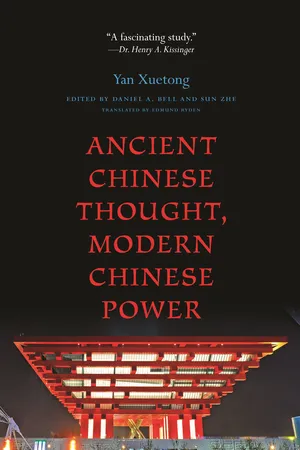
eBook - ePub
Ancient Chinese Thought, Modern Chinese Power
- 320 pages
- English
- ePUB (mobile friendly)
- Available on iOS & Android
eBook - ePub
Ancient Chinese Thought, Modern Chinese Power
About this book
Information
Publisher
Princeton University PressYear
2013Print ISBN
9780691160214
9780691148267
eBook ISBN
9781400848959

PART I
Ancient Chinese Thought, Modern Chinese Power
1

A Comparative Study of Pre-Qin Interstate Political Philosophy
There were several schools of thought on interstate politics among thinkers of pre-Qin (pre-221 BCE) China. Understanding the differences and commonalities among these schools may help us glean from their thought ideas to enrich contemporary theories of international relations. Given the great complexity of pre-Qin political philosophy—both in the number of schools and in their teachings—it is impossible to cover everything. Hence, this essay is limited to the works of seven thinkers: Guanzi, Laozi, Confucius, Mencius, Mozi, Xunzi, and Hanfeizi. It relies on the fruits of established research and examines these seven thinkers from four different angles: ways of thinking, views on interstate order, views on interstate leadership, and views on transfer of hegemonic power.1 The nine concrete issues addressed are analytical method, philosophical concepts, cause of war, path to peace, role of morality, the nature of all under heaven, the basis for the right to leadership among states, unbalanced development, and transfer of hegemonic power. Finally, this essay will apply what has been learned from this study of Chinese thought to enrich contemporary international relations theory and present some findings relevant to China’s foreign policy.
CURRENT RESEARCH: ITS FINDINGS AND LIMITATIONS
Early on, scholars noted the richness of pre-Qin ideas on interstate politics and did some research in this field. For instance, in 1922 Liang Qichao published a History of Pre-Qin Political Thought.2 Two chapters of that book, titled “Unification” and “Antimilitarism,” presented the views of Laozi, Mencius, and Mozi regarding world government and war. Liang Qichao interpreted the pre-Qin philosophers’ idea of “all under heaven” as referring to the whole body of humankind. He saw this as a kind of universalism and illustrated it with Mencius’s saying, “How can all under heaven be settled? It can be settled by being united,” and Mozi’s “Only the Son of Heaven can unify the standards in all under heaven.”3 The book also quotes Laozi’s “Weapons are inauspicious instruments,” and Mencius’s “In the Spring and Autumn Period there were no just wars,” and Mozi’s chapter “Against Aggression” to prove that all three were pacifists, while holding that the Legalists were militarists.4 Although scholars had begun to work on bringing together the interstate political thought of pre-Qin philosophers, in these studies domestic politics and foreign affairs were not clearly distinguished and there was very little in the way of systematic work, and thus this work had little impact on contemporary international relations theory.
There are four ways in which research in pre-Qin political thought has advanced. The first is the fruit of study of ancient Chinese history. While the emphasis here is placed on the pre-Qin period as such and on specific events, there are some studies analyzing pre-Qin thought though very few are undertaken from the point of view of interstate politics. For instance, a history book by Yang Kuan devotes twelve pages to summarizing Daoist thought but of this only some hundred words are devoted to interstate politics.5 History books generally quote pre-Qin works to illustrate the political views of the philosophers but do not discuss the philosophies behind these views. For instance, by quoting Laozi’s sayings that “It is better for the large to keep low” and “the ocean becomes the king of all the rivers because it is low-lying,” a scholar argued that Laozi opposes the annexation of large states by small ones. But this kind of analysis cannot explain the logic of Laozi’s thinking that a large state’s ceding power can head off the outbreak of war.6 If we look at this from the perspective of international relations theory, we will discover that the logical cause of Laozi’s thinking is that he believed war originated from human desires and for a large state to cede power to others indicated that it had no desire to swallow up other states. When a large state has no desire to annex other states and small states have no power to do so, then wars of annexation can be avoided.
The second kind of study is that devoted to the history of Chinese thought. Here the emphasis is placed on analysis of the various schools: Confucian, Daoist, Mohist, and Legalist. There are also studies devoted to specific thinkers.7 Books of this type enable us to understand the evolution of pre-Qin thought and the specific thought of the various pre-Qin masters. For example, scholars have discovered that “before Mencius, there was no clear opposition between ‘king’ and ‘hegemon’; there was only a political difference.”8 A summary like this permits us to conclude that there were different kinds of hegemonic power and helps in improving contemporary hegemonic theory. This kind of research is undertaken from the point of view of domestic politics, however, and does not look at the thought of pre-Qin thinkers from the angle of interstate politics. For instance, Guanzi’s theories on ruling the world in Conversations of the Hegemon have been summarized as discussing “rulers, power, and the relation between rulers and ministers” and understanding that “hegemons and sage kings have a sense of the right time. Having perfected their own states while neighboring states are without the Way is a major asset for becoming a hegemon or sage king.” This illustrates the idea that there is a right time to exert hegemony.9 If one looks at this statement from the point of view of international relations, it does not merely say that exertion of hegemony requires the proper time; more important, it points out the law of relative strength of a rising power to other states. In other words, whether a large state should exert itself to attain hegemonic status is determined by the relative proportion of strength between that state and others, not by an increase of its own absolute strength.
The third kind of study is dedicated to the history of China’s foreign relations. This approach views the thought of the pre-Qin masters from the perspective of diplomatic relations, and holds that it is already evidence of “interstate political theory.”10 This kind of research has changed the idea that the relations of the feudal states were not interstate relations and, hence, has opened a new perspective for understanding the thought of the pre-Qin masters from the point of view of interstate politics. Scholars adopting this approach use ideas from contemporary international relations theory to expound pre-Qin diplomatic thought and thus have opened up a new way of understanding these thinkers. For example, they use “idealism” and “realism” to differentiate the pre-Qin thinkers, taking Laozi, Mozi, and Confucius as “idealists” and Guanzi and Yanzi as “realists.”11 We must be very careful in applying concepts of contemporary international relations theory to the thought of the pre-Qin masters, however, because although there are instances in which these concepts and those of pre-Qin thought overlap, there are also differences. Hence, this kind of ticking off from a list may give rise to misunderstandings. Thus, in contemporary international relations theory, idealism refers to the idea of being founded on the notion of world government and hence avoiding war. This theory is compatible with that of Confucius—whereby the Zhou Son of Heaven is held in respect and the rites of Zhou are used to restrain war between the feudal lords—but it is not compatible with Mozi’s rejection of all war nor with Laozi’s opposition to the use of Zhou rites to uphold peace. Mozi’s thought is closer to modern pacifism, whereas Laozi’s is closer to anarchism.
The fourth kind of research is in international relations. This kind of research took off only in the twenty-first century. It employs ideas from contemporary international relations theory and undertakes comparative research into the political thought of the states of the pre-Qin masters. The initial results have focused on similarities between the pre-Qin masters and contemporary international relations theory. Some scholars maintain that as regards content there are many similarities between Western diplomatic thought and that of the pre-Qin masters. The West has moved from Grotius’s international legal idealism to realism; China went from Guanzi’s hegemonic order and Confucius’s moral order to the realism of Hanfeizi. Wen Zhong’s unlimited diplomacy and Machiavelli’s theories are the same.12 This work has provided us with a comparison of China and the West and has led us to recognize the richness of political thought among the feudal states of the pre-Qin masters.13 Nonetheless, some features of this work of comparison can be challenged. For instance, to describe the conference of the various peoples in the Zhou era as like the United Nations, or to treat the feudal states as independent nation-states easily leads us to overlook the differences between the two.14 At present the academic world accepts that the biggest difference between the nation-state and any other previous form of state is that the latter did not depend on international recognition. Previously, international recognition was not a prerequisite for acceptance as a state.
The results of international relations research have begun to head in a very revealing direction in recent years. Scholars are using pre-Qin thought and contemporary international relations theory to lead them to look for a way to shed new light on contemporary international relations theory. For instance, scholars have noticed that Hanfeizi adopts the view that the political system is an independent variable of the increase in a state’s power, enabling us to realize that there is a need to deepen our understanding of the relationship of between the system and both hard and soft power.15 Some scholars have studied the idea of intervention in Zuo’s Commentary and found that successful intervention depends on the degree of intervention and the consistency of purpose, not on the amount of power exerted.16 A Korean scholar has studied the Record of Rites and discovered that the idea of being a sage within and reigning without can help contemporary political leaders to undertake personal moral improvement and thereby enhance the international environment.17 Some scholars have noted that the Guanzi emphasizes a combination of the development of power in economics, military affairs, and politics, which can be of value to researchers interested in the strategy of rising powers.18 Having read the extracts in Zhongguo Xian Qin Guojiajian Zhengzhi Sixiang Xuandu (Readings in pre-Qin Chinese diplomatic thought), some scholars have remarked that the differences between the thought of the pre-Qin masters and contemporary international relations theory are more important than the similarities, because similarities simply reinforce each other whereas differences allow for the recognition of changes.19 Although the revelatory nature of this kind of research is powerful, little has been accomplished so far in comparing the interstate political thought of the pre-Qin masters.
In fact, none of these four kinds of comparative research of the interstate political thought of the pre-Qin masters has produced much. The main purpose of undertaking a comparison is to be able to grasp the true picture of pre-Qin thought so as to make new discoveries in theory, not to assess the past. That is what this essay attempts to do.
TABLE 1.1
Analytical Levels and Epistemological Ideas

ANALYSIS OF THOUGHT
The language and vocabulary of the pre-Qin thinkers were very different from those used today, yet their way of thinking about problems and their logic were very similar. In their works there is no clear methodology, their patterns of thought are heterogeneous, and their analytical logic is contradictory in places. Hence, to clarify and understand the logic of their thought, this essay relies on their basic concepts and categorizes them according to modern epistemological methods. The two axes are those of analytical level and epistemological ideas. In this way we can group the seven authors (Guanzi, Laozi, Confucius, Mencius, Xunzi, Mozi, and Hanfeizi) according to table 1.1.
Levels of System, State, and the Individual
Following the three levels of analysis of international relations, we can classify the analytical perspectives of Mozi and Laozi as on the level of the system, those of Guanzi and Hanfeizi as on the level of the state, and those of Confucius, Mencius, and Xunzi as on the level of the individual person.
Mozi and Laozi analyze interstate relations from the viewpoint of the whole interest of the whole world rather than from that of the advantage of each state. Mozi believes that using war to attain preeminence is beneficial only to a few states, not to most. War enables a very few states to become hegemons but at the cost of many, many small states that perish. Hence, he concludes that war is the greatest abuse. In refuting the idea that states should become strong and exert hegemony he says, “In the past the Son of Heaven enfeoffed the princes, more than ten thousand of them; today, because they have been annexed, the myriad and more states have been eliminated and only four states still stand. This is like the doctor who visits more than ten thousand patients but cures only four; such a one cannot be called a good doctor.”20 Laozi’s model of the ideal world order is based on many small, weak states, not on strong, big states. He holds that if all states returned to the primitive era of recording events on knotted cords and the contacts between states were reduced, then the conflict between states would be reduced, and so he advocates small states with small populations. He says, “Let the people tie knots and use them, enjoy their food, embellish their dress, repose in their homes, rejoice in their customs. Neighboring states will look across at one another, calls of chickens and dogs will reply to one another. The people will reach old age and die but not communicate with others.”21
Guanzi and Hanfeizi conduct their analyses largely at the level of the state. The starting point of their analyses is the state or the ruler, state and ruler being generally interchangeable. Guanzi and Hanfeizi both hold that...
Table of contents
- Cover Page
- Title Page
- Copyright Page
- Contents
- Acknowledgments
- A Note on the Translation
- Preface to the Paperback Edition
- Introduction
- Part I Ancient Chinese Thought, Modern Chinese Power
- Part II Comments
- Part III Response to the Commentators
- Appendix 1 The Spring and Autumn and Warring States Periods and the Pre-Qin Masters
- Appendix 2 Yan Xuetong: A Realist Scholar Clinging to Scientific Prediction
- Appendix 3 Why Is There No Chinese School of International Relations Theory?
- Notes
- Select Bibliography
- Contributors
- Index
Trusted by 375,005 students
Access to over 1.5 million titles for a fair monthly price.
Study more efficiently using our study tools.
Frequently asked questions
Yes, you can cancel anytime from the Subscription tab in your account settings on the Perlego website. Your subscription will stay active until the end of your current billing period. Learn how to cancel your subscription
No, books cannot be downloaded as external files, such as PDFs, for use outside of Perlego. However, you can download books within the Perlego app for offline reading on mobile or tablet. Learn how to download books offline
Perlego offers two plans: Essential and Complete
- Essential is ideal for learners and professionals who enjoy exploring a wide range of subjects. Access the Essential Library with 800,000+ trusted titles and best-sellers across business, personal growth, and the humanities. Includes unlimited reading time and Standard Read Aloud voice.
- Complete: Perfect for advanced learners and researchers needing full, unrestricted access. Unlock 1.5M+ books across hundreds of subjects, including academic and specialized titles. The Complete Plan also includes advanced features like Premium Read Aloud and Research Assistant.
We are an online textbook subscription service, where you can get access to an entire online library for less than the price of a single book per month. With over 1.5 million books across 990+ topics, we’ve got you covered! Learn about our mission
Look out for the read-aloud symbol on your next book to see if you can listen to it. The read-aloud tool reads text aloud for you, highlighting the text as it is being read. You can pause it, speed it up and slow it down. Learn more about Read Aloud
Yes! You can use the Perlego app on both iOS and Android devices to read anytime, anywhere — even offline. Perfect for commutes or when you’re on the go.
Please note we cannot support devices running on iOS 13 and Android 7 or earlier. Learn more about using the app
Please note we cannot support devices running on iOS 13 and Android 7 or earlier. Learn more about using the app
Yes, you can access Ancient Chinese Thought, Modern Chinese Power by Yan Xuetong, Daniel A. Bell,Sun Zhe, Edmund Ryden in PDF and/or ePUB format, as well as other popular books in Politics & International Relations & Chinese History. We have over 1.5 million books available in our catalogue for you to explore.