Before Palm Pilots and iPods, PCs and laptops, the term "computer" referred to the people who did scientific calculations by hand. These workers were neither calculating geniuses nor idiot savants but knowledgeable people who, in other circumstances, might have become scientists in their own right. When Computers Were Human represents the first in-depth account of this little-known, 200-year epoch in the history of science and technology.
Beginning with the story of his own grandmother, who was trained as a human computer, David Alan Grier provides a poignant introduction to the wider world of women and men who did the hard computational labor of science. His grandmother's casual remark, "I wish I'd used my calculus," hinted at a career deferred and an education forgotten, a secret life unappreciated; like many highly educated women of her generation, she studied to become a human computer because nothing else would offer her a place in the scientific world.
The book begins with the return of Halley's comet in 1758 and the effort of three French astronomers to compute its orbit. It ends four cycles later, with a UNIVAC electronic computer projecting the 1986 orbit. In between, Grier tells us about the surveyors of the French Revolution, describes the calculating machines of Charles Babbage, and guides the reader through the Great Depression to marvel at the giant computing room of the Works Progress Administration.
When Computers Were Human is the sad but lyrical story of workers who gladly did the hard labor of research calculation in the hope that they might be part of the scientific community. In the end, they were rewarded by a new electronic machine that took the place and the name of those who were, once, the computers.

- 424 pages
- English
- ePUB (mobile friendly)
- Available on iOS & Android
eBook - ePub
When Computers Were Human
About this book
Information
Publisher
Princeton University PressYear
2013Print ISBN
9780691133829
9780691091570
eBook ISBN
9781400849369
PART I
Astronomy and the Division of Labor 1682–1880
If your wish is to become really a man of science and not merely a petty experimentalist, I should advise you to apply to every branch of natural philosophy, including mathematics. Mary Shelley, Frankenstein (1818) |
CHAPTER ONE
The First Anticipated Return: Halley’s Comet 1758
When they come to model Heaven And calculate the stars, how they will wield The mighty frame … John Milton, Paradise Lost (1667) |
OUR STORY will begin with a comet, a new method of mathematics, and a seemingly intractable problem. The comet is the one that appeared over Europe in August 1682, the comet that has since been named for the English astronomer Edmund Halley (1656–1742). This comet emerged in the late summer sky and, according to observers at Cambridge University, hung like a beacon with a long, shimmering tail above the chapel of King’s College. To that age, comets were mysterious visitors, phenomena that appeared at irregular intervals with no obvious explanation. Their origins, substance, and purpose were matters of pure speculation. Some thought that they were wayward stars. Others suggested that they might originate in the atmosphere, each a burning piece of Helios’s chariot, perhaps, that had been caught between the earth and the moon.
The only aspects of the 1682 comet that could be studied with certainty were its position against the fixed stars of night and the length of its tail. The young Edmund Halley recorded both measurements on at least seven distinct nights that summer. He was a gentleman of private life, possessed of an independent income and a new house in a prosperous village just north of London. His collection of scientific instruments included a sextant, a small telescope mounted on an arc of a circle, which allowed him to measure the distance of the comet’s head from nearby stars. His measurements were not in miles or meters or light-years but in degrees of an angle. His home marked the joint of that celestial angle. One leg stretched from the earth to the head of the comet. The second leg reached to a star, the end of the tail, or some other reference point. The work required patience and a steady hand. By the time the comet vanished, Halley had traced its path across the sky and recorded the advance and retreat of the tail. At the time, it was not entirely clear what Halley might do with these measurements. If they had been the measurements of a planet, he might have computed an orbit, but few believed that comets moved in ellipses around the sun as the planets did. Halley had other interests to pursue, so he put his comet data away for future use.
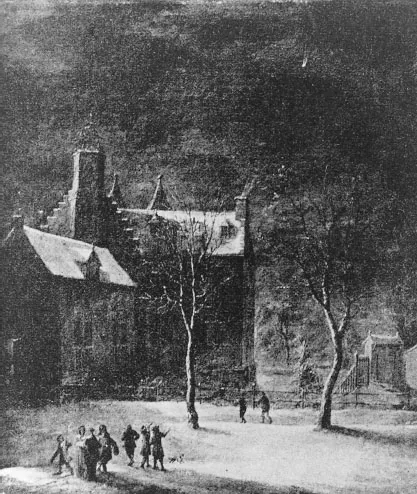
2. Halley’s comet over Cambridge, 1682
The new method of mathematics was calculus, a subject then known in England as fluxions. Calculus is the mathematics of physical activity, the mathematics of change. It probes the nature of movement by dividing it into smaller and smaller steps and then reassembling these tiny units into surprisingly elegant and simple expressions. The techniques of calculus had their origin in an attempt to explain the motion of the planets by physical laws rather than by the arbitrary actions of superhuman beings. The English proponent of calculus was Isaac Newton (1642–1727), who developed the method while he was writing his masterwork, Philosophiae Naturalis Principia Mathematica (The Mathematical Principles of Natural Philosophy), a book commonly called Principia. In Principia, Newton explained that he was attempting to analyze “the motions of the planets, the comets, the moon, and the sea,” the last term referring to the movements of the tides.1 In the central part of the book, Newton considered the motion of two objects under the influence of a single universal force, which he called gravity. The two objects might be the moon and the earth, a planet and the sun, or even a comet and some other celestial object. In these circumstances, Newton argued that gravity impels the bodies to follow certain kinds of paths: the gentle bend of the hyperbola, the tight hairpin of a parabola, and the cyclical orbit of an ellipse.
The intractable problem appeared when the calculus of Newton met the comet data of Halley. Halley called upon Newton in 1684, when Principia was nothing more than a collection of notes. He helped Newton prepare the final manuscript for publication in 1687 and promoted Newton’s ideas at the Royal Society, the central organization of seventeenth-century English science. Though he frequently thought about the problems of comets and astronomy, he let thirteen years pass after his initial observations in 1682 before he undertook a serious analysis of his data. During those intervening years, he had other problems to keep him busy. He served as clerk to the Royal Society and as the editor of its journal, Philosophical Transactions. He also studied a number of other scientific problems, such as the design of diving bells and the mathematics of finance.
In September 1695, Halley returned to his comet data and attempted to validate the statements that Newton had made about comets in Principia. Newton had speculated that comets moved in parabolas around the sun, narrow curves that started at a distant point in the universe, sped past the earth, turned sharply at the sun, and then rushed back to the void whence they came. It seemed a plausible theory, but he had never done the analysis to verify it.2 Halley spent about a month working with the measurements from four different comets, trying to identify the path that each object made through the solar system. From an individual comet, he would select three observations, each recorded on a different day. From these numbers he computed the parameters of a parabolic curve. Newton had done this sort of work with graphs, but after a little practice Halley could report, “I am now become so ready at the finding a Cometts orb by calculation.”3 Once he had calculated the parabola, he adjusted the curve by comparing it to the other observations of the comet. If he found that all of the observations were close to the parabola, he would conclude that he had found the proper path. If he discovered that some of them fell at a distance from the curve, he would attempt to adjust the parameters in order to bring the parabola closer to the observations.
The procedure worked well for the first three comets: one observed by Newton in 1664, a second that Halley had observed just before the 1682 comet, and a third that had appeared shortly after.4 Each of these objects seemed to followed a parabolic curve. When Halley began to work on the 1682 comet, the comet that he had observed from his home, he altered his methods. He chose to fit the data to a closed ellipse rather than an open-ended parabola. Halley’s biographer has noted that this idea did not come from calculation but was “based upon somewhat inspired insight.”5 Halley had noted that the 1682 comet followed a path that had been traversed by two earlier comets, one observed in 1531 by the German astronomer Peter Apian (1495–1552) and a second recorded in 1607 by Johannes Kepler. With his 1682 data, Halley computed the values for an elliptical orbit and then compared the curve to the earlier observations. Pleased with the results, he wrote to Newton, “I am more and more confirmed that we have seen that Comett now three times since ye Year 1531.”6
Though he was certain that the 1682 comet orbited the Sun, Halley recognized that his calculations did not prove his claim. His work did not address a substantial inconsistency in his data. Seventy-six years separated Apian’s observations from those of Kepler. Only seventy-five years passed between Kepler’s sighting and Halley’s data from 1682. The analysis suggested that the comet should have a fixed period, that it should return without fail every seventy-five years. Halley speculated that the discrepancy might be caused by the gravitational pull of the outer planets, forces which could easily disturb the orbit of the comet and change the date of its return. Writing to Newton, he asked, “When your more important business is over, I must entreat you to consider how far a Comet’s motion may be disturbed by the Centers of Saturn and Jupiter, particularly in its ascent from the Sun.”7
Newton responded quickly, but his reply was vague and unhelpful. “How far a comet’s motion may be disturbed,” he wrote to Halley, “cannot be affirmed without knowing the Orb of ye Comet & times of its transit through ye Orbs of [the two planets].”8 Once Saturn and Jupiter became part of the equations, the calculations were no longer straightforward and could not be handled by a single astronomer in his spare minutes and hours. The Sun, Saturn, and Jupiter form a three-body system, three objects moving through space, each exerting an influence upon the other two. Newton had been unable to find a simple expression that described the motion of such a system, even though he had been able to find solutions for two bodies in motion. In his best effort, he had devised an approximation that crudely described the movement of three bodies, but this expression was not precise enough to explain the variation in the comet’s period.9
The lack of a simple solution to the three-body problem stymied Halley’s calculations, but it did not shake his faith. He freely discussed his ideas in public and published his theory of comets in Astronomiae Cometicae Synopsis (A Synopsis of the Astronomy of Comets).10 In this book, he claimed that he could “undertake confidently to predict the return” of the comet in 1758. Some scholars noted a lack of mathematical rigor in Halley’s analysis and questioned this claim. Responding to the criticism, Halley weakened his statements, claimed that the comet might return at any time within a 600-day period that began in 1757, and replaced his confident prediction with a sentence that began, “I think, I may venture to foretell” the return of the comet.11
From time to time, Halley tried to improve his predictions for the 1758 return. He made little progress, as he was unwilling, or perhaps unable, to refine his estimates into a detailed computation. His final effort occurred in about 1720, just before he became Astronomer Royal and director of the Royal Observatory in Greenwich. For this calculation, he had a new approximate solution for the three-body problem of Saturn, Jupiter, and the Sun. From this solution, he deduced that the comet was pulled farther from the Sun after its 1682 return and hence would require more time to traverse its path. It was one more crude estimate, but it would stand as his final word on the subject. In his last revision of his Astronomiae Cometicae, which was published after his death in 1742, he announced that his comet would return “about the end of the year 1758, or the beginning of the next.”12 With this opinion on the subject, he bequeathed the comet to future generations. “Having touched upon these things,” he wrote, “I shall leave them to be discussed by the care of posterity, after the truth is found out by the event.”13
Posterity made the return of Halley’s comet a test for Newton’s theory of gravitation. Newton’s “followers have, from his principles, ventured even to predict the returns of several [comets],” wrote the Scottish philosopher Adam Smith (1723–1790), “particularly of one which is to make its appearance in 1758.” If scientists could predict the date of return, they would take the agreement between prediction and observation as evidence that Newton’s ideas on gravity were correct. If the predicted date did not coincide with the actual date, then they would conclude that other forces were at work in the universe. Smith believed that Newton’s analysis was probably correct. “His system,” he stated, “now prevails over all opposition, and has advanced to the acquisition of the most universal empire that was ever established in philosophy.” However, Smith was not willing to accept the prediction for Halley’s comet without a proper test. “We must wait for that time before we can determine, whether his philosophy corresponds as happily to [comets] as to all the [planets].”14
A thorough test of the gravitational theory required computational techniques beyond the mathematics that Halley had used for his initial analysis of the comet. Newton’s calculus would never provide a simple way to describe the motion of three or more bodies and hence would never give an accurate date for the comet’s return. The only way to determine the comet’s orbit was to substitute brawn for brain, to divide the comet’s progress into tiny steps, analyze the forces pulling on the comet, and then combine these steps into a serviceable whole through the tedious process of summation. “What immense labor,” wrote one astronomer, “what geometrical knowledge did not this task require?”15 Among the astronomers that followed Edmund Halley, few even considered undertaking the labor. Only one, a French mathematician named Alexis-Claude Clairaut (1713–1765), made a serious attempt to predict the date of the 1758 return, an attempt that required both a computational technique beyond those developed by Newton and the means of dividing the work among computing assistants.
Clairaut was described by his contemporaries as “ambitious,” “vivacious by nature,” and “successful in society.”16 He had already made a reputation as a mathematician by extending Newton’s calculus and developing a comp...
Table of contents
- Cover Page
- Title Page
- Copyright Page
- Dedication Page
- Contents
- Introduction: A Grandmother’s Secret Life
- Part I: Astronomy and the Division of Labor 1682–1880
- Part II: Mass Production and New Fields of Science 1880–1930
- Part III: Professional Computers and an Independent Discipline 1930–1964
- Epilogue: Final Passage: Halley’s Comet 1986
- Acknowledgments
- Appendix: Recurring Characters, Institutions, and Concepts
- Notes
- Research Notes and Bibliography
- Index
- Illustration Credits
Trusted by 375,005 students
Access to over 1.5 million titles for a fair monthly price.
Study more efficiently using our study tools.
Frequently asked questions
Yes, you can cancel anytime from the Subscription tab in your account settings on the Perlego website. Your subscription will stay active until the end of your current billing period. Learn how to cancel your subscription
No, books cannot be downloaded as external files, such as PDFs, for use outside of Perlego. However, you can download books within the Perlego app for offline reading on mobile or tablet. Learn how to download books offline
Perlego offers two plans: Essential and Complete
- Essential is ideal for learners and professionals who enjoy exploring a wide range of subjects. Access the Essential Library with 800,000+ trusted titles and best-sellers across business, personal growth, and the humanities. Includes unlimited reading time and Standard Read Aloud voice.
- Complete: Perfect for advanced learners and researchers needing full, unrestricted access. Unlock 1.5M+ books across hundreds of subjects, including academic and specialized titles. The Complete Plan also includes advanced features like Premium Read Aloud and Research Assistant.
We are an online textbook subscription service, where you can get access to an entire online library for less than the price of a single book per month. With over 1.5 million books across 990+ topics, we’ve got you covered! Learn about our mission
Look out for the read-aloud symbol on your next book to see if you can listen to it. The read-aloud tool reads text aloud for you, highlighting the text as it is being read. You can pause it, speed it up and slow it down. Learn more about Read Aloud
Yes! You can use the Perlego app on both iOS and Android devices to read anytime, anywhere — even offline. Perfect for commutes or when you’re on the go.
Please note we cannot support devices running on iOS 13 and Android 7 or earlier. Learn more about using the app
Please note we cannot support devices running on iOS 13 and Android 7 or earlier. Learn more about using the app
Yes, you can access When Computers Were Human by David Alan Grier in PDF and/or ePUB format, as well as other popular books in History & Computer Science General. We have over 1.5 million books available in our catalogue for you to explore.