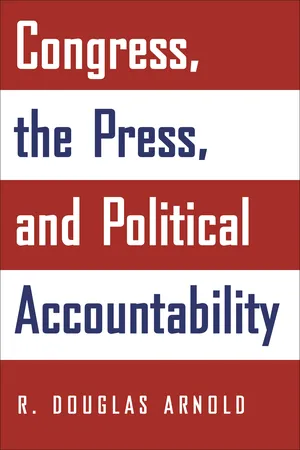
Congress, the Press, and Political Accountability is the first large-scale examination of how local media outlets cover members of the United States Congress. Douglas Arnold asks: do local newspapers provide the information citizens need in order to hold representatives accountable for their actions in office? In contrast with previous studies, which largely focused on the campaign period, he tests various hypotheses about the causes and consequences of media coverage by exploring coverage during an entire congressional session.
Using three samples of local newspapers from across the country, Arnold analyzes all coverage over a two-year period--every news story, editorial, opinion column, letter, and list. First he investigates how twenty-five newspapers covered twenty-five local representatives; and next, how competing newspapers in six cities covered their corresponding legislators. Examination of an even larger sample, sixty-seven newspapers and 187 representatives, shows why some newspapers cover legislators more thoroughly than do other papers. Arnold then links the coverage data with a large public opinion survey to show that the volume of coverage affects citizens' awareness of representatives and challengers.
The results show enormous variation in coverage. Some newspapers cover legislators frequently, thoroughly, and accessibly. Others--some of them famous for their national coverage--largely ignore local representatives. The analysis also confirms that only those incumbents or challengers in the most competitive races, and those who command huge sums of money, receive extensive coverage.
- 288 pages
- English
- ePUB (mobile friendly)
- Available on iOS & Android
eBook - ePub
Congress, the Press, and Political Accountability
About this book
Information
Publisher
Princeton University PressYear
2013Print ISBN
9780691126074
9780691117102
eBook ISBN
9781400849581
1
Legislators, Journalists, and Citizens
THE MASS MEDIA perform a vital function in democratic systems by reporting what elected officials are doing in office. The media convey not only factual accounts of officials’ activities and decisions; they also transmit evaluations of officials’ performance, including assessments by other politicians, interest group leaders, pundits, and ordinary citizens. Although the media are not the only source of information about officials’ performance, they are by far the most important. Indeed, it is difficult to imagine how large-scale democracy would be possible without a free and independent press to report the actions of governmental officials. Robert Dahl, the democratic theorist, argues that the existence of alternative and independent sources of information is one of seven necessary conditions for the existence of democratic government.1
Information about elected officials’ performance serves two important purposes. First, it allows citizens to evaluate the desirability of retaining or replacing officials when they run for reelection. Candidates promise all sorts of things when they first run for office. When they run for reelection, however, there is no better guide to their future performance than what they have already done. Second, a regular flow of information about governmental decision making helps keep officials on their toes when they first make decisions. Officials who expect their actions to be featured on the evening news and on the front pages of newspapers may make decisions different from officials who expect their decisions to remain forever hidden from public scrutiny.
How extensively and how effectively do media outlets in the United States cover elected officials? Do they report the kinds of information that citizens need to hold officials accountable for their actions in office? Or is coverage so spotty and incomplete that even the most diligent citizens cannot learn much about who is responsible for governmental decisions? These important questions are central to the performance of democratic government. Unfortunately, they are not questions to which we know the answers.
Most citizens are exposed to a regular diet of information about what the president is doing in office. The mass media cover presidential activities on an almost daily basis, reporting where the president travels, what he says, what he proposes, how his proposals fare in Congress, what he is doing about various crises, and what innumerable pundits, legislators, politicians, and foreign officials think of his performance in office. Although one can surely raise questions about the adequacy and fairness of the media’s coverage of presidential activities and about the depth of citizens’ knowledge of presidential performance, two things seem clear. First, presidents know that their deeds and misdeeds will be covered by the press and noticed by the public, so they work hard to produce pleasing records. Second, when pollsters come knocking at their doors, it is reasonable to believe that most citizens have some evidentiary basis for determining whether they “approve or disapprove of the way the president is handling his job as president.”
Can one make similar arguments about the way journalists cover members of Congress? Do legislators expect that their individual activities and decisions in Washington will be covered by the press and reported to their constituents? Are citizens exposed to regular information about what their senators or representatives are doing in office? Do citizens have any evidentiary basis for determining whether they approve or disapprove of the way their representatives are performing in office? Here the issues become more complicated, in part because there are 535 legislators to cover. Journalists do not cover all senators and representatives equally well. Citizens in different states and different districts are not exposed to identical flows of information.
Media Outlets
The so-called national press—the networks, newsmagazines, and national newspapers—could not possibly cover the individual activities of every senator and representative. The national press can cover Congress as an institution and report what it is doing about a whole range of problems. It can focus on some colorful or consequential legislators, making Ted Kennedy and Newt Gingrich into household names. The national press could not possibly make 535 legislators into household names. It has neither the time nor the space for such intensive coverage. The typical representative does not appear even once a year in Newsweek, USA Today, or on the CBS evening news.2
Local media outlets are better suited to cover individual members of Congress than the national media. Newspapers, television stations, and radio outlets serve geographically defined media markets, and most of these market areas are represented in Congress by only a few legislators. Even local media outlets, however, have constraints on their coverage. The congruence between congressional districts and media markets is far from perfect. A television station in New York City, which has thirty-five representatives within its broadcast area, has no more time in its broadcast day than a television station in Portland Maine, where the broadcast area is essentially congruent with a single congressional district.3 A small weekly newspaper has to decide whether to devote its meager resources to covering the politics of the several towns it serves or the activities of its representative in Washington. Each media outlet decides what kinds of news it wants to present. No law compels them to cover what representatives are doing in office.
Although local media outlets are better suited to covering individual representatives than are the national media, they are much more difficult to study. The difficulty involves both numbers and access. Four national networks, three newsmagazines, and a handful of major newspapers have been the focus of most previous studies of politics and the press. Once early studies established that coverage patterns were similar among national media outlets, subsequent studies often focused on a single network, newsmagazine, and newspaper. In contrast, 23,000 local media outlets blanket the country in a hodgepodge of overlapping territories.4 No one knows anything about the similarity of coverage patterns across these thousands of outlets, so one cannot discover much about the universe of outlets by studying only a handful. Studying local outlets requires sampling, but how should one draw a sample that is representative of what citizens see, hear, and read?
The problem of access is even more serious. A research center at Vanderbilt University has recorded and archived network television newscasts since 1968. No one has recorded and archived local television newscasts. Radio newscasts are similarly unavailable. Although most research libraries contain archives of newsmagazines and major newspapers, most local newspapers are found only in the communities where they are published. Given the problems of sampling and access, it is not surprising that few scholars have attempted to study how local media outlets cover members of Congress.
This book is the first large-scale study of how local media outlets cover members of Congress. The focus is on local newspapers because it is for them that I have solved the twin problems of sampling and access. No cost-effective solution is in sight for studying local radio or television newscasts.5 Unlike previous studies, which largely focused on the campaign period, this book explores how local newspapers covered representatives during an entire congressional session, from the first day of 1993 to election day 1994. The longer period is essential for studying political accountability.
Even if it were not the case that studying local newspapers is easier than studying local television, good reasons exist for beginning with newspapers. First, local newspapers have much larger newsholes than do local television stations. Local newscasts are usually fixed at thirty or sixty minutes, so after deducting for weather, sports, and advertisements, the time available for news is quite limited. Newspapers, by comparison, can cover many more subjects and in much greater detail. Second, the constraints in large metropolitan areas, where there are dozens of representatives to cover, are particularly severe for television, whereas large metropolitan newspapers can use regional editions and regional sections to cover representatives. The news hour is fixed; the newspaper is expandable. Third, in many localities, newspapers set the local news agenda and broadcast journalists follow their lead. Jeffrey Mondak found this to be especially true for House campaigns.6 Finally, two studies of how local media outlets cover Congress found much less coverage on local television stations than in local newspapers (Hess 1991; Vinson 2003).7
A full understanding of how the mass media cover representatives requires examination of all types of media—radio, television, cable, daily newspapers, weekly newspapers, and the Web. The arguments for beginning with local newspapers are two. First, local newspapers appear to cover local representatives more intensively than do other media outlets. Beginning with local newspapers allows one to establish a baseline for comparing other types of coverage. Second, the problems of sampling and access are more easily solved for newspapers, thus allowing for much larger sample sizes. It is worth emphasizing, however, that this study is essentially measuring the high-water mark for media coverage of representatives. When local newspapers fail to cover some aspect of a legislator’s behavior, it is unlikely that local radio and television outlets are somehow filling the void.
Accountability
The American system does not make it easy for citizens to hold elected officials accountable for governmental decisions. Holding officials accountable is easiest when power is concentrated on a single individual or party team. In a parliamentary system, for example, where two parties compete in regular elections and where the winning party gains complete control over policy making until the next election, citizens need not monitor who is doing what within government. With the executive and legislative functions united, it is reasonable for citizens to assume the in-party is responsible for everything that government does. If citizens don’t like what government has been doing, they can throw the rascals out. The incentives for the in-party to produce pleasing outcomes are especially strong when power is concentrated. The rewards are for action and results, not words and excuses.
The American system is one of dispersed power and scattered responsibility. Federalism, separation of powers, and bicameralism make it difficult for citizens to know who is responsible for improving or deteriorating conditions, and therefore whom they should reward or punish. If candidates ran for office and governed as members of strong party teams, citizens could reward and punish the team that controlled the legislative and executive branches, just as they do in parliamentary systems. But candidates run more as individuals than as members of strong party teams, citizens often split their votes among the parties’ candidates in separate House, Senate, and presidential elections, and parties do not govern as unified teams. Although the norm was once for a single party to control the House, Senate, and White House, the norm now is for divided control of these three institutions. With weak parties and divided party control, citizens need to know more about what particular officials have been doing if they are to reward and punish the right officials. They need to know who the rascals are before they can throw them out.
A system of dispersed power and scattered responsibility also affects the incentives of elected officials. Whereas members of strong party teams work for the good of the team, often giving up individual glory for team success, elected officials in the American system have a stronger interest in individual glory. Achieving any kind of coordinated action among officials so motivated is difficult. Officials also have strong incentives to blame others for inaction. A president lashes out against a do-nothing Congress; senators complain about the lack of presidential leadership; House members blame a senatorial filibuster. Every participant has a favorite explanation for legislative gridlock.
If citizens are to hold legislators accountable, they need information about what their representatives are doing in office. Where might they find appropriate information? One thing is certain: Most citizens do not have an incentive to search diligently for information about representatives’ actions in office. Anthony Downs made the case long ago that information is costly and that few citizens choose to incur substantial costs to become informed voters. Most citizens rely on whatever information comes their way in the course of daily life (Downs 1957, 207–37). Fortunately, many individuals and groups have incentives to inform citizens about representatives’ actions in office. They willingly bear the costs so that citizens receive information with little effort. Citizens have at least four sources for information.
Incumbent representatives have the strongest incentives for informing constituents about their legislative activities. If they can shape citizens’ views of their accomplishments, they gain an electoral advantage. To that end, they regularly visit their constituencies, speak before labor, business, and civic groups, and attend gatherings of every type. They use their free mailing privileges to shower constituents with newsletters and to target individuals with special mailings. They issue press releases to highlight their positions and accomplishments; they court local reporters and editors. Representatives are assisted in these tasks by press secretaries, legislative correspondents, and caseworkers, some residing in Washington, some in district offices.
Politicians who seek to remove representatives from office are another source for information about representatives’ actions in office. Quite naturally, these politicians emphasize different aspects of legislators’ records. They may publicize unpopular roll-call votes, complain about the lack of any real accomplishments, or place a different spin on activities that legislators consider to be accomplishments. These politicians include active challengers in primary and general election campaigns, individuals who are considering challenging incumbents, and leaders of the opposite party.
Individuals and groups who care intensely about specific policy problems are a third source for information about representatives’ actions in office. Interest group leaders usually monitor what representatives are doing to help or hurt their members’ interests and inform either group members or citizens more generally when they observe unfriendly actions. Individual citizens who are very interested in particular problems, policies, or programs—hereafter referred to as opinion leaders—often do the same thing. For example, much of the monitoring of what representatives say and do about abortion is performed by local opinion leaders who care intensely about this issue.
Local newspapers play several roles in conveying information to citizens about what representatives are doing. First, journalists are independent monitors of governmental decision making who actively seek and report information about what elected officials are doing in office. Most journalists consi...
Table of contents
- Cover Page
- Title Page
- Copyright Page
- Dedication
- Contents
- List of Tables and Figures
- Acknowledgments
- 1. Legislators, Journalists, and Citizens
- 2. Explaining the Volume of Newspaper Coverage
- 3. How Newspapers Cover Legislators
- 4. Legislators as Position Takers
- 5. Legislators as Policy Makers
- 6. Legislators as Candidates
- 7. How Newspapers Differ
- 8. Effects of Newspaper Coverage on Citizens
- 9. The Press and Political Accountability
- References
- Index
Trusted by 375,005 students
Access to over 1.5 million titles for a fair monthly price.
Study more efficiently using our study tools.
Frequently asked questions
Yes, you can cancel anytime from the Subscription tab in your account settings on the Perlego website. Your subscription will stay active until the end of your current billing period. Learn how to cancel your subscription
No, books cannot be downloaded as external files, such as PDFs, for use outside of Perlego. However, you can download books within the Perlego app for offline reading on mobile or tablet. Learn how to download books offline
Perlego offers two plans: Essential and Complete
- Essential is ideal for learners and professionals who enjoy exploring a wide range of subjects. Access the Essential Library with 800,000+ trusted titles and best-sellers across business, personal growth, and the humanities. Includes unlimited reading time and Standard Read Aloud voice.
- Complete: Perfect for advanced learners and researchers needing full, unrestricted access. Unlock 1.5M+ books across hundreds of subjects, including academic and specialized titles. The Complete Plan also includes advanced features like Premium Read Aloud and Research Assistant.
We are an online textbook subscription service, where you can get access to an entire online library for less than the price of a single book per month. With over 1.5 million books across 990+ topics, we’ve got you covered! Learn about our mission
Look out for the read-aloud symbol on your next book to see if you can listen to it. The read-aloud tool reads text aloud for you, highlighting the text as it is being read. You can pause it, speed it up and slow it down. Learn more about Read Aloud
Yes! You can use the Perlego app on both iOS and Android devices to read anytime, anywhere — even offline. Perfect for commutes or when you’re on the go.
Please note we cannot support devices running on iOS 13 and Android 7 or earlier. Learn more about using the app
Please note we cannot support devices running on iOS 13 and Android 7 or earlier. Learn more about using the app
Yes, you can access Congress, the Press, and Political Accountability by R. Douglas Arnold in PDF and/or ePUB format, as well as other popular books in Politics & International Relations & Journalism. We have over 1.5 million books available in our catalogue for you to explore.