In politics, ideas matter. They provide the foundation for economic policymaking, which in turn shapes what is possible in domestic and international politics. Yet until now, little attention has been paid to how these ideas are produced and disseminated, and how this process varies between countries. The National Origins of Policy Ideas provides the first comparative analysis of how "knowledge regimes"—communities of policy research organizations like think tanks, political party foundations, ad hoc commissions, and state research offices, and the institutions that govern them—generate ideas and communicate them to policymakers.
John Campbell and Ove Pedersen examine how knowledge regimes are organized, operate, and have changed over the last thirty years in the United States, France, Germany, and Denmark. They show how there are persistent national differences in how policy ideas are produced. Some countries do so in contentious, politically partisan ways, while others are cooperative and consensus oriented. They find that while knowledge regimes have adopted some common practices since the 1970s, tendencies toward convergence have been limited and outcomes have been heavily shaped by national contexts.
Drawing on extensive interviews with top officials at leading policy research organizations, this book demonstrates why knowledge regimes are as important to capitalism as the state and the firm, and sheds new light on debates about the effects of globalization, the rise of neoliberalism, and the orientation of comparative political economy in political science and sociology.
eBook - ePub
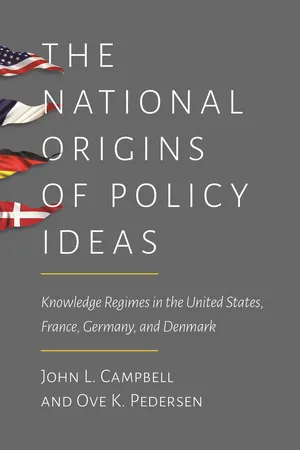
The National Origins of Policy Ideas
Knowledge Regimes in the United States, France, Germany, and Denmark
- 424 pages
- English
- ePUB (mobile friendly)
- Available on iOS & Android
eBook - ePub
The National Origins of Policy Ideas
Knowledge Regimes in the United States, France, Germany, and Denmark
About this book
Information
Publisher
Princeton University PressYear
2014Print ISBN
9780691161167
9780691150314
eBook ISBN
9781400850365
Subtopic
Storia franceseCHAPTER
1
Knowledge Regimes and the National Origins of Policy Ideas
Two conservative congressional staff members in Washington, D.C., Ed Feulner and Paul Weyrich, were frustrated in 1971 by the lack of timely policy-relevant research on Capitol Hill. Their frustration peaked when an impressive and potentially influential briefing paper about the supersonic transport prepared by a prominent conservative think tank arrived a day after Congress voted on the issue—too late to influence the vote. Frustration led to action. In 1973, with the help of wealthy benefactors like the beer tycoon Joseph Coors, they established the Heritage Foundation, an aggressive policy research organization dedicated to quickly producing and disseminating conservative policy analysis to members of Congress so that conservative ideas would have greater influence on policymaking. It worked. Notably, in 1980 the Heritage Foundation provided Edwin Meese, the head of Ronald Reagan’s transition team, a hefty volume called Mandate for Leadership, a conservative blueprint for transforming all aspects of public policy and intended as a guide for the incoming administration. It was a best seller in Washington for weeks and reputedly guided the administration’s initial budget cutting efforts at a time when conservatives believed that excessive government spending was causing inflation and economic malaise in America. The Heritage Foundation’s reputation soared, marking the beginning of a seismic change in how policy research organizations operated in Washington.1
Since then and thanks to challenges associated with the rise of globalization and the transformation of advanced capitalism, policy research organizations in the United States and Europe have undergone major changes as people have tried to use policy analysis and other ideas to more effectively influence policymaking and solve national economic problems. But they have done so in nationally specific ways. This book explains these changes as they unfolded in the United States, France, Germany, and Denmark. In doing so it answers several pressing yet much neglected questions: Where do the ideas come from over which policymakers fight and that affect policymaking and public debates? How has this changed with the onset of globalization? And, most important, how has all of this varied across different types of advanced capitalist countries? In short, this book is about the national origins of policy ideas. Its arguments bear directly on critical debates about the nature of globalization, the rise of neoliberalism, the orientation of comparative political economy, and fundamental theories of organizational and economic sociology.
Researchers in the social sciences have long debated whether policy analysis, economic theories, and other sorts of ideas as well as self-interests affect policymaking in advanced capitalist countries. Many now agree that ideas matter a lot. Peter Hall, for instance, showed that big intellectual policy paradigms like Keynesianism and then neoliberalism shaped economic policy after the Second World War. Mark Blyth revealed how policymakers used ideas as weapons in their political struggles to reform taxation and government spending. Frank Dobbin argued that deep-seated values regarding the appropriate relationship between the state and economy influenced the development of national transportation policies. And others, particularly Vivien Schmidt, explained that cognitive and discursive structures helped frame policy debates in different ways in different countries.2
We accept that ideas matter for politics. Our concern, however, is that those who have shown that ideas are important have paid remarkably little attention to how these ideas are produced and disseminated in the first place and how this varies across countries and over time. So this book is not about how ideas matter or why policymakers choose one idea over another. It is about the organizational and institutional machinery by which these ideas are produced in different ways in different countries. This is especially important because variation in this machinery helps explain how policy ideas themselves differ across time and place. To our knowledge this is the first study of its kind.
The book focuses on how policy research organizations like think tanks, government research units, political party foundations, and others that produce and disseminate policy ideas are organized, operate, and have changed during the past 30 years or so in our four advanced capitalist countries. In each country these organizations constitute what sociologists call an organizational field—a community of organizations whose participants engage in similar activities and interact more frequently with one another than with organizations outside the field.3 We call fields of policy research organizations and the institutions that govern them knowledge regimes. Knowledge regimes are the organizational and institutional machinery that generates data, research, policy recommendations, and other ideas that influence public debate and policymaking.
Policymakers need the information produced by knowledge regimes insofar as the policy problems they confront often involve ambiguity and uncertainty. They need it to make sense of these problems. Sense making is often a contested process involving varying degrees of competition, negotiation, and compromise—often involving power struggles—over the interpretation of problems and solutions for them. A knowledge regime, then, is a sense-making apparatus.4 Just as sense making occurs in different ways in organizations depending on how they are organized individually, it also occurs in different ways in knowledge regimes depending on how they are organized as a field. Sense making is especially important and difficult for policymaking during periods of crisis when ambiguity and uncertainty are extreme because problems are unfamiliar and conventional policy prescriptions no longer work. During periods of crisis sense making can take a long time and may involve changing the sense-making apparatus itself.5 This is just what happened in nationally specific ways in our four knowledge regimes beginning in the late 1970s and early 1980s.
Analytic Arguments
Our overarching argument is that policy ideas have national origins and the way they are produced is largely determined by nationally specific institutions. In substantiating this claim, however, we offer four additional analytic arguments. The first three provide new insights into previous research on globalization and the rise of neoliberal ideas, comparative political economy, and organizational convergence. As we are about to explain, we identify and begin to fill important gaps in these three overlapping research literatures and challenge some of their key claims. The fourth analytic argument constitutes our causal model of the national construction of knowledge regimes. Our interest in these things stems from our long-standing curiosity about institutions and institutional change.6
The End of the Golden Age and the Rise of Globalization and Neoliberalism
Sense making and knowledge regimes became especially important in advanced capitalist countries during the era of economic globalization whose onset was marked by the end of the Golden Age of postwar capitalism—a period of strong economic growth, welfare state development, and general prosperity enjoyed by many advanced capitalist countries during the first three decades after the Second World War.7 The end of the Golden Age was accompanied by the onset of a stagflation crisis where economic stagnation and inflation increased simultaneously during the 1970s and 1980s. We will have more to say about this later in the chapter. But for now what is important is that stagflation discredited conventional Keynesian policy ideas in many advanced capitalist countries and triggered what some have called a “war of ideas” in North America and Europe in which political opponents used theories, data, ideology, and rhetoric as weapons in the fight over economic policy.8 These ideas varied widely from left to right across the political spectrum and across countries and were all attempts to make sense of this unprecedented situation.9 Among them, neoliberalism—the call for less public spending, lower taxes, especially on business and the wealthy, and less state intervention into the economy—figured prominently. And once ideas like these were adopted they had far-reaching consequences for how successfully economies performed.10
Much attention has been paid to globalization and the end of the Golden Age and how it transformed the advanced capitalist countries after the 1970s thanks to pressures associated with increased international capital mobility, new telecommunications technologies, the emergence of free-trade zones like the European Union, and more. New forms of economic organization resulted, such as the emergence of global outsourcing, international commodity chains, and network-like corporate structures.11 New economic and social policies appeared too, including sometimes the scaling back of welfare states and tax burdens.12 What is missing in this literature, however, is attention to the rise of knowledge regimes as a means of searching for new ideas about how to make sense of and cope with globalization and its challenges. For instance, David Held and colleagues’ well-known Global Transformations offered an impressive analysis of how globalization caused a variety of political, economic, and cultural changes around the world. But they provided little discussion—or even recognition—of where the ideas came from with which people tried to make sense of these changes.13
Following Max Weber, who argued that ideas are an important starting point for the development of capitalism, we argue that knowledge regimes became more important for advanced capitalist countries as policymakers and others grappled with the challenges of globalization.14 Put differently, this is an age when policymakers strive to recognize and improve their country’s institutional competitive strengths and rely increasingly on the production of policy-relevant knowledge to do so.15 This is why overlooking the significance and transformation of knowledge regimes is a serious omission in the research on globalization and the end of the Golden Age. By correcting this we illuminate a previously unexplored dimension of the breakdown in consensus on economic management that followed the end of the Bretton Woods system in the 1970s and the demise of the Golden Age.
But the manner in which knowledge regimes help policymakers make sense of and deal with the challenges of globalization varies across countries. This is important for understanding the international diffusion of neoliberalism. Several scholars have argued that neoliberal ideas diffused internationally since the end of the Golden Age as globalization began to occur. In particular, researchers have claimed that this resulted in tendencies toward international convergence on a common set of political and economic outcomes, such as certain forms of market reregulation and welfare retrenchment.16 As Frank Dobbin and his colleagues remarked with reference to the globalization literature, “The power of global models is increasingly taken for granted even in studies focusing on domestic economic and political conditions.”17 We offer two arguments in this regard. First, we challenge albeit cautiously that neoliberalism is as taken for granted today as many believe. We show that the adoption of neoliberalism at least by national councils of economic advisors was highly uneven across our four countries and in one case was largely rejected. Second, although some researchers have also noted this sort of unevenness they attributed it to the fact that neoliberal ideas were translated (or not) into local practice by way of political and economic institutions already in place. In other words, national political-economic factors mediated the degree to which neoliberalism was adopted from one country to the next. We argue, however, that the structure and practices of knowledge regimes—not just political and economic institutions—also had important mediating effects. This is because knowledge regimes are where neoliberal ideas were often formulated and debated, and because the nationally specific organization of knowledge regimes affected how these and other ideas were crafted in the first place. This leads to our second argument—one that bears directly on literature in comparative political economy and the issue of national diversity.
Comparative Political Economy
Knowledge regimes are just as important for modern political economies as policymaking and production regimes at least insofar as knowledge regimes produce the ideas that inform what political and economic elites do. However, policymaking and production regimes have received the lion’s share of attention from comparative political economists. Much of their work dwells on how policymaking and production regimes respond to globalization in nationally specific ways. This work emerged in two waves. The first was about policymaking regimes, which were scrutinized closely in the 1980s and 1990s by social scientists like Peter Evans, Dietrich Rueschemeyer, and Theda Skocpol, whose volume Bringing the State Back In set the tone for much of this research.18 Policymaking regimes involve the organization and governance of states, political parties, and other political institutions. They vary across countries in many ways. For instance, policymaking is more centralized bureaucratically in some policymaking regimes than others. Elections are based on winner-take-all rules in some policymaking regimes but proportional represe...
Table of contents
- Cover Page
- Title Page
- Copyright Page
- Dedication Page
- Contents
- List of Tables and Figures
- List of Acronyms
- Preface
- Chapter 1: Knowledge Regimes and the National Origins of Policy Ideas
- Part I: The Political Economy of Knowledge Regimes
- Part II: Issues of Similarity and Impact
- Part III: Conclusions
- Appendix: Research Design and Methods
- References
- Index
Trusted by 375,005 students
Access to over 1.5 million titles for a fair monthly price.
Study more efficiently using our study tools.
Frequently asked questions
Yes, you can cancel anytime from the Subscription tab in your account settings on the Perlego website. Your subscription will stay active until the end of your current billing period. Learn how to cancel your subscription
No, books cannot be downloaded as external files, such as PDFs, for use outside of Perlego. However, you can download books within the Perlego app for offline reading on mobile or tablet. Learn how to download books offline
Perlego offers two plans: Essential and Complete
- Essential is ideal for learners and professionals who enjoy exploring a wide range of subjects. Access the Essential Library with 800,000+ trusted titles and best-sellers across business, personal growth, and the humanities. Includes unlimited reading time and Standard Read Aloud voice.
- Complete: Perfect for advanced learners and researchers needing full, unrestricted access. Unlock 1.5M+ books across hundreds of subjects, including academic and specialized titles. The Complete Plan also includes advanced features like Premium Read Aloud and Research Assistant.
We are an online textbook subscription service, where you can get access to an entire online library for less than the price of a single book per month. With over 1.5 million books across 990+ topics, we’ve got you covered! Learn about our mission
Look out for the read-aloud symbol on your next book to see if you can listen to it. The read-aloud tool reads text aloud for you, highlighting the text as it is being read. You can pause it, speed it up and slow it down. Learn more about Read Aloud
Yes! You can use the Perlego app on both iOS and Android devices to read anytime, anywhere — even offline. Perfect for commutes or when you’re on the go.
Please note we cannot support devices running on iOS 13 and Android 7 or earlier. Learn more about using the app
Please note we cannot support devices running on iOS 13 and Android 7 or earlier. Learn more about using the app
Yes, you can access The National Origins of Policy Ideas by John L. Campbell,Ove K. Pedersen in PDF and/or ePUB format, as well as other popular books in Politica e relazioni internazionali & Storia francese. We have over 1.5 million books available in our catalogue for you to explore.