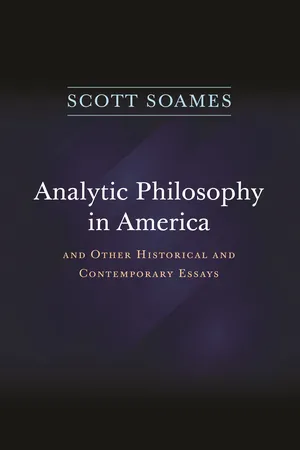
In this collection of recent and unpublished essays, leading analytic philosopher Scott Soames traces milestones in his field from its beginnings in Britain and Germany in the late nineteenth and early twentieth century, through its subsequent growth in the United States, up to its present as the world's most vigorous philosophical tradition. The central essay chronicles how analytic philosophy developed in the United States out of American pragmatism, the impact of European visitors and immigrants, the midcentury transformation of the Harvard philosophy department, and the rapid spread of the analytic approach that followed. Another essay explains the methodology guiding analytic philosophy, from the logicism of Frege and Russell through Wittgenstein's linguistic turn and Carnap's vision of replacing metaphysics with philosophy of science. Further essays review advances in logic and the philosophy of mathematics that laid the foundation for a rigorous, scientific study of language, meaning, and information. Other essays discuss W.V.O. Quine, David K. Lewis, Saul Kripke, the Frege-Russell analysis of quantification, Russell's attempt to eliminate sets with his "no class theory," and the Quine-Carnap dispute over meaning and ontology. The collection then turns to topics at the frontier of philosophy of language. The final essays, combining philosophy of language and law, advance a sophisticated originalist theory of interpretation and apply it to U.S. constitutional rulings about due process.
- 376 pages
- English
- ePUB (mobile friendly)
- Available on iOS & Android
eBook - ePub
About this book
Information
Publisher
Princeton University PressYear
2014Print ISBN
9780691176406
9780691160726
eBook ISBN
9781400850464
Topic
PhilosophySubtopic
Analytic PhilosophyPART ONE
Milestones
1
Analytic Philosophy in America
The leading preanalytic philosopher in America, and one of its giants of all time, was Charles Sanders Peirce (1839–1914). Having received a scientific education (including a Harvard BS in chemistry in 1863), he lectured on logic and philosophy of science at Harvard (1864–65, 1869–71) and Johns Hopkins (1879–84), after which he moved to Milford, Pennsylvania, where he continued to write prodigiously. His greatest contributions were in logic, including a syntax for quantification theory (1870) and (1883), and a truth-functionally complete system based on what later came to be called “the Sheffer stroke.” Though his contributions were, in many respects, parallel to those of Gottlob Frege, the two logicians worked independently, with the writing of Frege, through its influence on Bertrand Russell, becoming the more widely known. Still, Alfred North Whitehead was an admirer whose knowledge of quantification theory was said to have come substantially from Peirce, while Hilary Putnam (1982) observed that much that is “quite familiar in modern logic actually became known to the logical world through the efforts of Peirce and his students.” In 1985, W.V.O. Quine identified Peirce as sharing credit with Frege for the development of modern quantification theory, and cited his influence on Ernst Schröder and Giuseppe Peano.
Outside of logic, Peirce’s philosophy of pragmatism—or, as he called it, “pragmaticism”—was widely admired. In epistemology, he was an antifoundationalist, resisting the idea of a privileged starting point of maximally certain statements (e.g., of private sensation) and adopting, as a guiding hypothesis, the idea that the application of scientific method to intersubjectively verifiable claims would, through a process of self-correction, lead different investigators to converge on a common result, no matter what their starting points. While not definitively identifying truth with that which would be confirmed in the limit of ideal (scientific) inquiry, Peirce did think that the practical consequences of true beliefs provided grounds for expecting them to be confirmed by continuing investigation. Correspondingly, he took the meaning of a theoretical claim to be its experiential “cash value”—the collection of possible empirical observations that would verify it. He had little patience with metaphysical speculation about “things in themselves” underlying observed phenomena, or grand metaphysical systems. In all these ways, Peirce exerted a strong influence on those who would follow. Peircean reverence for logic, respect for science, suspicion of apriori metaphysics, and emphasis on the practical consequences of theoretical differences found fertile soil and took root in America, creating a hospitable environment for the later growth, and distinctive shape, of analytic philosophy there.
The other great American pragmatist was William James (1842–1910). Like Peirce, James had a scientific education in chemistry, anatomy, and medicine at Harvard, where he received an MD in 1869. He taught physiology in 1872, and in 1875 he set up the first laboratory for experimental psychology in America. Between 1885 and 1907 he was professor of psychology and philosophy at Harvard, during which period he gave The Varieties of Religious Experience (1902) as the Gifford Lectures at Edinburgh, and published Pragmatism in 1907. Though influenced by Peirce, James’s outlook was less scientific, and his audience broader. Whereas for Peirce truth and meaning rested on the intellectual foundation of possible observation, for James they rested on what it is beneficial to believe. To the extent that religious beliefs help us live better lives, they pass the Jamesian pragmatic test for truth, just as scientific beliefs do.
Third in the trio of preanalytic pragmatists was John Dewey (1859–1952), who earned his PhD in philosophy from Johns Hopkins in 1884, where he encountered Peirce. Between 1884 and 1930, Dewey taught at the Universities of Michigan, Minnesota, Chicago, and (for the last twenty-four years) at Columbia. Like Peirce, he was an antifoundationalist and believer in the self-correcting nature of empirical investigation in a community of inquirers. Like Quine, who was to follow, he held that there are no absolute first principles that are either known with certainty or beyond rational revision in light of new experience. Truth, for Dewey, was warranted assertability. Though less influential than Peirce in the later development of analytic philosophy, Dewey’s views on education, and other social issues, had a large and controversial impact.
Along with pragmatism, realism and naturalism characterized much American philosophy between Peirce and Quine. Peirce wrote in 1896, “Nothing can be more completely false than that we can experience only our own ideas. That is indeed without exaggeration the very epitome of all falsity” (Peirce, CP 6.95). The independence of the perceived from the perceiver, and the known from the knower, was emphasized in The New Realism (1912) by philosophers such as Edwin Bissell Holt and Ralph Barton Perry. As John Passmore (1957) noted, their conception of perception was similar to that given in George Edward Moore’s “The Refutation of Idealism” (1903), while their rejection of “internal relations” paralleled a similar rejection, central to the rebellion of Moore and Russell against absolute idealism. (The importance of the rejection for New Realists was in their observation that when a knows b, the relational properties of knowing b, and of being known by a, are not essential to a and b, respectively.) By 1920, another brand of realism, Critical Realism, was on the scene. Advocated by Arthur Oncken Lovejoy, George Santayana, and Roy Wood Sellars, among others, it struggled to reconcile the objective physical world, revealed in perception, with an irreducible Kantian residue added by the perceiver to the content of experience. Although disputes between these varieties of realism have now lost much of their force, it is striking how congenial the broad themes of naturalism, respect for science and common sense, and suspicion of idealism and other apriori speculation were to the growth of analytic philosophy in America.
THE TRANSITION TO ANALYTIC PHILOSOPHY
The American transition to analytic philosophy was mediated by several pivotal figures, institutions, and events. One such figure was Morris Cohen (1880–1947). Born in Russia, educated at City College of New York, with a 1906 Harvard PhD, he taught at City from 1912 to 1938, and at the University of Chicago from 1938 to 1941. Known for his interest in logic and the philosophy of science, he was a committed naturalist who recognized no nonscientific methods capable of attaining knowledge in philosophy. One of his students was the Czechoslovakian born Ernest Nagel (1901–85), who, after earning his BA at City, got his PhD in 1931 (under Dewey) from Columbia, where (with the exception of a year at Rockefeller University in the 1960s) he spent his career teaching and writing about the philosophy of science, and explaining the centrality of logic to philosophy. His little book, Gödel’s Proof (1958) coauthored with James R. Newman, introduced the incompleteness theorems to many students, while his main work, The Structure of Science (1961), summed up the results of decades of teaching and research on the nature of explanation, and the logical structure of scientific knowledge.
Of all the transitional figures, the greatest was C. I. Lewis (1883–1964). While earning his BA (1905) and PhD (1910) from Harvard he worked with, and was influenced by, William James, Josiah Royce, and Ralph Barton Perry. After teaching at Berkeley for nine years, he returned to take a position at Harvard in 1920, from which he retired thirty-three years later, having taught many who would become leading analytic figures—including Quine, Roderick Chisholm, Roderick Firth, William Frankena, Nelson Goodman, and Norman Malcolm. He finished his career at Stanford University in 1960. An eclectic thinker and system-builder, Lewis combined an element of perceptual realism, filtered through Perry; a Kantian element, filtered through Josiah Royce; and a pragmatic element, filtered through Peirce (whose work he encountered when given the job of cataloging the latter’s vast unpublished writings). Like Perry, Lewis believed that perception and knowledge require an independent reality given in experience. Like Royce he was convinced that experience is the result of structuring and interpreting the given in terms of “apriori” concepts added by the mind. Like Peirce, Lewis held that (i) our concepts—even the “apriori” ones—are not fixed by the nature of the mind but are revisable in light of experience, and (ii) the meanings of concepts, thoughts, and experience lie in their pragmatic success in anticipating and predicting new experience and grounding successful action. These ideas were worked out in his two major works, Mind and the World Order (1929) and An Analysis of Knowledge and Valuation (1946), which were among the most widely read of their day—the former being the subject of a memorable seminar at Oxford led by J. L. Austin and Isaiah Berlin in the 1936–37 academic year.
Lewis’s relation to the logical positivists was ambiguous. He shared their scientific naturalism, their emphasis on logical analysis, and their view of testable consequences as the basis of empirical significance, but he vigorously opposed their noncognitivism about value, their physicalism, and their embrace of “the linguistic turn.” For him, the primary bearers of meaning and truth were mental: thoughts, concepts, and experiences. Of most importance for analytic philosophy was his pioneering work in modal logic, included in his widely read Symbolic Logic (1932), coauthored with Cooper Harold Langford. Lewis’s main contribution was in formulating a series of increasingly strong axiomatic systems (the S-systems) of the modal propositional calculus (with operators for necessity and possibility)—which provided the basis for (i) later axiomatic extensions to the predicate calculus by Ruth Marcus (1946) and Rudolf Carnap (1946), (ii) the fledgling semantic treatment in Carnap (1947), and (iii) the revealing model-theoretic interpretations of the S-systems in Saul Kripke (1959) and (1963). For Lewis, the philosophical moral drawn from the competing axiomatic systems was that logical first principles are not decidable apriori but must be judged by their pragmatic success—a conclusion that, no matter what its ultimate merits, was premature in light of later work. Finally, the distinction in Lewis (1946) between the different “modes of meaning of a term”—(i) its extension, consisting of things to which it refers or applies; (ii) its “comprehension” (now called its “intension”), consisting of a mapping of possible world-states to extensions; and (iii) its “signification,” consisting of a concept or property determining (ii)—was an important forerunner of later developments in analytic philosophy of language.
In understanding the transition to the analytic period in America, it is important to remember that analytic philosophy is not a fixed body of substantive doctrine, a precise methodology, or a radical break with most traditional philosophy of the past—save for varieties of romanticism, theism, and absolute idealism. Instead, it is a discrete historical tradition stemming from Frege, Moore, Russell, Wittgenstein, and the logical positivists, characterized by respect for science and common sense, belief in the relevance of logic and language for philosophy, emphasis on precision and clarity of argumentation, suspicion of apriori metaphysics, and elevation of the goals of truth and knowledge over inspiration, moral uplift, and spiritual comfort—plus a dose of professional specialization. All these tendencies were already present in America—preeminently at Harvard, but also at Columbia, City College of New York, the University of Michigan, and other environs. They were reinforced by repeated visits to America to teach and lecture by Moore (1940–44) and Russell (1896, 1914, 1924, 1927, 1929, 1931, 1938, 1939, 1940–42), and the addition to the Harvard philosophy faculty in 1924 of the coauthor of Principia Mathematica, Alfred North Whitehead. Each had a noticeable impact on the locals. For example, Quine—whose ...
Table of contents
- Cover Page
- Title Page
- Copyright Page
- Dedication Page
- Contents
- Introduction
- Origins of the Essays
- Part One: Milestones
- Part Two: Historical Problems and Controversies
- Part Three: Current Topics
- Index
Trusted by 375,005 students
Access to over 1.5 million titles for a fair monthly price.
Study more efficiently using our study tools.
Frequently asked questions
Yes, you can cancel anytime from the Subscription tab in your account settings on the Perlego website. Your subscription will stay active until the end of your current billing period. Learn how to cancel your subscription
No, books cannot be downloaded as external files, such as PDFs, for use outside of Perlego. However, you can download books within the Perlego app for offline reading on mobile or tablet. Learn how to download books offline
Perlego offers two plans: Essential and Complete
- Essential is ideal for learners and professionals who enjoy exploring a wide range of subjects. Access the Essential Library with 800,000+ trusted titles and best-sellers across business, personal growth, and the humanities. Includes unlimited reading time and Standard Read Aloud voice.
- Complete: Perfect for advanced learners and researchers needing full, unrestricted access. Unlock 1.5M+ books across hundreds of subjects, including academic and specialized titles. The Complete Plan also includes advanced features like Premium Read Aloud and Research Assistant.
We are an online textbook subscription service, where you can get access to an entire online library for less than the price of a single book per month. With over 1.5 million books across 990+ topics, we’ve got you covered! Learn about our mission
Look out for the read-aloud symbol on your next book to see if you can listen to it. The read-aloud tool reads text aloud for you, highlighting the text as it is being read. You can pause it, speed it up and slow it down. Learn more about Read Aloud
Yes! You can use the Perlego app on both iOS and Android devices to read anytime, anywhere — even offline. Perfect for commutes or when you’re on the go.
Please note we cannot support devices running on iOS 13 and Android 7 or earlier. Learn more about using the app
Please note we cannot support devices running on iOS 13 and Android 7 or earlier. Learn more about using the app
Yes, you can access Analytic Philosophy in America by Scott Soames in PDF and/or ePUB format, as well as other popular books in Philosophy & Analytic Philosophy. We have over 1.5 million books available in our catalogue for you to explore.