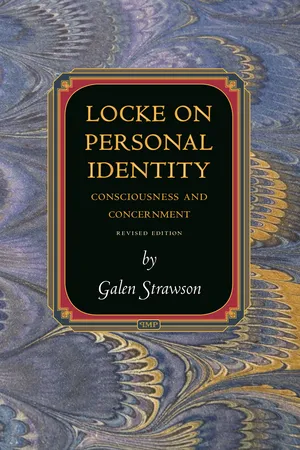
John Locke's theory of personal identity underlies all modern discussion of the nature of persons and selves—yet it is widely thought to be wrong. In this book, Galen Strawson argues that in fact it is Locke's critics who are wrong, and that the famous objections to his theory are invalid. Indeed, far from refuting Locke, they illustrate his fundamental point.
Strawson argues that the root error is to take Locke's use of the word "person" as merely a term for a standard persisting thing, like "human being." In actuality, Locke uses "person" primarily as a forensic or legal term geared specifically to questions about praise and blame, punishment and reward. This point is familiar to some philosophers, but its full consequences have not been worked out, partly because of a further error about what Locke means by the word "conscious." When Locke claims that your personal identity is a matter of the actions that you are conscious of, he means the actions that you experience as your own in some fundamental and immediate manner.
Clearly and vigorously argued, this is an important contribution both to the history of philosophy and to the contemporary philosophy of personal identity.
eBook - ePub
Locke on Personal Identity
Consciousness and Concernment - Updated Edition
- 280 pages
- English
- ePUB (mobile friendly)
- Available on iOS & Android
eBook - ePub
About this book
Information
Publisher
Princeton University PressYear
2014Print ISBN
9780691161006
9780691147574
eBook ISBN
9781400851843
Topic
PhilosophySubtopic
Philosophy History & TheoryChapter One
Introduction
IT’S WIDELY HELD that Locke’s account of personal identity, first published in 1694, is circular and inconsistent, and blatantly so. Locke, however, thought long and hard about the matter.1 He discussed it extensively with friends and colleagues, and was a profoundly intelligent, generally very careful, and exceptionally sensible philosopher. He made no foolish error.
Why has he been so misunderstood? I blame certain influential commentators, in whose vanguard one finds one of the worst readers of other philosophers in the history of philosophy: the good Bishop Berkeley. Thomas Reid is also to blame, for although he is a great (and often funny) philosopher, and sometimes accurate enough in his renderings of the views of his predecessors, he enjoys mockery too much to be reliable, he’s too free with the word “absurd,” and his misreading of Locke’s views on personal identity, which follows Berkeley’s, is spectacular.2 Bishop Butler is the other main reprobate, although the objection to Locke for which he is well known is not his, having been put by John Sergeant in 1697 and by Henry Lee in 1702, among others.3
History has designated Butler and Reid as the main representatives of the circularity and inconsistency objections, and their influence has been such that few since then have had a chance to read what Locke wrote without prejudice. The tide of misunderstanding was already high in 1769, when Edmund Law provided an essentially correct account of Locke’s position in his Defence of Mr. Locke’s Opinion Concerning Personal Identity. His intervention was, however, little noticed.
The extent of the misreading of Locke is remarkable. Edmund Law judged it an “endless” task to “unravel all the futile sophisms and false suppositions, that have been introduced into the present question”; he “endeavoured [only] to obviate such as appeared most material, and account for them” (1769: 36). If, however, one embarks on Locke’s discussion confident that his view will not contain any glaring error, it becomes hard to understand how he can have been so misread for so long. For he makes his central point extremely plain, and he does so, it must be said, over and over and over again. To read the wonderfully fluent and imaginative text of 2.27 of An Essay concerning Human Understanding is to see how familiar Locke is with his material, how easy in exposition he is, how he has thought through the objections, and how much he’s enjoying himself. Locke likes to vary his terms, and is sometimes loose of expression by modern lights, but not in a way that makes it possible for a moderately careful reader to misread him in the manner of Butler, Berkeley, Reid, and many who have followed them.4
The following essay records my line of thought as I read and reread, and sometimes struggled with, Locke’s chapter. I spend the next several sections introducing a number of distinctions that I believe to be useful, extracting some central notions for inspection—notably person, consciousness, concernment—before returning them to context. The discussion lacks a standard expository structure, and it’s not meant to be introductory. I assume basic familiarity with Locke’s text, and criticize other accounts of it only indirectly. I think that almost all the elements of a correct view of his theory of personal identity are now to be found in the writings of a few Locke scholars, among whom Udo Thiel stands out,5 but misunderstanding is still widespread in the philosophical community as a whole.
The interpretative situation was hardly better in the eighteenth century, as just observed.6 Law was honestly amazed that Locke had been so “miserably misunderstood”—that so many “ingenious writers” had been “so marvellously mistaken” about Locke’s views on personal identity, and had engaged in so much irrelevant and “egregious trifling” on the matter (1769: 23, 21). Law cites, as an “extraordinary instance” (p. 22) of this trifling, the inconsistency argument that Berkeley gave in his Alciphron (1732), and for a version of which Reid later became famous (see p. 53 below).7
The root cause of the misunderstanding, perhaps, is the tendency of most of Locke’s readers to take the term “person” as if it were only a sortal term of a standard kind, i.e. a term for a standard temporal continuant, like “human being” or “thinking thing,” without paying sufficient attention to the fact that Locke is focusing on the use of “person” as a “forensic” term (§26), i.e. a term that finds its principal use in contexts in which questions about the attribution of responsibility (praise and blame, punishment and reward) are foremost. No doubt it’s natural enough to take “person” only in the first way, but this doesn’t excuse the perversity of doing so when reading what Locke says, and says again and again. (The common mistake of thinking that Locke means memory by “consciousness” is, relatively speaking, a smaller mistake.) That said, Locke must also bear some of the responsibility for the misreading—a point addressed by Law in the brief appendix to his Defence.
1 His central thought on the question was in place by 1683; see Ayers 1990: 2.255.
2 Berkeley 1732: 304–5, Reid 1785: §3.6. Reid also follows Berkeley in mistakenly attributing to Locke the view that secondary qualities are in the mind (1764: §6.6). He makes many other such errors.
3 Butler 1736: 441. Sergeant picked up the objection for which Butler is known from a debate in which Robert South (1693) made it validly against a proposal by William Sherlock (1690). See Ayers 1990: 2.257, 269; Thiel 1998: 875–77, 898. Leibniz does not make it in his Nouveaux Essais, contrary to the initial appearance (c. 1704: 236 [2.27.9]).
4 Mackie sufficiently answers the Butler objection in Problems from Locke (1976: 186–87).
5 See e.g. Thiel 1998, 2011.
6 See Thiel 2011, chap. 4.
7 “Many historians of philosophy, with all their intended praise, . . . attribute mere nonsense . . . to past philosophers. They are incapable of recognizing, beyond what the philosophers actually said, what they really meant to say” (Kant 1790: 160). “If we take single passages, torn from their context, and compare them with one another, contradictions are not likely to be lacking, especially in a work that is written with any freedom of expression . . .; but they are easily resolved by those who have mastered the idea of the whole” (Kant 1787: Bxliv).
Chapter Two
“Person”
THE WORD “PERSON” has a double use, both now and in the seventeenth century. In its most common everyday use, today as in the seventeenth century, it simply denotes a human being considered as a whole, a person1, as I will say. Its next most common everyday use, which I will call the person2 use, is the one that allows us to say, of a single human being, “She’s not the same person anymore,” or “He’s become a completely different person.” When Henry James writes, of one of his early novels, “I think of . . . the masterpiece in question . . . as the work of quite another person than myself . . . a rich . . . relation, say, who . . . suffers me still to claim a shy fourth cousinship,”1 he knows perfectly well that he’s the same human being (person1) as the author of that book, but he doesn’t feel he’s the same person2 as the author of that book, and we all know what he means, even though the notion of a person2 is not a precise one. James is using the word “person” in the familiar way that allows one to distinguish the person or self that one is from the human being that one is considered as a whole. His claim is that he no longer relates to his early novel in such a way as to feel that he—he who is here now in the person2 sense—is its author.
The current everyday person2 use of “person” is closely connected to the notion of personality, but we ordinarily think of personality as a property of a creature, a property that can change, and not as itself a thing of any sort; whereas when we use “person” to mean a person2, we naturally take it to denote a thing or entity that isn’t just a property. We take it to denote a persisting subject of experience, a self; we don’t feel we’re using the word just as a way of talking about personality, where personality is a mere property of a person1. When people say, “She isn’t the same person anymore,” using “person” in the person2 sense, they tend to feel that they’re saying something more than merely that a person1’s personality has changed, although they may also allow a sense in which this is all that has happened.
At the same time, we don’t feel obliged to come up with clear identity conditions for these supposed entities, these persons in the person2 sense. For while people sometimes look back to a past time and say categorically, “I’m not the same person any more,” i.e. not the same person2, they don’t usually think there’s some sharp dividing line between the person2 in the past and the person2 present now (except, perhaps, in rare cases, e.g. those that involve a radical conversion).
I think that the person2 use of “person” gives us some useful insight into Locke’s use of “person,” because it’s related, although it’s not the same. A Lockean person, a Person, as I’ll say, marking my employment of the term in his sense with a capital letter, is certainly not a person1, because a Person doesn’t have the same identity conditions as a person1. A person1 is simply a human being (a man, in Locke’s terminology, in which “man” refers equally to male and female). It’s a human being considered as a thing of such a kind that same human being doesn’t immediately entail same Person. In §15 Locke famously and explicitly considers imaginary cases in which Persons switch human bodies: cases in which one has to do with the same man (human being) even though one doesn’t have to do with the same Person, and, conversely, cases in which one has to do with the same Person even though one doesn’t have to do with the same man (§15). (Note that Locke’s functional definition of Personhood (see chapter 8) doesn’t restrict Personhood t...
Table of contents
- Cover
- Half title
- Title
- Copyright
- Contents
- Preface
- Chapter 1: Introduction
- Chapter 2: “Person”
- Chapter 3: “Person . . . is a forensic term”
- Chapter 4: Concernment
- Chapter 5: Consciousness
- Chapter 6: “Consciousness . . . is inseparable from thinking”
- Chapter 7: “From the inside”
- Chapter 8: “Person”—Locke’s Definition
- Chapter 9: Consciousness Is Not Memory
- Chapter 10: Personal Identity
- Chapter 11: Psychological Connectedness
- Chapter 12: Transition (Butler Dismissed)
- Chapter 13: “But next . . . ”: Personal Identity without Substantial Continuity
- Chapter 14: “And therefore . . . ”: [I]-transfers, [Ag]-transfers, [P]-transfers
- Chapter 15: “A fatal error of theirs”
- Chapter 16: A Fatal Error of Locke’s?
- Chapter 17: Circularity?
- Chapter 18: The Distinction between [P] and [S]
- Chapter 19: Concernment and Repentance
- Chapter 20: Conclusion
- Postface
- Appendix 1: “Of Identity and Diversity” by John Locke
- Appendix 2: A Defence of Mr. Locke’s Opinion Concerning Personal Identity by Edmund Law
- References
- Index
Trusted by 375,005 students
Access to over 1.5 million titles for a fair monthly price.
Study more efficiently using our study tools.
Frequently asked questions
Yes, you can cancel anytime from the Subscription tab in your account settings on the Perlego website. Your subscription will stay active until the end of your current billing period. Learn how to cancel your subscription
No, books cannot be downloaded as external files, such as PDFs, for use outside of Perlego. However, you can download books within the Perlego app for offline reading on mobile or tablet. Learn how to download books offline
Perlego offers two plans: Essential and Complete
- Essential is ideal for learners and professionals who enjoy exploring a wide range of subjects. Access the Essential Library with 800,000+ trusted titles and best-sellers across business, personal growth, and the humanities. Includes unlimited reading time and Standard Read Aloud voice.
- Complete: Perfect for advanced learners and researchers needing full, unrestricted access. Unlock 1.5M+ books across hundreds of subjects, including academic and specialized titles. The Complete Plan also includes advanced features like Premium Read Aloud and Research Assistant.
We are an online textbook subscription service, where you can get access to an entire online library for less than the price of a single book per month. With over 1.5 million books across 990+ topics, we’ve got you covered! Learn about our mission
Look out for the read-aloud symbol on your next book to see if you can listen to it. The read-aloud tool reads text aloud for you, highlighting the text as it is being read. You can pause it, speed it up and slow it down. Learn more about Read Aloud
Yes! You can use the Perlego app on both iOS and Android devices to read anytime, anywhere — even offline. Perfect for commutes or when you’re on the go.
Please note we cannot support devices running on iOS 13 and Android 7 or earlier. Learn more about using the app
Please note we cannot support devices running on iOS 13 and Android 7 or earlier. Learn more about using the app
Yes, you can access Locke on Personal Identity by Galen Strawson in PDF and/or ePUB format, as well as other popular books in Philosophy & Philosophy History & Theory. We have over 1.5 million books available in our catalogue for you to explore.