In 1700, most composers were employees of noble courts or the church. But by the nineteenth century, Chopin, Schumann, Brahms, Verdi, and many others functioned as freelance artists teaching, performing, and selling their compositions in the private marketplace. While some believe that Mozart's career marks a clean break between these two periods, this book tells the story of a more complex and interesting transition.
F. M. Scherer first examines the political, intellectual, and economic roots of the shift from patronage to a freelance market. He describes the eighteenth-century cultural "arms race" among noble courts, the spread of private concert halls and opera houses, the increasing attendance of middle-class music lovers, and the founding of conservatories. He analyzes changing trends in how composers acquired their skills and earned their living, examining such impacts as demographic developments and new modes of transportation. The book offers insight into the diversity of composers' economic aspirations, the strategies through which they pursued success, the burgeoning music publishing industry, and the emergence of copyright protection. Scherer concludes by drawing some parallels to the economic state of music composition in our own times.
Written by a leading economist with an unusually broad knowledge of music, this fascinating account is directed toward individuals intrigued by the world of classical composers as well as those interested in economic history or the role of money in art.
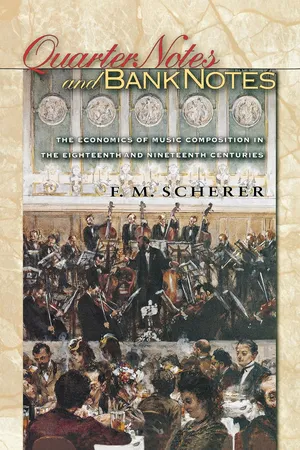
eBook - PDF
Quarter Notes and Bank Notes
The Economics of Music Composition in the Eighteenth and Nineteenth Centuries
- 277 pages
- English
- PDF
- Available on iOS & Android
eBook - PDF
Quarter Notes and Bank Notes
The Economics of Music Composition in the Eighteenth and Nineteenth Centuries
About this book
Information
Publisher
Princeton University PressYear
2018Print ISBN
9780691155463
9780691116211
eBook ISBN
9780691188096
Table of contents
- Cover
- Title Page
- Copyright Page
- CONTENTS
- List of Figures and Tables
- Foreword
- CHAPTER ONE: Introduction
- CHAPTER TWO: The Political, Social, and Economic Milieu
- CHAPTER THREE: Music Composition as a Profession
- CHAPTER FOUR: Composers' Backgrounds, Aspirations, and Economic Rewards
- CHAPTER FIVE: The Geography of Composer Supply and Demand
- CHAPTER SIX: Changes in Transportation and Composers' Mobility
- CHAPTER SEVEN: The Economics of Music Publishing
- CHAPTER EIGHT: Conclusion
- APPENDIX TO CHAPTER ONE A Currency Conversion Matrix
- APPENDIX TO CHAPTER FOUR Consumption Outlays of Robert and Clara Schumann, 1841
- Notes
- References
- Index
Trusted by 375,005 students
Access to over 1.5 million titles for a fair monthly price.
Study more efficiently using our study tools.
Frequently asked questions
Yes, you can cancel anytime from the Subscription tab in your account settings on the Perlego website. Your subscription will stay active until the end of your current billing period. Learn how to cancel your subscription
No, books cannot be downloaded as external files, such as PDFs, for use outside of Perlego. However, you can download books within the Perlego app for offline reading on mobile or tablet. Learn how to download books offline
We are an online textbook subscription service, where you can get access to an entire online library for less than the price of a single book per month. With over 1.5 million books across 990+ topics, we’ve got you covered! Learn about our mission
Look out for the read-aloud symbol on your next book to see if you can listen to it. The read-aloud tool reads text aloud for you, highlighting the text as it is being read. You can pause it, speed it up and slow it down. Learn more about Read Aloud
Yes! You can use the Perlego app on both iOS and Android devices to read anytime, anywhere — even offline. Perfect for commutes or when you’re on the go.
Please note we cannot support devices running on iOS 13 and Android 7 or earlier. Learn more about using the app
Please note we cannot support devices running on iOS 13 and Android 7 or earlier. Learn more about using the app
Yes, you can access Quarter Notes and Bank Notes by F. M. Scherer in PDF and/or ePUB format, as well as other popular books in Médias et arts de la scène & Histoire et critiques de la musique. We have over 1.5 million books available in our catalogue for you to explore.