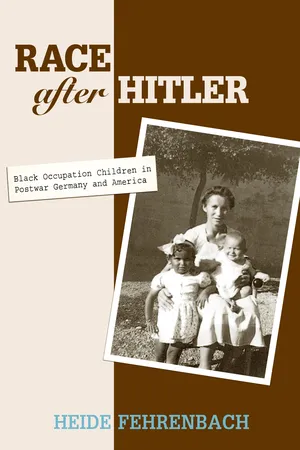
When American victors entered Germany in the spring of 1945, they came armed not only with a commitment to democracy but also to Jim Crow practices. Race after Hitler tells the story of how troubled race relations among American occupation soldiers, and black-white mixing within Germany, unexpectedly shaped German notions of race after 1945. Biracial occupation children became objects of intense scrutiny and politicking by postwar Germans into the 1960s, resulting in a shift away from official antisemitism to a focus on color and blackness.
Beginning with black GIs' unexpected feelings of liberation in postfascist Germany, Fehrenbach investigates reactions to their relations with white German women and to the few thousand babies born of these unions. Drawing on social welfare and other official reports, scientific studies, and media portrayals from both sides of the Atlantic, Fehrenbach reconstructs social policy debates regarding black occupation children, such as whether they should be integrated into German society or adopted to African American or other families abroad. Ultimately, a consciously liberal discourse of race emerged in response to the children among Germans who prided themselves on--and were lauded by the black American press for--rejecting the hateful practices of National Socialism and the segregationist United States.
Fehrenbach charts her story against a longer history of German racism extending from nineteenth-century colonialism through National Socialism to contemporary debates about multiculturalism. An important and provocative work, Race after Hitler explores how racial ideologies are altered through transnational contact accompanying war and regime change, even and especially in the most intimate areas of sex and reproduction.
eBook - PDF
Race after Hitler
Black Occupation Children in Postwar Germany and America
- 280 pages
- English
- PDF
- Available on iOS & Android
eBook - PDF
Race after Hitler
Black Occupation Children in Postwar Germany and America
About this book
Information
Publisher
Princeton University PressYear
2018Print ISBN
9780691133799
9780691119069
eBook ISBN
9780691188102
Topic
StoriaSubtopic
Storia tedescaTable of contents
- Cover
- Title Page
- Copyright Page
- CONTENTS
- List of Illustrations
- Acknowledgments
- INTRODUCTION Democratizing the Racial State: Toward a Transnational History
- CHAPTER ONE: Contact Zones: American Military Occupation and the Politics of Race
- CHAPTER TWO: Flaccid Fatherland: Rape, Sex, and the Reproductive Consequences of Defeat
- CHAPTER THREE: “Mischlingskinder” and the Postwar Taxonomy of Race
- CHAPTER FOUR: Reconstruction in Black and White: The Toxi Films
- CHAPTER FIVE: Whose Children, Theirs or Ours? Intercountry Adoptions and Debates about Belonging
- CHAPTER SIX: Legacies: Race and the Postwar Nation
- Abbreviations of Archives Consulted
- Notes
- Select Bibliography
- Index
Trusted by 375,005 students
Access to over 1.5 million titles for a fair monthly price.
Study more efficiently using our study tools.
Frequently asked questions
Yes, you can cancel anytime from the Subscription tab in your account settings on the Perlego website. Your subscription will stay active until the end of your current billing period. Learn how to cancel your subscription
No, books cannot be downloaded as external files, such as PDFs, for use outside of Perlego. However, you can download books within the Perlego app for offline reading on mobile or tablet. Learn how to download books offline
Perlego offers two plans: Essential and Complete
- Essential is ideal for learners and professionals who enjoy exploring a wide range of subjects. Access the Essential Library with 800,000+ trusted titles and best-sellers across business, personal growth, and the humanities. Includes unlimited reading time and Standard Read Aloud voice.
- Complete: Perfect for advanced learners and researchers needing full, unrestricted access. Unlock 1.5M+ books across hundreds of subjects, including academic and specialized titles. The Complete Plan also includes advanced features like Premium Read Aloud and Research Assistant.
We are an online textbook subscription service, where you can get access to an entire online library for less than the price of a single book per month. With over 1.5 million books across 990+ topics, we’ve got you covered! Learn about our mission
Look out for the read-aloud symbol on your next book to see if you can listen to it. The read-aloud tool reads text aloud for you, highlighting the text as it is being read. You can pause it, speed it up and slow it down. Learn more about Read Aloud
Yes! You can use the Perlego app on both iOS and Android devices to read anytime, anywhere — even offline. Perfect for commutes or when you’re on the go.
Please note we cannot support devices running on iOS 13 and Android 7 or earlier. Learn more about using the app
Please note we cannot support devices running on iOS 13 and Android 7 or earlier. Learn more about using the app
Yes, you can access Race after Hitler by Heide Fehrenbach,Heidi Fehrenbach in PDF and/or ePUB format, as well as other popular books in Storia & Storia tedesca. We have over 1.5 million books available in our catalogue for you to explore.