A Note from the Author: On August 24, 2006, at the 26th General Assembly of the International Astronomical Union (IAU) in Prague, by a majority vote of only the 424 members present, the IAU (an organization of over 10,000 members) passed a resolution defining planet in such a way as to exclude Pluto and established a new class of objects in the solar system to be called "dwarf planets," which was deliberately designed to include Pluto.
With the discovery of Eris (2003 UB313)—an outer solar system object thought to be both slightly larger than Pluto and twice as far from the Sun—astronomers have again been thrown into an age-old debate about what is and what is not a planet. One of many sizeable hunks of rock and ice in the Kuiper Belt, Eris has resisted easy classification and inspired much controversy over the definition of planethood. But, Pluto itself has been subject to controversy since its discovery in 1930, and questions over its status linger. Is it a planet? What exactly is a planet?
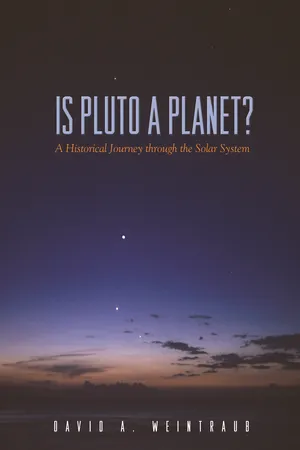
Is Pluto a Planet? tells the story of how the meaning of the word "planet" has changed from antiquity to the present day, as new objects in our solar system have been discovered. In lively, thoroughly accessible prose, David Weintraub provides the historical, philosophical, and astronomical background that allows us to decide for ourselves whether Pluto is indeed a planet.
The number of possible planets has ranged widely over the centuries, from five to seventeen. This book makes sense of it all—from the ancient Greeks' observation that some stars wander while others don't; to Copernicus, who made Earth a planet but rejected the Sun and the Moon; to the discoveries of comets, Uranus, Ceres, the asteroid belt, Neptune, Pluto, centaurs, the Kuiper Belt and Eris, and extrasolar planets.
Weaving the history of our thinking about planets and cosmology into a single, remarkable story, Is Pluto a Planet? is for all those who seek a fuller understanding of the science surrounding both Pluto and the provocative recent discoveries in our outer solar system.
- 280 pages
- English
- ePUB (mobile friendly)
- Available on iOS & Android
eBook - ePub
About this book
Information
Publisher
Princeton University PressYear
2014Print ISBN
9780691138466
9780691123486
eBook ISBN
9781400852970
Topic
Physical SciencesSubtopic
Astronomy & Astrophysics1
What Is a Planet?

Is Pluto a planet? This question appears so simple—clearly the answer is either yes or no—yet the simplicity is misleading. Logically, we must know what a planet is and determine whether Pluto fits those criteria if we are to construct a well-reasoned answer.
The question Is Pluto a planet? has stirred the passions of professional astronomers since this enigmatic object was discovered in 1930. In order to understand why this question vexes the professionals, we will first follow the path of early intellectual discovery along which scientists came to recognize that the Earth is a planet. Then we will walk the historical path that led to the discovery of much of the solar system, including the planets Uranus and Neptune, the asteroid belt, and Pluto. Finally, we will focus our attention on important astrophysical discoveries since the discovery of Pluto that have culminated in widespread, popular confusion and impassioned professional debate over the status of Pluto.
At the end of the twentieth century, the debate over the answer to the question Is Pluto a planet? spilled into the public domain because several new discoveries—large objects in the Kuiper Belt in our solar system, giant planets orbiting other stars, possible planet-sized objects floating freely through space—all provide new and important ways to think about how to answer this question. We will look at these new discoveries, especially at their impact on how we think about planets and planetary systems, including, of course, how we think about our own solar system.
The question Is Pluto a planet? illustrates a difficult challenge common to all areas of research and thought: how do we draw the lines we use to categorize objects and ideas? Categorization is one of the first steps in learning: we organize information by similarities and differences. We know that mammals give birth to live young; yet, a platypus lays eggs and is a mammal. Despite its name, a koala bear is a marsupial, not a bear. So which similarities are most important and fundamentally determine membership in a group or class? Which differences are incidental? As is often said, the devil is in the details.
Astronomers like to joke that knowledge of one object—a bright point of light in the nighttime sky—defines a class of objects: stars. The discovery of a second bright point of light that is not identical to the first forces us to create two distinct classes of objects—for example, red stars and blue stars. In this example, the two stars share one important characteristic—they are both bright points of light in the sky—but differ in the apparently important characteristic of color. If we then discover a third object in the sky sharing the original characteristic—a bright point of light in the nighttime sky—but differing in the second characteristic—this third object is yellow—do we conclude that these three objects belong to three distinct categories of objects, with each group being represented by only one example? Or, might we realize that we have discovered three similar objects that differ only in the incidental quality of color? Which is more important, recognizing the similarities among the objects (they are all stars) or emphasizing the differences (colors) between them? At what point should we discard the categories we are using and start anew?
By defining finer and finer categories, we learn about the physical universe in which we live. We use our knowledge both to expand our understanding (Wow, three kinds of stars exist!) and to delimit what we do not understand (Why do stars have different colors?). The problem for us lies in how we define a group (for example, planets) when we know very little about the individual objects in the group and almost nothing about the processes that made or make similar objects and have very few examples of objects that presumably are members of the group.
We cannot answer our question Is Pluto a planet? unless we are able to determine the qualities that define the boundaries of the category planet. Once we agree on how to define planet, we can ask whether a particular object, in this case Pluto, satisfies our criteria. Since we need to define planet, we could turn to a dictionary.
The Oxford English Dictionary (OED)1 defines the modern word planet as deriving from the Old French planete out of the Latin planeta; in turn, the Latin is derived from the Greek word for wandering star, planetos, which in turn evolved from planasthai, the verb “to wander.” Clearly, we need to understand what the ancient Greeks meant by their word, and the OED tells us, giving the Old Astronomy (i.e., archaic and no longer used) usage:
A heavenly body distinguished from the fixed stars by having an apparent motion of its own among them; each planet, according to the Ptolemaic system, being carried round the Earth by the rotation of the particular sphere or orb in which it was placed. The seven planets, in the order of their accepted distance from the Earth, were the Moon, Mercury, Venus, the Sun, Mars, Jupiter, and Saturn.
If you are reading carefully, you will have noticed that according to the ancient Greeks, the Sun was a planet but the Earth was not! Certainly, no person in the twenty-first century thinks of the Sun as a planet. We all were taught that the Sun is a star, not a planet.
So did the Sun change from a planet into a star? Of course not. Apparently, though, our understanding of what is meant by planet changed; hence, at the moment when our understanding changed, we reclassified the Sun as a star and the Earth as a planet and discarded the Old Astronomy usage.
Next, we find the Modern Astronomy definition:
The name given to each of the heavenly bodies that revolve in approximately circular orbits round the Sun (primary planets), and to those that revolve round these (secondary planets or satellites). The primary planets comprise the major planets, of which nine are known, viz., in order of distance from the Sun, Mercury, Venus, the Earth, Mars, Jupiter, Saturn, Uranus, Neptune, and Pluto, and the minor planets or asteroids, the orbits of which lie between those of Mars and Jupiter.
Another OED definition, given in the New Shorter OED, is similar:
Any of various rocky or gaseous bodies that revolve in elliptical orbits about the Sun and are visible by its reflective light, esp. each of the nine major planets (see below); any of various smaller bodies that revolve around these; a similar body revolving around another star.
The “see below” points to a list of primary planets, a definition of minor planet as an asteroid, and a definition of secondary planet as “a planet that orbits another planet, a satellite, a moon.”
Whoa! The Moon revolves around the Earth; therefore, the Moon must be considered a secondary planet? Certainly, a secondary planet is some kind of planet just as a sweet potato is some kind of potato. Do we normally think of our Moon as a planet? No.
Mars has two potato-shaped moons, Phobos and Deimos, each no larger than a small city, both of which also match this definition. Are objects like Phobos and Deimos, with diameters of only a few miles, planets? No.
The Hubble Space Telescope most definitely is a satellite revolving around a primary planet, the Earth. Is the manufactured Hubble Space Telescope, which astronomers would consider to be a “rocky body,” a heavenly body? If not, what if NASA hauled a ten-ton boulder into space and launched that boulder into a terrestrial orbit? The boulder is certainly a naturally made rocky body that would be in orbit around a primary planet. What meaningful difference would permit us to distinguish between these two orbiting objects, or would both qualify as secondary planets?
According to the latter two definitions, all of these objects might be planets, as are the asteroids in the asteroid belt, even the ones that are smaller than a house or car, since most of these objects revolve in approximately circular orbits around the Sun. However, according to the Modern Astronomy definition, a Sun-orbiting asteroid whose orbit keeps it in between the orbits of Earth and Mars, rather than in between the orbits of Mars and Jupiter, would not be a planet. Similarly, an asteroid in a moderately elliptical orbit between Mars and Jupiter, traveling from an outermost distance just outside of Jupiter’s orbit to an innermost distance just inside of Mars’s orbit, also would be disqualified as a planet. The New Shorter OED definition would allow asteroids with more elliptical orbits and those outside the Mars and Jupiter boundaries to be secondary planets, but why are such objects considered planets at all?
When I read these definitions, I want to know: Who are these Old and Modern astronomers? Am I one? Surely, the Old astronomers were not to be trusted, as they included the Moon and Sun as planets. And what of these Modern astronomers whose definition appears to include objects big and small, natural and manufactured, but only if those objects are in nearly circular orbits and in preferred locations? If either of the modern definitions is correct, far more than nine planets orbit the Sun. In fact, there must be hundreds of thousands, perhaps even millions, of planets in our solar system. Clearly, the commonly accepted notion that nine planets orbit the Sun does not match the OED version of the universe.
I, for one, am very dissatisfied when I read the OED definitions. I hope you are similarly bothered. Because the dictionary definition of planet is essentially worthless, scientifically, we have to probe much deeper into astronomy in order to answer what initially appeared to be a simple question. That is what we will do in the rest of this book.
2
Seven Perfect Planets Made of Aether
What would you learn if you could look up and observe the sky, night after night, year after year, unencumbered by the accumulated intellectual burdens and prejudices of the twenty-first-century world? The first thing you would notice is that, like clockwork, the Sun rises every morning and sets every evening. The exact moments and directions of sunrise and sunset change in cyclical patterns that mark the seasons; yet, no matter the season, the Sun appears to sweep out one great circle, moving from east to west in the sky, from exact noon one day to exact noon the next day, in exactly twenty-four hours.
Ancient peoples everywhere must have watched the Sun. By doing so, they learned how to predict the onset of seasonal changes based on the height of the Sun above the southern horizon at noon, the position of the Sun along the eastern horizon at sunrise or the western horizon at sunset, or the lengths and directions of shadows cast by the Sun at different times of day. Those peoples with more advanced skills in measuring time—times of day and times of year—were more likely to prosper and survive, as their ability to stay warm and dry and to find, store, and secure adequate food supplies depended on their expertise in predicting seasonal changes.
Certainly, in times long before written records were kept, our ancestors also must have recognized that the points of light that illuminate the nighttime sky rise and set, just like the Sun. They also would have noticed that different stars rise and set at different times of the year and are organized in recognizable patterns. Furthermore, they would have discovered that these stars, as they wheel around the Earth from east to west, never change positions with respect to each other. Their positions seem to be fixed; the stars themselves seem to be attached to an unimaginably large and distant celestial sphere, with the Earth at the center, which makes one complete revolution in twenty-four hours.
At first glance, the Sun seems to be attached to the celestial sphere, as the Sun appears to be carried around the Earth from east to west with the stars, once per day. Yet, the most attentive of the ancient sky watchers would have discovered that the stars appear to go around the Earth just a little more quickly than the Sun. On our modern clocks, we would note that the time for a complete cycle of the stars is almost exactly 23 hours, 56 minutes, and 4 seconds, nearly 4 minutes less than the 24 hours required for the passage of the Sun from the position in the sky we refer to as noon to its next noontime appearance. Thus, we might imagine that the Sun has two motions. One motion takes the Sun completely around the heavens from east to west in 23 hours, 56 minutes, and 4 seconds; the second motion takes it much more slowly in the opposite direction, from west to east, by the equivalent of almost 4 minutes each day.
Since 24 hours is 1,440 minutes, and 1,440 minutes divided by 4 minutes is 360, and since the circumference of a circle has 360 degrees, the Sun moves about 1 degree per day through the fixed stars. At the end of one year, or very nearly 365 days, not only is the Sun back to its starting point among the patterns of the stars, the seasons have also completed one cycle. Thus, the ancient astronomers would have discovered that they could track the seasons by watching the stars, which for some peoples may have been easier than watching the Sun. The warmth of the Sun obviously influences the weather, the growth of plant life, and the regulation of the seasons, whereas the stars do not obviously cause any of these effects; yet, one can easily understand how ancient peoples would have assumed that the stars, like the Sun, somehow must affect life on Earth. This primitive logic is ultimately the origin of the practice of astrology and many ancient religious practices.
Once ancient peoples had associated the ability to predict the onset of the changing seasons with the nighttime sky, watching and observing the patterns of the heavens and knowing how to interpret these observations would have become one of the most important jo...
Table of contents
- Cover Page
- Title Page
- Copyright Page
- Dedication Page
- Contents
- Preface
- 1 What Is a Planet?
- 2 Seven Perfect Planets Made of Aether
- 3 The Earth Becomes a Planet
- 4 Sixteen Planets
- 5 Not Everything That Orbits the Sun Is a Planet
- 6 Uranus!
- 7 The Celestial Police
- 8 Neptune, the Thirteenth Planet
- 9 Easy Come, Easy Go
- 10 Pluto, the Fourth Ninth Planet
- 11 Hidden Secrets of the Outer Solar System
- 12 The Plutinos
- 13 Is Pluto a Planet?
- 14 Goldilocks
- 2006 Postscript: Current Thoughts by Other Astronomers
- 2008 Postscript: The Post-2006 Status of Pluto
- Appendix: What We Know about Pluto
- Notes
- Index
Trusted by 375,005 students
Access to over 1.5 million titles for a fair monthly price.
Study more efficiently using our study tools.
Frequently asked questions
Yes, you can cancel anytime from the Subscription tab in your account settings on the Perlego website. Your subscription will stay active until the end of your current billing period. Learn how to cancel your subscription
No, books cannot be downloaded as external files, such as PDFs, for use outside of Perlego. However, you can download books within the Perlego app for offline reading on mobile or tablet. Learn how to download books offline
Perlego offers two plans: Essential and Complete
- Essential is ideal for learners and professionals who enjoy exploring a wide range of subjects. Access the Essential Library with 800,000+ trusted titles and best-sellers across business, personal growth, and the humanities. Includes unlimited reading time and Standard Read Aloud voice.
- Complete: Perfect for advanced learners and researchers needing full, unrestricted access. Unlock 1.5M+ books across hundreds of subjects, including academic and specialized titles. The Complete Plan also includes advanced features like Premium Read Aloud and Research Assistant.
We are an online textbook subscription service, where you can get access to an entire online library for less than the price of a single book per month. With over 1.5 million books across 990+ topics, we’ve got you covered! Learn about our mission
Look out for the read-aloud symbol on your next book to see if you can listen to it. The read-aloud tool reads text aloud for you, highlighting the text as it is being read. You can pause it, speed it up and slow it down. Learn more about Read Aloud
Yes! You can use the Perlego app on both iOS and Android devices to read anytime, anywhere — even offline. Perfect for commutes or when you’re on the go.
Please note we cannot support devices running on iOS 13 and Android 7 or earlier. Learn more about using the app
Please note we cannot support devices running on iOS 13 and Android 7 or earlier. Learn more about using the app
Yes, you can access Is Pluto a Planet? by David A. Weintraub in PDF and/or ePUB format, as well as other popular books in Physical Sciences & Astronomy & Astrophysics. We have over 1.5 million books available in our catalogue for you to explore.