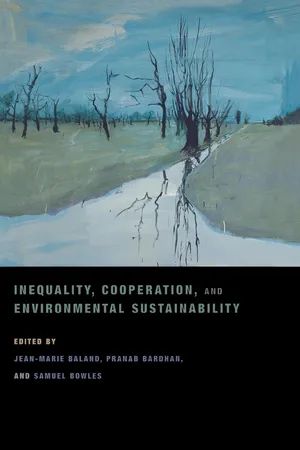
Would improving the economic, social, and political condition of the world's disadvantaged people slow--or accelerate--environmental degradation? In Inequality, Cooperation, and Environmental Sustainability, leading social scientists provide answers to this difficult question, using new research on the impact of inequality on environmental sustainability.
The contributors' findings suggest that inequality may exacerbate environmental problems by making it more difficult for individuals, groups, and nations to cooperate in the design and enforcement of measures to protect natural assets ranging from local commons to the global climate. But a more equal division of a given amount of income could speed the process of environmental degradation--for example, if the poor value the preservation of the environment less than the rich do, or if the consumption patterns of the poor entail proportionally greater environmental degradation than that of the rich. The contributors also find that the effect of inequality on cooperation and environmental sustainability depends critically on the economic and political institutions governing how people interact, and the technical nature of the environmental asset in question. The contributors focus on the local commons because many of the world's poorest depend on them for their livelihoods, and recent research has made great strides in showing how private incentives, group governance, and government policies might combine to protect these resources.
eBook - PDF
Inequality, Cooperation, and Environmental Sustainability
- 368 pages
- English
- PDF
- Available on iOS & Android
eBook - PDF
Inequality, Cooperation, and Environmental Sustainability
About this book
Information
Table of contents
- Cover
- Title Page
- Copyright Page
- Contents
- Preface
- CHAPTER 1 Introduction
- CHAPTER 2 Collective Action on the Commons: The Role of Inequality
- CHAPTER 3 Inequality and Collective Action
- CHAPTER 4 Adoption of a Ne w Regulation for the Governance of Common-Pool Resources by a Heterogeneous Population
- CHAPTER 5 Inequality and the Governance of Water Resources in Mexico and South India
- CHAPTER 6 Managing Pacific Salmon: The Role of Distributional Conflicts in Coastal Salish Fisheries
- CHAPTER 7 Heterogeneity and Collective Action for Effort Regulation: Lessons from Senegalese Small-Scale Fisheries
- CHAPTER 8 Wealth Inequality and Overexploitation of the Commons: Field Experiments in Colombia
- CHAPTER 9 Collective Action for Forest Conservation: Does Heterogeneity Matter?
- CHAPTER 10 Inequality, Collective Action, and the Environment: Evidence from Firewood Collection in Nepal
- CHAPTER 11 Gender Inequality, Cooperation, and Environmental Sustainability
- CHAPTER 12 Inequality and Environmental Protection
- Index
Trusted by 375,005 students
Access to over 1.5 million titles for a fair monthly price.
Study more efficiently using our study tools.
Frequently asked questions
Yes, you can cancel anytime from the Subscription tab in your account settings on the Perlego website. Your subscription will stay active until the end of your current billing period. Learn how to cancel your subscription
No, books cannot be downloaded as external files, such as PDFs, for use outside of Perlego. However, you can download books within the Perlego app for offline reading on mobile or tablet. Learn how to download books offline
Perlego offers two plans: Essential and Complete
- Essential is ideal for learners and professionals who enjoy exploring a wide range of subjects. Access the Essential Library with 800,000+ trusted titles and best-sellers across business, personal growth, and the humanities. Includes unlimited reading time and Standard Read Aloud voice.
- Complete: Perfect for advanced learners and researchers needing full, unrestricted access. Unlock 1.5M+ books across hundreds of subjects, including academic and specialized titles. The Complete Plan also includes advanced features like Premium Read Aloud and Research Assistant.
We are an online textbook subscription service, where you can get access to an entire online library for less than the price of a single book per month. With over 1.5 million books across 990+ topics, we’ve got you covered! Learn about our mission
Look out for the read-aloud symbol on your next book to see if you can listen to it. The read-aloud tool reads text aloud for you, highlighting the text as it is being read. You can pause it, speed it up and slow it down. Learn more about Read Aloud
Yes! You can use the Perlego app on both iOS and Android devices to read anytime, anywhere — even offline. Perfect for commutes or when you’re on the go.
Please note we cannot support devices running on iOS 13 and Android 7 or earlier. Learn more about using the app
Please note we cannot support devices running on iOS 13 and Android 7 or earlier. Learn more about using the app
Yes, you can access Inequality, Cooperation, and Environmental Sustainability by Jean-Marie Baland, Pranab Bardhan, Samuel Bowles, Jean-Marie Baland,Pranab Bardhan,Samuel Bowles in PDF and/or ePUB format, as well as other popular books in Economics & Comparative Economics. We have over 1.5 million books available in our catalogue for you to explore.