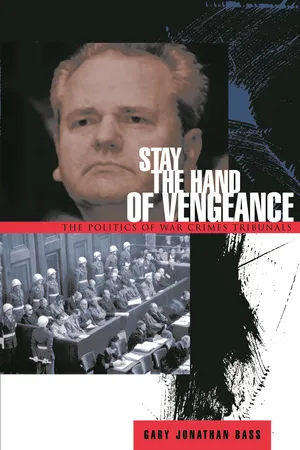
International justice has become a crucial part of the ongoing political debates about the future of shattered societies like Bosnia, Kosovo, Rwanda, Cambodia, and Chile. Why do our governments sometimes display such striking idealism in the face of war crimes and atrocities abroad, and at other times cynically abandon the pursuit of international justice altogether? Why today does justice seem so slow to come for war crimes victims in the Balkans? In this book, Gary Bass offers an unprecedented look at the politics behind international war crimes tribunals, combining analysis with investigative reporting and a broad historical perspective. The Nuremberg trials powerfully demonstrated how effective war crimes tribunals can be. But there have been many other important tribunals that have not been as successful, and which have been largely left out of today's debates about international justice. This timely book brings them in, using primary documents to examine the aftermath of the Napoleonic Wars, World War I, the Armenian genocide, World War II, and the recent wars in the former Yugoslavia.
Bass explains that bringing war criminals to justice can be a military ordeal, a source of endless legal frustration, as well as a diplomatic nightmare. The book takes readers behind the scenes to see vividly how leaders like David Lloyd George, Winston Churchill, Franklin Roosevelt, and Bill Clinton have wrestled with these agonizing moral dilemmas. The book asks how law and international politics interact, and how power can be made to serve the cause of justice.
Bass brings new archival research to bear on such events as the prosecution of the Armenian genocide, presenting surprising episodes that add to the historical record. His sections on the former Yugoslavia tell--with important new discoveries--the secret story of the politicking behind the prosecution of war crimes in Bosnia, drawing on interviews with senior White House officials, key diplomats, and chief prosecutors at the war crimes tribunal for the former Yugoslavia. Bass concludes that despite the obstacles, legalistic justice for war criminals is nonetheless worth pursuing. His arguments will interest anyone concerned about human rights and the pursuit of idealism in international politics.
- 440 pages
- English
- ePUB (mobile friendly)
- Available on iOS & Android
eBook - ePub
About this book
Information
Publisher
Princeton University PressYear
2014Print ISBN
9780691092782
9780691049229
eBook ISBN
9781400851713
* CHAPTER ONE *
Introduction
TIHOMIR BLASKIC was brought into court in The Hague on June 24, 1997, flanked by two policemen wearing the baby-blue of the UN. An unexceptional dark man with wispy thinning black hair and gold glasses, dressed for the occasion in a gray civilian suit, Blaskic looked constantly grim. He did not change his expression as the morning wore on. He gave no hint of emotion, even when the prosecutor, a square-jawed American draped in a black robe, described the 1993 sack of Ahmici, a small, innocuous village in central Bosnia’s Lasva Valley.
Blaskic had then been a colonel and the commander of the Bosnian Croat army’s operations in central Bosnia. In April 1993, Dario Kordic, the young local Bosnian Croat leader, decided to take the Lasva Valley, a rugged area populated both by Muslims and Croats. Forces under Blaskic’s command launched an assault on the Bosnian government’s forces and the Muslim towns of the Lasva Valley. The rain of shells took a heavy toll on Muslim civilians. Men allegedly under Blaskic’s command rounded up hundreds of Muslims who remained in the valley, and held them in makeshift facilities in Vitez and Busovaca. They forced the prisoners, hungry and thirsty, to dig trenches on confrontation lines or used them as human shields to deter the Bosnian government forces from striking back at the Croat forces. The atrocities in Ahmici, a mostly Muslim village, were the most notorious: its mosques and the homes of its Muslim inhabitants had been razed, and ninety-six civilians were killed.1
But that was all a world away. Now Blaskic could only see Ahmici—with its Muslim houses gutted, and Croatian nationalist graffiti spray-painted on a toppled Muslim minaret—in stark black-and-white video images, filmed by a swooping camera that had been carried by a NATO helicopter. Blaskic’s old headquarters at the Hotel Vitez, only about five kilometers from Ahmici and mere blocks away from what became a mass grave site, were also just pictures on the screens in a hushed and darkened courtroom on the other side of Europe. Instead, Blaskic was surrounded by the self-important trappings of a new effort at international justice.
The courtroom is in fact a rebuilt conference room, which until 1994 housed Dutch businesspeople working for Aegon, the insurance firm with which the tribunal was sharing its sprawling, shabby building on Churchillplein in the northern part of The Hague. The courtroom, which cost the UN about three million Dutch guilders, boasts ultramodern computer and video monitors, immediate computerized stenography, and simultaneous translation broadcast in three languages: English, French, and what used to be called Serbo-Croatian and is now prudently listed by the UN as “Bosnian, Croatian, Serbian.”2 Visitors and the press are separated from Blaskic only by a pane of bulletproof glass. The courtroom is sleek and gleaming white, with baby-blue drapes and two big UN flags flanking the judges. They are robed in black and red, with faintly ridiculous white bibs in the Continental style; the attorneys wear simpler black robes, with the same bibs. The air is a riot of international accents: the presiding judge is French, his two colleagues are from Egypt and Guyana, the defense team are from Croatia and Los Angeles, and the prosecutors have American accents (one of them distinctly from New York). It is all built to impress. There was no sign that day that it had made any impact on Blaskic.
Nor were his superiors in Croatia any more impressed. Croatia was resisting the tribunal’s attempts to subpoena its records on the Lasva Valley attacks, presumably fearing that such papers might implicate men of greater rank than Blaskic. Dario Kordic was still at large, widely assumed to be living comfortably in Zagreb. The mere fact that Blaskic was in court at all was an anomaly. On the day Blaskic walked into the dock, only eight out of seventy-five men publicly indicted by the tribunal were in custody.3 Blaskic was the only high-ranking one. Over three years after the UN set up the first international war crimes tribunal since World War II, all it had to show for it were these eight men: whiling away their days by playing chess, reading a spy novel by John Le Carré, and, in the case of a man who had brutalized prisoners at the Omarska concentration camp, doing a series of paintings for an exhibition in a London restaurant.
Most of what really mattered for the tribunal was going on far from the former insurance office in The Hague. The machinery of justice was here, still a bit creaky with its new duties, but, it was hoped, up to the task. What was missing, as the tribunal’s staff constantly says, was the world’s political will. The crucial decisions that had brought Blaskic to the dock had mostly been made elsewhere: by the member states of the UN Security Council when they created the Hague tribunal in 1993 but then kept it underfunded and understaffed; by ex-Yugoslav authorities as they flouted the tribunal’s authority; by Britain and France as they limited the duties of their peacekeeping troops; by Russia as it interfered with the tribunal to shelter the Serbs; and above all by America, an inattentive superpower.
Those decisions had left the tribunal’s staff grumbling that the West was not remotely serious about the work being done here. “We are not offering anywhere enough justice,” said a tribunal staffer, recently back from Bosnia. “All the old grievances are still there.” There was no triumphalism in The Hague, only a gnawing fear that the entire effort would prove pointless, or would discredit the Nuremberg legacy by failing.
This book is about idealism in international relations, and its sharp limits. It asks why some countries will sometimes be strikingly idealistic in the face of foreign wickedness, and at other times will cynically abandon the pursuit of justice. For those who were glad to see the likes of Blaskic on trial, the crucial question is: What makes governments support international war crimes tribunals? And, conversely: What makes governments abandon them? Those are the basic questions that this book will try to answer.
The answers, such as they are, are in patterns of politics from historical events that have largely been forgotten. The dominant—and incorrect—view of war crimes tribunals centers on Nuremberg as an almost unique moment.4 In fact, war crimes trials are a fairly regular part of international politics, with Nuremberg as only the most successful example. International war crimes tribunals are a recurring modern phenomenon, with discernible patterns. Today’s debates about war criminals in Rwanda, Bosnia, and Kosovo are partial echoes of political disputes from 1815, 1918, and 1944.
There are at least seven major comparable times when states confronted issues of international justice: abortive treason trials of Bonapartists in 1815 after the Hundred Days; botched trials of German war criminals after World War I; an abortive prosecution of some of the Young Turk perpetrators of the Armenian genocide; the great trials of top German war criminals at Nuremberg after World War II; a parallel but less successful process for major Japanese war criminals at the Tokyo international military tribunal; the current ex-Yugoslavia tribunal; and a twin tribunal for Rwanda.5 There are even less well-known cases too. The United States set up war crimes trials after the Spanish-American War, as did Britain after the Boer War.6 After World War I, Yugoslavia pushed Bulgaria into trying some of its own.7 Indira Gandhi, India’s premier, called for trials of Pakistanis accused of atrocities in Bangladesh in 1972.8 There was also some discussion in America of trials for North Koreans after the Korean War.9 The Bush administration threatened trials for Iraqi cruelty in Kuwait,10 and the Clinton administration is considering a tribunal for Iraq’s so-called Anfal atrocities against the Kurds.11 The sudden capture of Pol Pot in the summer of 1997 prompted a chorus of calls for his trial; after his death, the UN is planning a tribunal for other Khmer Rouge leaders, with Cambodian and foreign judges. And in July 1998, a UN conference in Rome approved a plan for a permanent international criminal court (ICC) to judge war crimes and crimes against humanity.
This book is a systematic and comparative account of the politics of international war crimes tribunals.12 It is meant to be part of a growing debate about reconciliation and reconstruction after political violence, whether after democratization at home or war abroad. But unlike cases like South Africa and Chile, where heated arguments about justice and forgiveness and truth take place within one country, the war crimes tribunals in this book are all international. They rely on foreign political will and on military force. They carry special dangers of nationalist backlash caused by Western arrogance—and, perhaps, special opportunities to impose justice.
Why support a war crimes tribunal?13 The treatment of humbled or defeated enemy leaders and war criminals can make the difference between war and peace.14 If the job is done well, as after World War II, it may lay the foundation for a durable peacetime order; if botched, as when Napoleon was exiled to Elba, it may spark a new outbreak of war.
Still, if one wants to get rid of undesirables, using the trappings of a domestic courtroom is a distinctly awkward way to do it. Sustaining a tribunal means surrendering control of the outcome to a set of unwieldy rules designed for other occasions, and to a group of rule-obsessed lawyers. These lawyers have a way of washing their hands of responsibility for the political consequences of their own legal proceedings. “It’s a political decision as to whether you should execute these people without trial, release them without trial, or try them and decide at the end of the trial what to do,” said Robert Jackson, the U.S. Supreme Court justice who served as America’s chief prosecutor at Nuremberg. “That decision was made by the President, and I was asked to run the legal end of the prosecution. So I’m not really in a position to say whether it’s the wisest thing to do or not.”15 Did Richard Goldstone, the first chief prosecutor of the ex-Yugoslavia tribunal, worry about the consequences to the Bosnian peace process of indicting Radovan Karadzic and Ratko Mladic, the war-time political and military leaders of the Bosnian Serbs? “But it was really done as, if you like, as an academic exercise,” Goldstone says. “Because our duty was clear.” That kind of professional detachment may make sense to lawyers; it is bizarre to diplomats.
There are easier ways to punish vanquished enemies. Victorious leaders have come up with an impressive array of nonlegalist fates for their defeated foes. One could shoot them on sight.16 One could round them up and shoot them en masse later. One could have a perfunctory show trial and then shoot them. One could put them in concentration camps. One could (as both Winston Churchill and Franklin Roosevelt suggested) castrate them.17 One could deport them to a neutral country, or perhaps a quiet island somewhere. Or one could simply ignore their sordid past and do business with them. Of all things, why bother to go to the trouble of a bona fide trial, with the possibility of acquittals, of cases being thrown out on technicalities, of embarrassing evidence and irritating delays, of uncooperative judges, of a vigorous defense? After World War I, one of the reasons why efforts to punish German and Ottoman war criminals failed was that the Allies found they could not get convictions in the respective courts. Why give up direct state control to independent lawyers?
There is a flip side to these questions, too, which is just as puzzling. American diplomats had no great enthusiasm for the prosecution of Balkan war criminals. Some of these men, like Mladic, have powerful domestic followings. Arrests could spark violence, or turn Bosnian Serb sentiment even more bitterly against NATO. And the Hague tribunal has a way of reminding the world of the savage habits of men like Slobodan Milosevic (indicted in 1999 by Louise Arbour, Goldstone’s successor) and Franjo Tudjman, who have often been deemed essential to America’s plans for a stable region. Despite that, America has offered grudging support to the tribunal since its creation. Why take the risk?
The core argument of this book—fleshed out in this chapter and running throughout the historical chapters—is that some leaders do so because they, and their countries, are in the grip of a principled idea. There is nothing structural that necessitates the adoption of this idea. A tribunal is not necessarily part of a punitive peace, nor of a generous one.18 Nevertheless, some decision makers believe that it is right for war criminals to be put on trial—a belief that I will call, for brevity’s sake, legalism.
There are strict limits to the influence of legalism. Above all, legalism is a concept that seems only to spring from a particular kind of liberal domestic polity. After all, a war crimes tribunal is an extension of the rule of law from the domestic sphere to the international sphere. Although illiberal or totalitarian states accustomed to running domestic show trials mig...
Table of contents
- Cover Page
- Title Page
- Copyright Page
- Dedication Page
- Contents
- List of Abbreviations
- Chapter One: Introduction
- Chapter Two: St. Helena
- Chapter Three: Leipzig
- Chapter Four: Constantinople
- Chapter Five: Nuremberg
- Chapter Six: The Hague
- Chapter Seven: Conclusion
- Chapter Eight: Epilogue
- Afterword
- Acknowledgments
- Notes
- Index
Trusted by 375,005 students
Access to over 1.5 million titles for a fair monthly price.
Study more efficiently using our study tools.
Frequently asked questions
Yes, you can cancel anytime from the Subscription tab in your account settings on the Perlego website. Your subscription will stay active until the end of your current billing period. Learn how to cancel your subscription
No, books cannot be downloaded as external files, such as PDFs, for use outside of Perlego. However, you can download books within the Perlego app for offline reading on mobile or tablet. Learn how to download books offline
Perlego offers two plans: Essential and Complete
- Essential is ideal for learners and professionals who enjoy exploring a wide range of subjects. Access the Essential Library with 800,000+ trusted titles and best-sellers across business, personal growth, and the humanities. Includes unlimited reading time and Standard Read Aloud voice.
- Complete: Perfect for advanced learners and researchers needing full, unrestricted access. Unlock 1.5M+ books across hundreds of subjects, including academic and specialized titles. The Complete Plan also includes advanced features like Premium Read Aloud and Research Assistant.
We are an online textbook subscription service, where you can get access to an entire online library for less than the price of a single book per month. With over 1.5 million books across 990+ topics, we’ve got you covered! Learn about our mission
Look out for the read-aloud symbol on your next book to see if you can listen to it. The read-aloud tool reads text aloud for you, highlighting the text as it is being read. You can pause it, speed it up and slow it down. Learn more about Read Aloud
Yes! You can use the Perlego app on both iOS and Android devices to read anytime, anywhere — even offline. Perfect for commutes or when you’re on the go.
Please note we cannot support devices running on iOS 13 and Android 7 or earlier. Learn more about using the app
Please note we cannot support devices running on iOS 13 and Android 7 or earlier. Learn more about using the app
Yes, you can access Stay the Hand of Vengeance by Gary Jonathan Bass in PDF and/or ePUB format, as well as other popular books in Politics & International Relations & Political History & Theory. We have over 1.5 million books available in our catalogue for you to explore.