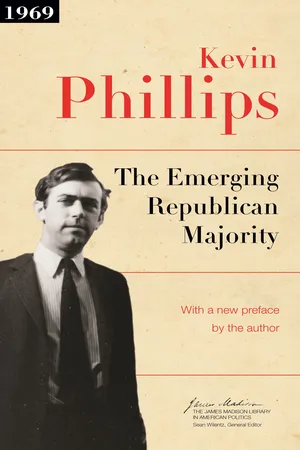
One of the most important and controversial books in modern American politics, The Emerging Republican Majority (1969) explained how Richard Nixon won the White House in 1968—and why the Republicans would go on to dominate presidential politics for the next quarter century. Rightly or wrongly, the book has widely been seen as a blueprint for how Republicans, using the so-called Southern Strategy, could build a durable winning coalition in presidential elections. Certainly, Nixon's election marked the end of a "New Deal Democratic hegemony" and the beginning of a conservative realignment encompassing historically Democratic voters from the South and the Florida-to-California "Sun Belt," in the book's enduring coinage. In accounting for that shift, Kevin Phillips showed how two decades and more of social and political changes had created enormous opportunities for a resurgent conservative Republican Party. For this new edition, Phillips has written a preface describing his view of the book, its reception, and how its analysis was borne out in subsequent elections.
A work whose legacy and influence are still fiercely debated, The Emerging Republican Majority is essential reading for anyone interested in American politics or history.
- 600 pages
- English
- ePUB (mobile friendly)
- Available on iOS & Android
eBook - ePub
About this book
Information
II
The Northeast
Since the eighteenth-century beginnings of the United States, the northeast, as the seat of national wealth, power, population and culture, has more often than not dominated American politics. The exceptions to this hegemony have been periods of popular rule—the Jeffersonian, Jacksonian and New Deal eras—during which Southern, Western and urban working-class upheaval displaced the party of powerful Northeastern interests. More than any other region, the Northeast can be relied upon to defend the politics of the past and the interests of the dominant American “establishment.” Such persisting loyalty produced nationally atypical support for the fading regimes and impetus of John Adams, John Quincy Adams and Herbert Hoover.
In George Washington’s day, the contemporary Northeast—the Middle Atlantic states and New England—was a heterogeneity of regional entities. New York, Boston, Philadelphia and Baltimore were centers of distinctive cultural and economic patterns. The first establishmentarian party, the Federalists, spoke for New England and the Seaboard mercantile aristocracy; they were followed by the Jeffersonians, whose popular politics gave way to a broader grouping of vested interests, only to be overturned in 1828 by the popular Jacksonians. After 1860, a new, powerful Northeastern Establishment of Boston and New York financiers, railroaders, New England manufacturers and Pennsylvania mine-owners and ironmongers, in control of the Republican Party, fought the South and won, profited extraordinarily and set a new course for the nation.
The Northeastern Establishment—those ruling powers which have historically played such an important national role—is not a fixed geographic, sociological, economic or ideological entity; it is a changing aggregation of vested interests, and Northeastern politics have shown a considerable tendency to change in its wake.
After the Civil War, the Northeastern industrial and commercial establishment espoused laissez faire and the locally controlled Republican Party, giving each more support than did any other part of the nation. Finally, the New Deal triumph of 1932 overthrew the old establishment, enthroning a new liberal impetus of expansive government. At first, the New Deal was Western, Southern, urban Catholic and anti-establishment, but as liberalism and the New Deal institutions took firm hold, they gave rise to a new establishment in the Northeast and became vested interests themselves. By 1968, there was a very real Northeastern Establishment centered on the profits of social and welfare spending, the knowledge industry, conglomerate corporatism, dollar internationalism and an interlocking directorate with the like-concerned power structure of political liberalism. Ever the mirror of establishmentarianism, the Northeast of 1968 was the most liberal and Democratic section of the United States (just as it was the most Federalist, anti-Jacksonian and anti-New Deal in bygone days). A new political cycle is beginning, and it is entirely commensurate with past history that loyalty to the existing order of things should be centered in the Northeast.
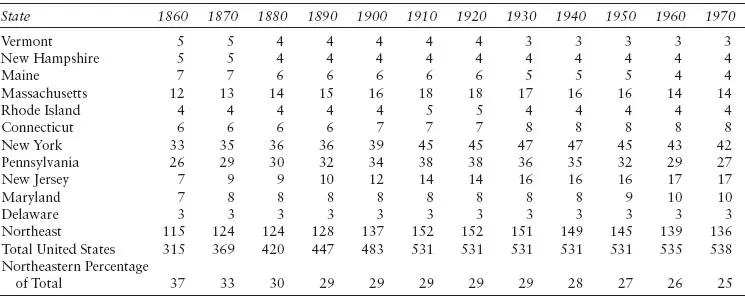
But if Northeastern politics flow onward in a dynamics of establishmentarianism, they do so with steadily less power to sway the nation. Every passing decade has shrunk the Northeast’s share of United States population. Chart 5 shows the steady decline in the percentage of the electoral vote for president cast by the Northeastern states in the century after the Civil War. Liberalism does not face a bright national future as a Northeastern-based establishmentarian impetus.
Chart 5. Northeastern Electoral Vote Strength, 1860–1970, Census Results and Projections
Given the establishmentarianism of the Northeast, it is fitting that the Northeast should be delineated by the Megalopolis, seat of the liberal Establishment. Thus drawn, the Northeast encompasses the eleven states north of the Potomac and east of the Appalachians, all of which save Vermont are traversed by the Megalopolis. As analyzed by geographer Jean Gottman, the Megalopolis is the massive urban-suburban corridor stretching from Washington, D.C. to Portland, Maine.1 It is no exaggeration to say that the Megalopolis is the sociocultural spinal column of the Northeast and the prime shaper of the region’s outlook. Even as the national power of the Northeast is on the wane, the Megalopolis’ share of the population within the region is growing. However, the Megalopolis is not everywhere dominant; part of the Northeast remains small-city and rural. Non-Megalopolitan politics are particularly influential in the six states of Maine, Vermont, New Hampshire, Delaware, Pennsylvania and Maryland. Prior to the mid-century emergence of the Megalopolis, the true Northeast was more limited in geopolitical scope, pivoting as it did on Northern Civil War tradition.
In the years between the Civil War and the New Deal (and especially between the war and 1896), two different traditions relating back to the fratricidal conflict divided the area now spanned by the Megalopolis. The division was regional rather than sociological. Maryland, Delaware and much of southern New Jersey and Pennsylvania looked to the South while New England, upstate New York and northern Pennsylvania were Yankee by culture and Republican by politics. Map 5 shows the contemporary Megalopolis-defined Northeast, together with the two rural sections of disparate tradition. However, the rise of the Megalopolis has withered the partisan Mason-Dixon line and Megalopolitan social conflicts are structuring a new era. Given the impact of the Megalopolis, the best way to fathom Northeastern political trends is to tear apart the regional political fabric and examine the many strands—rural Yankee, Negro, urban Catholic, silk-stocking and suburban—rather than discuss states or sections. But first a historical sketch is in order.
The Civil War period was a decisive one for the Northeast. For many years the South and the Northeast had been rivals for the nation’s future, and as the two competing socioeconomies moved west, they jealously divided the United States into slave and non-slave spheres of influence. Finally, the peace of Appomattox resolved the issue in favor of Yankeedom. Subsequent decades saw Northern industry expand, Northern capital multiply and Northern interests rule the country through the Republican Party which, having been born in the pre-war sectional struggle and baptized in wartime strife, was virtually an arm of Northern hegemony. By 1929, the laissez faire of Northern industrialism and Republicanism was obsolescent, it was no longer needed for nation-building, but history could not have been written so boldly by a lesser drive.
Throughout this entire period, non-Yankee and non-Republican traditions prevailed through considerable sections of the Northeast; areas that had neither sought the Civil War nor shared in its political and industrial fruits. Most of today’s history books oversimplify the Civil War; the loyalties of the time were quite complex. To many Northerners, the Civil War was a Yankee war, not a Northern war. Not only Border Marylanders and Delawareans, but a sizeable number of Pennsylvania Germans, Southern New Jerseyans, New York Irish, Hudson Valley landed conservatives and Ohio Valley farmers, feeling that none of their own interests were at stake in a war against the South, strongly objected to fighting a war for New England manufacturers and Pennsylvania ironmongers. To some of these groups, the South was their principal trade and produce outlet. For economic reasons, the New England states were the only bloc solidly behind the war. Beyond the boundaries of rabid New England, Northeastern war support was overwhelming only in upstate New York, northern Pennsylvania and the Great Lakes, all areas settled by New Englanders. The Civil War was principally a Yankee war and the party that fought it was principally a Yankee party. As the victors, the Northeast and the Republican party shared the spoils.
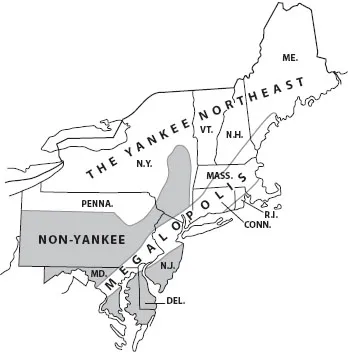
Map 5. The Northeast
The non-Yankee Northeast is essentially that part of the Northeast which was settled by non-New Englanders prior to the American Revolution. It included Hudson Valley Dutch, Schoharie Germans, Pennsylvania Germans, Scotch-Irish Appalachian uplanders, Quakers and the Southern-leaning inhabitants of Delaware Bay and Chesapeake Bay. New England is the cradle of the Yankee Northeast, but this latter section also includes most of upstate New York and part of Pennsylvania settled by New Englanders after the Revolution. Almost entirely Anglo-Saxon, the Yankee Northeast was the Nineteenth-Century seedbed of both the Civil War and the Republican Party, while the non-Yankee Northeast viewed both the war and the party with considerably less favor.
Since World War II, a number of Northeastern coastal cities and suburbs have fused into a practically contiguous corridor often called “Megalopolis.” The new sociological oppositions attendant upon the rise of this Megalopolis have blurred the rural cleavage stemming from Civil War traditions and cultural oppositions. Democratic traditions are fading in the non-Yankee Northeast and Republican traditions in the Yankee bastions.
Since World War II, a number of Northeastern coastal cities and suburbs have fused into a practically contiguous corridor often called “Megalopolis.” The new sociological oppositions attendant upon the rise of this Megalopolis have blurred the rural cleavage stemming from Civil War traditions and cultural oppositions. Democratic traditions are fading in the non-Yankee Northeast and Republican traditions in the Yankee bastions.
Contrary to public impression, the Civil War did not really create a Republican majority. As a matter of fact, once Northern military-supported Reconstruction governments surrendered their hold on the South, the GOP all but became a minority again, a détente, which persisted through 1896. The base of Republican power was exactly those Yankee districts where Civil War support had been greatest—New England, upstate New York, machine-run Pennsylvania and the Great Lakes. (In Ohio, Indiana and Illinois there were close fights, because Great Lakes Republicanism was counterbalanced by Democratic voting in the Southern-settled Ohio Valley.) Voting patterns tended to refight the Civil War.
In the years between the Civil War and 1896 (when William Jennings Bryan’s agrarian radicalism prompted conservative Democrats to flee to the GOP), Northeastern presidential preference divided along quite predictable lines. Maryland, Delaware and New Jersey—much of southern New Jersey lay below the Mason-Dixon line extended—normally voted for Democratic presidents; Vermont, Maine, New Hampshire, Massachusetts, Rhode Island and Pennsylvania always voted for the Republican nominee; and New York and Connecticut were highly marginal. In Delaware, Maryland, Pennsylvania and New Jersey, Democratic strength occurred in rural and Southern-leaning areas, but from New York north, Democratic support in Yankee country was principally Catholic. Charts 6 and 7 illustrate the presidential partisanship of t...
Table of contents
- Cover Page
- Title Page
- Copyright Page
- Dedication Page
- Contents
- General Editor’s Introduction
- Preface to the Princeton University Press edition
- Preface to the 1970 paperback edition
- I. Introduction
- II. The Northeast
- III. The South
- IV. The Heartland
- V. The Pacific States
- VI. The Future of American Politics
- Index
Trusted by 375,005 students
Access to over 1.5 million titles for a fair monthly price.
Study more efficiently using our study tools.
Frequently asked questions
Yes, you can cancel anytime from the Subscription tab in your account settings on the Perlego website. Your subscription will stay active until the end of your current billing period. Learn how to cancel your subscription
No, books cannot be downloaded as external files, such as PDFs, for use outside of Perlego. However, you can download books within the Perlego app for offline reading on mobile or tablet. Learn how to download books offline
Perlego offers two plans: Essential and Complete
- Essential is ideal for learners and professionals who enjoy exploring a wide range of subjects. Access the Essential Library with 800,000+ trusted titles and best-sellers across business, personal growth, and the humanities. Includes unlimited reading time and Standard Read Aloud voice.
- Complete: Perfect for advanced learners and researchers needing full, unrestricted access. Unlock 1.5M+ books across hundreds of subjects, including academic and specialized titles. The Complete Plan also includes advanced features like Premium Read Aloud and Research Assistant.
We are an online textbook subscription service, where you can get access to an entire online library for less than the price of a single book per month. With over 1.5 million books across 990+ topics, we’ve got you covered! Learn about our mission
Look out for the read-aloud symbol on your next book to see if you can listen to it. The read-aloud tool reads text aloud for you, highlighting the text as it is being read. You can pause it, speed it up and slow it down. Learn more about Read Aloud
Yes! You can use the Perlego app on both iOS and Android devices to read anytime, anywhere — even offline. Perfect for commutes or when you’re on the go.
Please note we cannot support devices running on iOS 13 and Android 7 or earlier. Learn more about using the app
Please note we cannot support devices running on iOS 13 and Android 7 or earlier. Learn more about using the app
Yes, you can access The Emerging Republican Majority by Kevin P. Phillips in PDF and/or ePUB format, as well as other popular books in Politics & International Relations & North American History. We have over 1.5 million books available in our catalogue for you to explore.