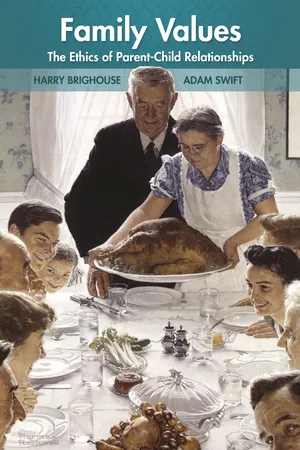
The family is hotly contested ideological terrain. Some defend the traditional two-parent heterosexual family while others welcome its demise. Opinions vary about how much control parents should have over their children's upbringing. Family Values provides a major new theoretical account of the morality and politics of the family, telling us why the family is valuable, who has the right to parent, and what rights parents should—and should not—have over their children.
Harry Brighouse and Adam Swift argue that parent-child relationships produce the "familial relationship goods" that people need to flourish. Children's healthy development depends on intimate relationships with authoritative adults, while the distinctive joys and challenges of parenting are part of a fulfilling life for adults. Yet the relationships that make these goods possible have little to do with biology, and do not require the extensive rights that parents currently enjoy. Challenging some of our most commonly held beliefs about the family, Brighouse and Swift explain why a child's interest in autonomy severely limits parents' right to shape their children's values, and why parents have no fundamental right to confer wealth or advantage on their children.
Family Values reaffirms the vital importance of the family as a social institution while challenging its role in the reproduction of social inequality and carefully balancing the interests of parents and children.
- 240 pages
- English
- ePUB (mobile friendly)
- Available on iOS & Android
eBook - ePub
About this book
Information
Publisher
Princeton University PressYear
2014Print ISBN
9780691173733
9780691126913
eBook ISBN
9781400852543
Topic
PhilosophySubtopic
Education Theory & PracticeTable of contents
- Cover Page
- Title Page
- Copyright Page
- Contents
- Preface
- Acknowledgments
- Part One: Liberty, Equality, Family
- Part Two: Justifying the Family
- Part Three: Parents’ Rights
- Conclusion
- Notes
- Bibliography
- Index
Trusted by 375,005 students
Access to over 1.5 million titles for a fair monthly price.
Study more efficiently using our study tools.
Frequently asked questions
Yes, you can cancel anytime from the Subscription tab in your account settings on the Perlego website. Your subscription will stay active until the end of your current billing period. Learn how to cancel your subscription
No, books cannot be downloaded as external files, such as PDFs, for use outside of Perlego. However, you can download books within the Perlego app for offline reading on mobile or tablet. Learn how to download books offline
Perlego offers two plans: Essential and Complete
- Essential is ideal for learners and professionals who enjoy exploring a wide range of subjects. Access the Essential Library with 800,000+ trusted titles and best-sellers across business, personal growth, and the humanities. Includes unlimited reading time and Standard Read Aloud voice.
- Complete: Perfect for advanced learners and researchers needing full, unrestricted access. Unlock 1.5M+ books across hundreds of subjects, including academic and specialized titles. The Complete Plan also includes advanced features like Premium Read Aloud and Research Assistant.
We are an online textbook subscription service, where you can get access to an entire online library for less than the price of a single book per month. With over 1.5 million books across 990+ topics, we’ve got you covered! Learn about our mission
Look out for the read-aloud symbol on your next book to see if you can listen to it. The read-aloud tool reads text aloud for you, highlighting the text as it is being read. You can pause it, speed it up and slow it down. Learn more about Read Aloud
Yes! You can use the Perlego app on both iOS and Android devices to read anytime, anywhere — even offline. Perfect for commutes or when you’re on the go.
Please note we cannot support devices running on iOS 13 and Android 7 or earlier. Learn more about using the app
Please note we cannot support devices running on iOS 13 and Android 7 or earlier. Learn more about using the app
Yes, you can access Family Values by Harry Brighouse,Adam Swift in PDF and/or ePUB format, as well as other popular books in Philosophy & Education Theory & Practice. We have over 1.5 million books available in our catalogue for you to explore.