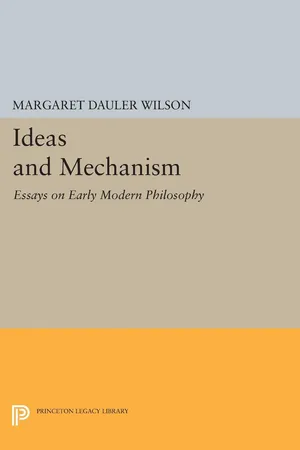
For more than three decades, Margaret Wilson's essays on early modern philosophy have influenced scholarly debate. Many are considered classics in the field and remain as important today as they were when they were first published. Until now, however, they have never been available in book form and some have been particularly difficult to find. This collection not only provides access to nearly all of Wilson's most significant work, but also demonstrates the continuity of her thought over time. These essays show that Wilson possesses a keen intelligence, coupled with a fearlessness in tackling the work of early modern philosophers as well as the writing of modern commentators. Many of the pieces collected here respond to philosophical issues of continuing importance.
The thirty-one essays gathered here deal with some of the best known early philosophers, including Descartes, Leibniz, Locke, Spinoza, and Berkeley. As this collection shows, Wilson is a demanding critic. She repeatedly asks whether the philosophers' arguments were adequate to the problems they were trying to solve and whether these arguments remain compelling today. She is not afraid to engage in complex argument but, at the same time, her own writing remains clear and fresh. Ideas and Mechanism is an essential collection of work by one of the leading scholars of our era.
Originally published in 1999.
The Princeton Legacy Library uses the latest print-on-demand technology to again make available previously out-of-print books from the distinguished backlist of Princeton University Press. These editions preserve the original texts of these important books while presenting them in durable paperback and hardcover editions. The goal of the Princeton Legacy Library is to vastly increase access to the rich scholarly heritage found in the thousands of books published by Princeton University Press since its founding in 1905.
- 545 pages
- English
- PDF
- Available on iOS & Android
eBook - PDF
About this book
Information
Publisher
Princeton University PressYear
2014Print ISBN
9780691606309
9780691635088
eBook ISBN
9781400864980
Topic
PhilosophySubtopic
North American HistoryTable of contents
- Cover
- Contents
- Preface
- Editions and Abbreviations
- 1 Skepticism Without Indubitability
- 2 Descartes on Sense and "Resemblance"
- 3 Descartes on the Perception of Primary Qualities
- 4 Descartes on the Origin of Sensation
- 5 Descartes on the Representationality of Sensation
- 6 Descartes: The Epistemological Argument for Mind-Body Distinctness
- 7 True and Immutable Natures
- 8 Can I Be the Cause of My Idea of the World? (Descartes on the Infinite and Indefinite)
- 9 Objects, Ideas, and "Minds": Comments on Spinoza's Theory of Mind
- 10 Spinoza's Causal Axiom (Ethics I, Axiom 4)
- 11 Infinite Understanding, Scientia Intuiliva, and Ethics I.16
- 12 "For They Do Not Agree in Nature with Us": Spinoza on the Lower Animals
- 13 Superadded Properties: The Limits of Mechanism in Locke
- 14 Discussion: Superadded Properties: A Reply to M. R. Ayers
- 15 Did Berkeley Completely Misunderstand the Basis of the Primary-Secondary Quality Distinction in Locke?
- 16 Berkeley on the Mind-Dependence of Colors
- 17 Berkeley and the Essence of the Corpuscularians
- 18 The Issue of "Common Sensibles" in Berkeley's New Theory of Vision
- 19 Kant and "The Dogmatic Idealism of Berkeley"
- 20 The "Phenomenalisms" of Berkeley and Kant
- 21 The "Phenomenalisms" of Leibniz and Berkeley
- 22 Confused Ideas
- 23 Confused vs. Distinct Perception in Leibniz: Consciousness, Representation, and God's Mind
- 24 Leibniz and Locke on "First Truths"
- 25 Leibniz: Self-Consciousness and Immortality in the Paris Notes and After
- 26 Leibniz and Materialsm
- 27 Possible Gods
- 28 Leibniz's Dynamics and Contingency in Nature
- 29 Compossibility and Law
- 30 History of Philosophy in Philosophy Today; And the Case of the Sensible Qualities
- 31 Animal Ideas
- Sources and Acknowledgments
- Index
Trusted by 375,005 students
Access to over 1.5 million titles for a fair monthly price.
Study more efficiently using our study tools.
Frequently asked questions
Yes, you can cancel anytime from the Subscription tab in your account settings on the Perlego website. Your subscription will stay active until the end of your current billing period. Learn how to cancel your subscription
No, books cannot be downloaded as external files, such as PDFs, for use outside of Perlego. However, you can download books within the Perlego app for offline reading on mobile or tablet. Learn how to download books offline
Perlego offers two plans: Essential and Complete
- Essential is ideal for learners and professionals who enjoy exploring a wide range of subjects. Access the Essential Library with 800,000+ trusted titles and best-sellers across business, personal growth, and the humanities. Includes unlimited reading time and Standard Read Aloud voice.
- Complete: Perfect for advanced learners and researchers needing full, unrestricted access. Unlock 1.5M+ books across hundreds of subjects, including academic and specialized titles. The Complete Plan also includes advanced features like Premium Read Aloud and Research Assistant.
We are an online textbook subscription service, where you can get access to an entire online library for less than the price of a single book per month. With over 1.5 million books across 990+ topics, we’ve got you covered! Learn about our mission
Look out for the read-aloud symbol on your next book to see if you can listen to it. The read-aloud tool reads text aloud for you, highlighting the text as it is being read. You can pause it, speed it up and slow it down. Learn more about Read Aloud
Yes! You can use the Perlego app on both iOS and Android devices to read anytime, anywhere — even offline. Perfect for commutes or when you’re on the go.
Please note we cannot support devices running on iOS 13 and Android 7 or earlier. Learn more about using the app
Please note we cannot support devices running on iOS 13 and Android 7 or earlier. Learn more about using the app
Yes, you can access Ideas and Mechanism by Margaret Dauler Wilson in PDF and/or ePUB format, as well as other popular books in Philosophy & North American History. We have over 1.5 million books available in our catalogue for you to explore.