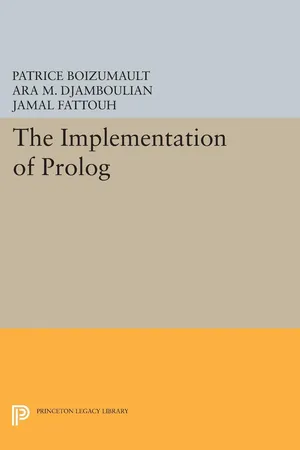
A semantically well-defined programming language widely used in artificial intelligence, Prolog has greatly influenced other programming languages since its introduction in the late 1970s. A user may find Prolog deceptively easy, however, and there are a number of different implementations. In this book Patrice Boizumault draws from his extensive experience in Prolog implementation to describe for students of all levels the concepts, difficulties, and design limits of a Prolog system.
Boizumault introduces the specific problems posed by the implementation of Prolog, studies and compares different solutions--notably those of the schools of Marseilles and Edinburgh--and concludes with three examples of implementation. Major points of interest include identifying the important differences in implementing unification and resolution; presenting three features of Prolog II--infinite trees, dif, and freeze--that introduce constraints; thoroughly describing Warren's Abstract Machine (WAM); and detailing a Lisp imple-mentation of Prolog.
Originally published in 1993.
The Princeton Legacy Library uses the latest print-on-demand technology to again make available previously out-of-print books from the distinguished backlist of Princeton University Press. These editions preserve the original texts of these important books while presenting them in durable paperback and hardcover editions. The goal of the Princeton Legacy Library is to vastly increase access to the rich scholarly heritage found in the thousands of books published by Princeton University Press since its founding in 1905.
eBook - PDF
The Implementation of Prolog
- 313 pages
- English
- PDF
- Available on iOS & Android
eBook - PDF
The Implementation of Prolog
About this book
Information
Publisher
Princeton University PressYear
2014Print ISBN
9780691609393
9780691087573
eBook ISBN
9781400863440
Table of contents
- Cover
- Contents
- Foreword
- Acknowledgments
- Introduction
- Part I Fundamental Principles of the Language
- Part II Principles and Techniques of Implementation
- Part II Implementations
- Conclusion
- Appendix A Mini-Cprolog
- Appendix B Mini-WAM
- Appendix C Mini-Prolog-II
- Appendix D Common Part
- Bibliography
Trusted by 375,005 students
Access to over 1.5 million titles for a fair monthly price.
Study more efficiently using our study tools.
Frequently asked questions
Yes, you can cancel anytime from the Subscription tab in your account settings on the Perlego website. Your subscription will stay active until the end of your current billing period. Learn how to cancel your subscription
No, books cannot be downloaded as external files, such as PDFs, for use outside of Perlego. However, you can download books within the Perlego app for offline reading on mobile or tablet. Learn how to download books offline
Perlego offers two plans: Essential and Complete
- Essential is ideal for learners and professionals who enjoy exploring a wide range of subjects. Access the Essential Library with 800,000+ trusted titles and best-sellers across business, personal growth, and the humanities. Includes unlimited reading time and Standard Read Aloud voice.
- Complete: Perfect for advanced learners and researchers needing full, unrestricted access. Unlock 1.5M+ books across hundreds of subjects, including academic and specialized titles. The Complete Plan also includes advanced features like Premium Read Aloud and Research Assistant.
We are an online textbook subscription service, where you can get access to an entire online library for less than the price of a single book per month. With over 1.5 million books across 990+ topics, we’ve got you covered! Learn about our mission
Look out for the read-aloud symbol on your next book to see if you can listen to it. The read-aloud tool reads text aloud for you, highlighting the text as it is being read. You can pause it, speed it up and slow it down. Learn more about Read Aloud
Yes! You can use the Perlego app on both iOS and Android devices to read anytime, anywhere — even offline. Perfect for commutes or when you’re on the go.
Please note we cannot support devices running on iOS 13 and Android 7 or earlier. Learn more about using the app
Please note we cannot support devices running on iOS 13 and Android 7 or earlier. Learn more about using the app
Yes, you can access The Implementation of Prolog by Patrice Boizumault, Jamal Fattouh, Ara M. Djamboulian, Jamal Fattouh,Ara M. Djamboulian in PDF and/or ePUB format, as well as other popular books in Mathematics & Linear & Nonlinear Programming. We have over 1.5 million books available in our catalogue for you to explore.