The tumult of the Cultural Revolution after 1966 is often blamed on a few leaders in Beijing, or on long-term egalitarian ideals, or on communist or Chinese political cultures. Lynn White shows, however, that the chaos resulted mainly from reactions by masses of individuals and small groups to three specific policies of administrative manipulation: labeling groups, designating bosses, and legitimating violence in political campaigns. These habits of local organization were common after 1949 and gave the state success in short-term revolutionary aims, despite scarce resources and staff--but they also drove millions to attack each other later.
First, measures accumulated before 1966 to give people bad or good names (such as "rightist" or "worker"); these set a family's access to employment, education, residence, and rations--so they gave interests to potential conflict groups. Second, policies for bossism went far beyond Confucian patronage patterns, making work units tightly dependent on Party monitors--so rational individuals either pandered to local bosses or (when they could) deposed them. Third, the institutionalized violence of political campaigns both mobilized activists and scared others into compliance. These organizational measures were often effective in the short run before 1966 but accumulated social costs that China paid later. The book ends with comparisons to past cases of mass urban ostracism in other countries, and it suggests how such tragedies may be forecast or prevented in the future.
Originally published in 1989.
The Princeton Legacy Library uses the latest print-on-demand technology to again make available previously out-of-print books from the distinguished backlist of Princeton University Press. These editions preserve the original texts of these important books while presenting them in durable paperback and hardcover editions. The goal of the Princeton Legacy Library is to vastly increase access to the rich scholarly heritage found in the thousands of books published by Princeton University Press since its founding in 1905.
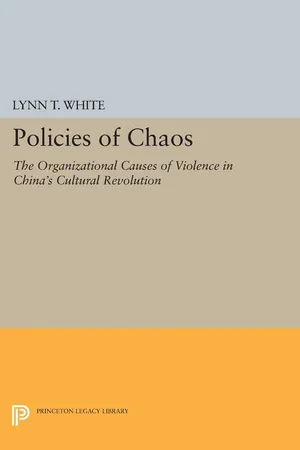
eBook - PDF
Policies of Chaos
The Organizational Causes of Violence in China's Cultural Revolution
- 381 pages
- English
- PDF
- Available on iOS & Android
eBook - PDF
Policies of Chaos
The Organizational Causes of Violence in China's Cultural Revolution
About this book
Information
Publisher
Princeton University PressYear
2014Print ISBN
9780691008769
9780691055466
eBook ISBN
9781400860579
Topic
HistoireSubtopic
Histoire de la ChineTable of contents
- Cover
- Contents
- Acknowledgments
- Abbreviations
- Romanizations
- 1 What the Cultural Revolution Was, and Why It Happened
- 2 Workers and Managers: New Democracy vs. Socialism, 1949-1956
- 3 Students and Residents: Policing vs. Patriotism, 1949-1956
- 4 Workers and Managers: The Transition to Socialism, 1956-1957
- 5 Students and Residents: Flowers, Coercion, and Minds, 1956-1957
- 6 The Great Leap Forward and Salvation by Work, 1958-1962
- 7 Exhaustion in the Leap Among Residents and Intellectuals, 1958-1962
- 8 Tightening Control over the Economy, 1962-1966
- 9 A Standardized System for Urban Statuses, 1962-1966
- 10 Maoists Try to Remake Management, 1966-1968
- 11 Conflict Among Local Symbol Makers, 1966-1968
- 12 Conclusion: Causes and Lessons of the Tragedy
- Bibliography
- Index
Trusted by 375,005 students
Access to over 1.5 million titles for a fair monthly price.
Study more efficiently using our study tools.
Frequently asked questions
Yes, you can cancel anytime from the Subscription tab in your account settings on the Perlego website. Your subscription will stay active until the end of your current billing period. Learn how to cancel your subscription
No, books cannot be downloaded as external files, such as PDFs, for use outside of Perlego. However, you can download books within the Perlego app for offline reading on mobile or tablet. Learn how to download books offline
Perlego offers two plans: Essential and Complete
- Essential is ideal for learners and professionals who enjoy exploring a wide range of subjects. Access the Essential Library with 800,000+ trusted titles and best-sellers across business, personal growth, and the humanities. Includes unlimited reading time and Standard Read Aloud voice.
- Complete: Perfect for advanced learners and researchers needing full, unrestricted access. Unlock 1.5M+ books across hundreds of subjects, including academic and specialized titles. The Complete Plan also includes advanced features like Premium Read Aloud and Research Assistant.
We are an online textbook subscription service, where you can get access to an entire online library for less than the price of a single book per month. With over 1.5 million books across 990+ topics, we’ve got you covered! Learn about our mission
Look out for the read-aloud symbol on your next book to see if you can listen to it. The read-aloud tool reads text aloud for you, highlighting the text as it is being read. You can pause it, speed it up and slow it down. Learn more about Read Aloud
Yes! You can use the Perlego app on both iOS and Android devices to read anytime, anywhere — even offline. Perfect for commutes or when you’re on the go.
Please note we cannot support devices running on iOS 13 and Android 7 or earlier. Learn more about using the app
Please note we cannot support devices running on iOS 13 and Android 7 or earlier. Learn more about using the app
Yes, you can access Policies of Chaos by Lynn T. White III in PDF and/or ePUB format, as well as other popular books in Histoire & Histoire de la Chine. We have over 1.5 million books available in our catalogue for you to explore.