Writing with the vigor and elan that readers have come to expect from his many astute reviews and essays, Willard Spiegelman maintains that contemporary American poets have returned to the poetic aims of an earlier era: to edify, as well as to delight, and thus to serve the "didactic muse." What Spiegelman says about individual poets--such as Nemerov, Hecht, Ginsberg, Pinsky, Ammons, Rich, and Merrill, among others--is wonderfully insightful. Furthermore, his outlook on their work--the way he takes quite literally the teacherly elements of their poems--challenges long-standing conceptions both about contemporary writing and about the poetry of the Eliot-Pound-Stevens-Williams generation. Beginning the book with a meditation on W. H. Auden's legacy to American poets, Spiegelman ends with a discussion of the multiple scenes of learning in Merrill's The Changing Light at Sandover, which he identifies as not only the major epic poem of the second half of the twentieth century but also as the period's most important georgic: a textbook full of scientific, mythic, artistic, and human instruction. The Didactic Muse reminds us that poets have traditionally acknowledged their function as teachers, from Horace's advice that poetry should please and instruct to Robert Frost's aphorism that a poem "begins in delight and ends in wisdom." Whereas many of the critical remarks of the most important Romantic and modern poets suggest their desperate attempts to separate poetry from instruction, Spiegelman demonstrates that their practices often contradicted their theories. And he shows that our best contemporary poets are now embracing the older, classical paradigms.
Originally published in 1989.
The Princeton Legacy Library uses the latest print-on-demand technology to again make available previously out-of-print books from the distinguished backlist of Princeton University Press. These editions preserve the original texts of these important books while presenting them in durable paperback and hardcover editions. The goal of the Princeton Legacy Library is to vastly increase access to the rich scholarly heritage found in the thousands of books published by Princeton University Press since its founding in 1905.
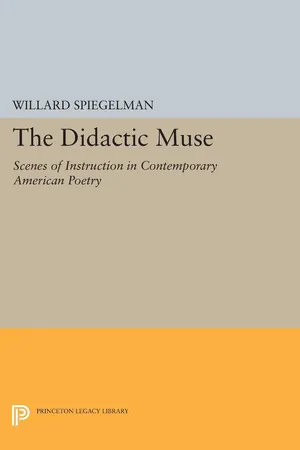
eBook - PDF
The Didactic Muse
Scenes of Instruction in Contemporary American Poetry
- 291 pages
- English
- PDF
- Available on iOS & Android
eBook - PDF
About this book
Information
Publisher
Princeton University PressYear
2014Print ISBN
9780691014609
9780691067995
eBook ISBN
9781400860265
Table of contents
- Cover
- Contents
- Acknowledgments
- 1 Introduction: W. H. Auden's "New Year Letter"
- 2 The Tempered Tone of Howard Nemerov
- 3 The Moral Imperative in Anthony Hecht, Allen Ginsberg, and Robert Pinsky
- 4 Myths of Concretion, Myths of Abstraction: The Case of A. R. Ammons
- 5 "Driving to the Limits of the City of Words": The Poetry of Adrienne Rich
- 6 The Sacred Books of James Merrill
- 7 Some Speculations in Place of a Conclusion
- Notes
- Index
Trusted by 375,005 students
Access to over 1.5 million titles for a fair monthly price.
Study more efficiently using our study tools.
Frequently asked questions
Yes, you can cancel anytime from the Subscription tab in your account settings on the Perlego website. Your subscription will stay active until the end of your current billing period. Learn how to cancel your subscription
No, books cannot be downloaded as external files, such as PDFs, for use outside of Perlego. However, you can download books within the Perlego app for offline reading on mobile or tablet. Learn how to download books offline
Perlego offers two plans: Essential and Complete
- Essential is ideal for learners and professionals who enjoy exploring a wide range of subjects. Access the Essential Library with 800,000+ trusted titles and best-sellers across business, personal growth, and the humanities. Includes unlimited reading time and Standard Read Aloud voice.
- Complete: Perfect for advanced learners and researchers needing full, unrestricted access. Unlock 1.5M+ books across hundreds of subjects, including academic and specialized titles. The Complete Plan also includes advanced features like Premium Read Aloud and Research Assistant.
We are an online textbook subscription service, where you can get access to an entire online library for less than the price of a single book per month. With over 1.5 million books across 990+ topics, we’ve got you covered! Learn about our mission
Look out for the read-aloud symbol on your next book to see if you can listen to it. The read-aloud tool reads text aloud for you, highlighting the text as it is being read. You can pause it, speed it up and slow it down. Learn more about Read Aloud
Yes! You can use the Perlego app on both iOS and Android devices to read anytime, anywhere — even offline. Perfect for commutes or when you’re on the go.
Please note we cannot support devices running on iOS 13 and Android 7 or earlier. Learn more about using the app
Please note we cannot support devices running on iOS 13 and Android 7 or earlier. Learn more about using the app
Yes, you can access The Didactic Muse by Willard Spiegelman in PDF and/or ePUB format, as well as other popular books in Literature & Literary Criticism in Poetry. We have over 1.5 million books available in our catalogue for you to explore.