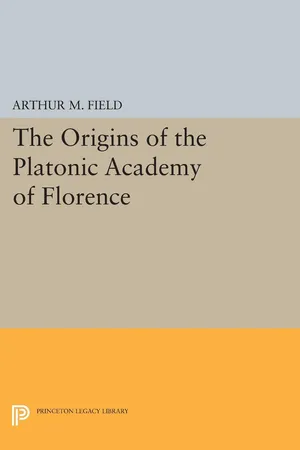
Founded by Cosimo de' Medici in the early 1460s, the Platonic Academy shaped the literary and artistic culture of Florence in the later Renaissance and influenced science, religion, art, and literature throughout Europe in the early modern period. This major study of the Academy's beginnings presents a fresh view of the intellectual and cultural life of Florence from the Peace of Lodi of 1454 to the death of Cosimo a decade later. Challenging commonly held assumptions about the period, Arthur Field insists that the Academy was not a hothouse plant, grown and kept alive by the Medici in the splendid isolation of their villas and courts. Rather, Florentine intellectuals seized on the Platonic truths and propagated them in the heart of Florence, creating for the Medici and other Florentines a new ideology.
Based largely on new or neglected manuscript sources, this book includes discussions of the earliest works by the head of the Academy, Marsilio Ficino, and the first public, Platonizing lectures of the humanist and poet Cristoforo Landino. The author also examines the contributions both of religious orders and of the Byzantines to the Neoplatonic revival.
Originally published in 1988.
The Princeton Legacy Library uses the latest print-on-demand technology to again make available previously out-of-print books from the distinguished backlist of Princeton University Press. These editions preserve the original texts of these important books while presenting them in durable paperback and hardcover editions. The goal of the Princeton Legacy Library is to vastly increase access to the rich scholarly heritage found in the thousands of books published by Princeton University Press since its founding in 1905.
- 319 pages
- English
- PDF
- Available on iOS & Android
eBook - PDF
The Origins of the Platonic Academy of Florence
About this book
Information
Publisher
Princeton University PressYear
2014Print ISBN
9780691601694
9780691631332
eBook ISBN
9781400859764
Table of contents
- Cover
- Contents
- Preface
- Note on the Text
- Abbreviations
- Part 1 The Philosophical Renaissance and the Role of Intellectuals
- Part 2 The Florentine Lyceum
- Part 3 The Florentine Academy
- Conclusion
- Appendix A: One or Two Lorenzo Pisanos?
- Appendix B: Lorenzo Pisano's De Amore
- Appendix C: Some Notes on Minor Works of Lorenzo Pisano
- Select Bibliography
- Index of Manuscripts
- General Index
Trusted by 375,005 students
Access to over 1.5 million titles for a fair monthly price.
Study more efficiently using our study tools.
Frequently asked questions
Yes, you can cancel anytime from the Subscription tab in your account settings on the Perlego website. Your subscription will stay active until the end of your current billing period. Learn how to cancel your subscription
No, books cannot be downloaded as external files, such as PDFs, for use outside of Perlego. However, you can download books within the Perlego app for offline reading on mobile or tablet. Learn how to download books offline
Perlego offers two plans: Essential and Complete
- Essential is ideal for learners and professionals who enjoy exploring a wide range of subjects. Access the Essential Library with 800,000+ trusted titles and best-sellers across business, personal growth, and the humanities. Includes unlimited reading time and Standard Read Aloud voice.
- Complete: Perfect for advanced learners and researchers needing full, unrestricted access. Unlock 1.5M+ books across hundreds of subjects, including academic and specialized titles. The Complete Plan also includes advanced features like Premium Read Aloud and Research Assistant.
We are an online textbook subscription service, where you can get access to an entire online library for less than the price of a single book per month. With over 1.5 million books across 990+ topics, we’ve got you covered! Learn about our mission
Look out for the read-aloud symbol on your next book to see if you can listen to it. The read-aloud tool reads text aloud for you, highlighting the text as it is being read. You can pause it, speed it up and slow it down. Learn more about Read Aloud
Yes! You can use the Perlego app on both iOS and Android devices to read anytime, anywhere — even offline. Perfect for commutes or when you’re on the go.
Please note we cannot support devices running on iOS 13 and Android 7 or earlier. Learn more about using the app
Please note we cannot support devices running on iOS 13 and Android 7 or earlier. Learn more about using the app
Yes, you can access The Origins of the Platonic Academy of Florence by Arthur M. Field in PDF and/or ePUB format, as well as other popular books in History & Italian History. We have over 1.5 million books available in our catalogue for you to explore.