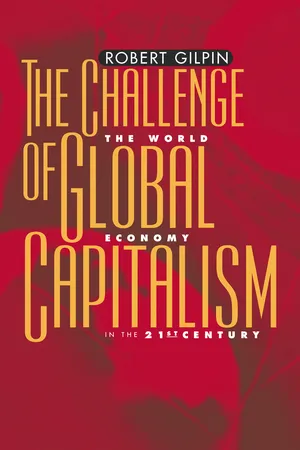
Many individuals proclaim that global capitalism is here to stay. Unfettered markets, they argue, now drive the world, and all countries must adjust, no matter how painful this may be for some. Robert Gilpin, author of the widely acclaimed Political Economy of International Relations (Princeton, 1987), urges us, however, not to take an open and integrated global economy for granted. Rather, we must consider the political circumstances that have enabled global markets to function and the probability that these conditions will continue. Gilpin's new book amounts to a magisterial inquiry into all major aspects of the contemporary world political economy. Beginning with the 1989 end of the Cold War and the subsequent collapse of communism, it focuses on globalization and rapid technological change and covers a broad sweep of economic developments and political cultures. Gilpin demonstrates the fragility of a global and integrated economy and recommends what can be done to strengthen it.
The international community has another chance to solidify the global market economy that collapsed with the outbreak of World War I. Yet, writes Gilpin, the full implications of this historic development for international affairs are not yet clear. Will socialist economies make a successful transition to market-type economies? What role will a dynamic China play in the world economy? Will the United States continue to exercise leadership or gravitate toward self-centered policies? Gilpin explores such questions along with problems in the areas of trade liberalization, multinational corporations, and destabilizing financial flows. He also investigates the struggles of less developed countries and the spread of economic regionalism, particularly in Europe, North America, and Pacific Asia, which directly threatens an open world economy.
The author maintains that global capitalism and economic globalization have rested and must continue to rest on a secure political foundation. However, this foundation has eroded since the end of the Soviet threat. To ensure survival of the global economy, Gilpin concludes, the United States and other major powers must recommit themselves to working together to rebuild its weakened political foundations.
- 408 pages
- English
- PDF
- Available on iOS & Android
eBook - PDF
About this book
Information
Publisher
Princeton University PressYear
2018Print ISBN
9780691092799
9780691049359
eBook ISBN
9780691186474
Table of contents
- Cover
- Title Page
- Copyright Page
- Contents
- List of Illustrations
- Preface to the Paperback Edition
- Acknowledgments
- List of Abbreviations
- INTRODUCTION: The Fragile Global Economy
- CHAPTER ONE: The Second Great Age of Capitalism
- CHAPTER TWO: The Cold War International Economy
- CHAPTER THREE: The Insecure Trading System
- CHAPTER FOUR: The Unstable Monetary System
- CHAPTER FIVE: Global Financial Vulnerability
- CHAPTER SIX: Age of the Multinational
- CHAPTER SEVEN: European Regional Integration
- CHAPTER EIGHT: American Economic Strategy
- CHAPTER NINE: Asian Regionalism
- CHAPTER TEN: Globalization and Its Discontents
- CHAPTER ELEVEN: Managing the Global Economy
- Notes
- Select Bibliography
- Index
Trusted by 375,005 students
Access to over 1.5 million titles for a fair monthly price.
Study more efficiently using our study tools.
Frequently asked questions
Yes, you can cancel anytime from the Subscription tab in your account settings on the Perlego website. Your subscription will stay active until the end of your current billing period. Learn how to cancel your subscription
No, books cannot be downloaded as external files, such as PDFs, for use outside of Perlego. However, you can download books within the Perlego app for offline reading on mobile or tablet. Learn how to download books offline
We are an online textbook subscription service, where you can get access to an entire online library for less than the price of a single book per month. With over 1.5 million books across 990+ topics, we’ve got you covered! Learn about our mission
Look out for the read-aloud symbol on your next book to see if you can listen to it. The read-aloud tool reads text aloud for you, highlighting the text as it is being read. You can pause it, speed it up and slow it down. Learn more about Read Aloud
Yes! You can use the Perlego app on both iOS and Android devices to read anytime, anywhere — even offline. Perfect for commutes or when you’re on the go.
Please note we cannot support devices running on iOS 13 and Android 7 or earlier. Learn more about using the app
Please note we cannot support devices running on iOS 13 and Android 7 or earlier. Learn more about using the app
Yes, you can access The Challenge of Global Capitalism by Robert G. Gilpin in PDF and/or ePUB format, as well as other popular books in Business & Business internazionale. We have over 1.5 million books available in our catalogue for you to explore.