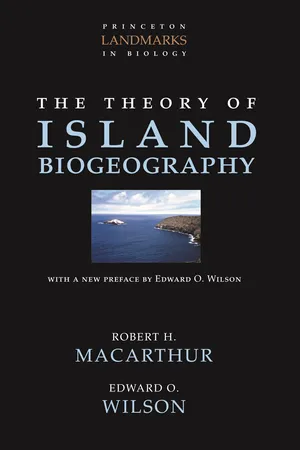
Biogeography was stuck in a "natural history phase" dominated by the collection of data, the young Princeton biologists Robert H. MacArthur and Edward O. Wilson argued in 1967. In this book, the authors developed a general theory to explain the facts of island biogeography. The theory builds on the first principles of population ecology and genetics to explain how distance and area combine to regulate the balance between immigration and extinction in island populations. The authors then test the theory against data. The Theory of Island Biogeography was never intended as the last word on the subject. Instead, MacArthur and Wilson sought to stimulate new forms of theoretical and empirical studies, which will lead in turn to a stronger general theory. Even a third of a century since its publication, the book continues to serve that purpose well. From popular books like David Quammen's Song of the Dodo to arguments in the professional literature, The Theory of Island Biogeography remains at the center of discussions about the geographic distribution of species. In a new preface, Edward O. Wilson reviews the origins and consequences of this classic book.
- 221 pages
- English
- PDF
- Available on iOS & Android
eBook - PDF
The Theory of Island Biogeography
About this book
Information
Publisher
Princeton University PressYear
2016Print ISBN
9780691623085
9780691080499
eBook ISBN
9781400881376
Table of contents
- Cover
- Title
- Copyright
- Contents
- Preface to the Princeton Landmarks in Biology Edition
- Preface
- Symbols Used
- 1. The Importance of Islands
- 2. Area and Number of Species
- 3. Further Explanations of the Area-Diversity Pattern
- 4. The Strategy of Colonization
- 5. Invasibility and the Variable Niche
- 6. Stepping Stones and Biotic Exchange
- 7. Evolutionary Changes Following Colonization
- 8. Prospect
- Glossary
- References
- Index
Trusted by 375,005 students
Access to over 1.5 million titles for a fair monthly price.
Study more efficiently using our study tools.
Frequently asked questions
Yes, you can cancel anytime from the Subscription tab in your account settings on the Perlego website. Your subscription will stay active until the end of your current billing period. Learn how to cancel your subscription
No, books cannot be downloaded as external files, such as PDFs, for use outside of Perlego. However, you can download books within the Perlego app for offline reading on mobile or tablet. Learn how to download books offline
Perlego offers two plans: Essential and Complete
- Essential is ideal for learners and professionals who enjoy exploring a wide range of subjects. Access the Essential Library with 800,000+ trusted titles and best-sellers across business, personal growth, and the humanities. Includes unlimited reading time and Standard Read Aloud voice.
- Complete: Perfect for advanced learners and researchers needing full, unrestricted access. Unlock 1.5M+ books across hundreds of subjects, including academic and specialized titles. The Complete Plan also includes advanced features like Premium Read Aloud and Research Assistant.
We are an online textbook subscription service, where you can get access to an entire online library for less than the price of a single book per month. With over 1.5 million books across 990+ topics, we’ve got you covered! Learn about our mission
Look out for the read-aloud symbol on your next book to see if you can listen to it. The read-aloud tool reads text aloud for you, highlighting the text as it is being read. You can pause it, speed it up and slow it down. Learn more about Read Aloud
Yes! You can use the Perlego app on both iOS and Android devices to read anytime, anywhere — even offline. Perfect for commutes or when you’re on the go.
Please note we cannot support devices running on iOS 13 and Android 7 or earlier. Learn more about using the app
Please note we cannot support devices running on iOS 13 and Android 7 or earlier. Learn more about using the app
Yes, you can access The Theory of Island Biogeography by Robert H. MacArthur,Edward O. Wilson in PDF and/or ePUB format, as well as other popular books in Biological Sciences & Biology. We have over 1.5 million books available in our catalogue for you to explore.