People have always been xenophobic, but an explicit philosophical and scientific view of human racial difference only began to emerge during the modern period. Why and how did this happen? Surveying a range of philosophical and natural-scientific texts, dating from the Spanish Renaissance to the German Enlightenment, Nature, Human Nature, and Human Difference charts the evolution of the modern concept of race and shows that natural philosophy, particularly efforts to taxonomize and to order nature, played a crucial role.
Smith demonstrates how the denial of moral equality between Europeans and non-Europeans resulted from converging philosophical and scientific developments, including a declining belief in human nature's universality and the rise of biological classification. The racial typing of human beings grew from the need to understand humanity within an all-encompassing system of nature, alongside plants, minerals, primates, and other animals. While racial difference as seen through science did not arise in order to justify the enslavement of people, it became a rationalization and buttress for the practices of trans-Atlantic slavery. From the work of François Bernier to G. W. Leibniz, Immanuel Kant, and others, Smith delves into philosophy's part in the legacy and damages of modern racism.
With a broad narrative stretching over two centuries, Nature, Human Nature, and Human Difference takes a critical historical look at how the racial categories that we divide ourselves into came into being.
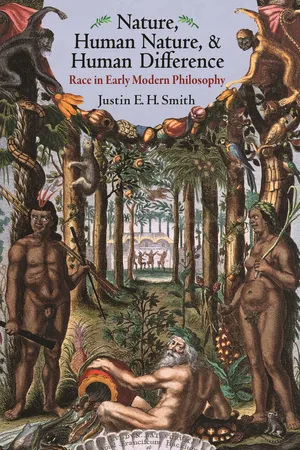
eBook - ePub
Nature, Human Nature, and Human Difference
Race in Early Modern Philosophy
- 312 pages
- English
- ePUB (mobile friendly)
- Available on iOS & Android
eBook - ePub
About this book
Information
Publisher
Princeton University PressYear
2015Print ISBN
9780691176345
9780691153643
eBook ISBN
9781400866311
Topic
PhilosophySubtopic
Social HistoryTable of contents
- Cover Page
- Title Page
- Copyright Page
- Contents
- Acknowledgments
- A Note on Citations and Terminology
- Introduction
- Chapter 1: Curious Kinks
- Chapter 2: Toward a Historical Ontology of Race
- Chapter 3: New Worlds
- Chapter 4: The Specter of Polygenesis
- Chapter 5: Diversity as Degeneration
- Chapter 6: From Lineage to Biogeography
- Chapter 7: Leibniz on Human Equality and Human Domination
- Chapter 8: Anton Wilhelm Amo
- Chapter 9: Race and Its Discontents in the Enlightenment
- Conclusion
- Biographical Notes
- Bibliography
- Index
Trusted by 375,005 students
Access to over 1.5 million titles for a fair monthly price.
Study more efficiently using our study tools.
Frequently asked questions
Yes, you can cancel anytime from the Subscription tab in your account settings on the Perlego website. Your subscription will stay active until the end of your current billing period. Learn how to cancel your subscription
No, books cannot be downloaded as external files, such as PDFs, for use outside of Perlego. However, you can download books within the Perlego app for offline reading on mobile or tablet. Learn how to download books offline
Perlego offers two plans: Essential and Complete
- Essential is ideal for learners and professionals who enjoy exploring a wide range of subjects. Access the Essential Library with 800,000+ trusted titles and best-sellers across business, personal growth, and the humanities. Includes unlimited reading time and Standard Read Aloud voice.
- Complete: Perfect for advanced learners and researchers needing full, unrestricted access. Unlock 1.5M+ books across hundreds of subjects, including academic and specialized titles. The Complete Plan also includes advanced features like Premium Read Aloud and Research Assistant.
We are an online textbook subscription service, where you can get access to an entire online library for less than the price of a single book per month. With over 1.5 million books across 990+ topics, we’ve got you covered! Learn about our mission
Look out for the read-aloud symbol on your next book to see if you can listen to it. The read-aloud tool reads text aloud for you, highlighting the text as it is being read. You can pause it, speed it up and slow it down. Learn more about Read Aloud
Yes! You can use the Perlego app on both iOS and Android devices to read anytime, anywhere — even offline. Perfect for commutes or when you’re on the go.
Please note we cannot support devices running on iOS 13 and Android 7 or earlier. Learn more about using the app
Please note we cannot support devices running on iOS 13 and Android 7 or earlier. Learn more about using the app
Yes, you can access Nature, Human Nature, and Human Difference by Justin Smith-Ruiu in PDF and/or ePUB format, as well as other popular books in Philosophy & Social History. We have over 1.5 million books available in our catalogue for you to explore.