How a Greek philosopher's encounters with Buddhism in Central Asia influenced Western philosophy
Pyrrho of Elis went with Alexander the Great to Central Asia and India during the Greek invasion and conquest of the Persian Empire in 334–324 BC. There he met with early Buddhist masters. Greek Buddha shows how their Early Buddhism shaped the philosophy of Pyrrho, the famous founder of Pyrrhonian scepticism in ancient Greece.
Christopher I. Beckwith traces the origins of a major tradition in Western philosophy to Gandhara, a country in Central Asia and northwestern India. He systematically examines the teachings and practices of Pyrrho and of Early Buddhism, including those preserved in testimonies by and about Pyrrho, in the report on Indian philosophy two decades later by the Seleucid ambassador Megasthenes, in the first-person edicts by the Indian king Devanampriya Priyadarsi referring to a popular variety of the Dharma in the early third century BC, and in Taoist echoes of Gautama's Dharma in Warring States China. Beckwith demonstrates how the teachings of Pyrrho agree closely with those of the Buddha Sakyamuni, "the Scythian Sage." In the process, he identifies eight distinct philosophical schools in ancient northwestern India and Central Asia, including Early Zoroastrianism, Early Brahmanism, and several forms of Early Buddhism. He then shows the influence that Pyrrho's brand of scepticism had on the evolution of Western thought, first in Antiquity, and later, during the Enlightenment, on the great philosopher and self-proclaimed Pyrrhonian, David Hume.
Greek Buddha demonstrates that through Pyrrho, Early Buddhist thought had a major impact on Western philosophy.
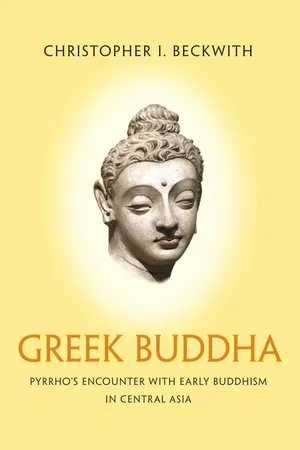
eBook - ePub
Greek Buddha
Pyrrho's Encounter with Early Buddhism in Central Asia
- 304 pages
- English
- ePUB (mobile friendly)
- Available on iOS & Android
eBook - ePub
About this book
Information
Publisher
Princeton University PressYear
2015Print ISBN
9780691176321
9780691166445
eBook ISBN
9781400866328
CHAPTER 1

Pyrrho’s Thought
A brief passage that derives ultimately from the lost dialogue Pythō ‘Python’1 by Timon of Phlius is accepted to be the single most important testimony for the thought of his teacher, Pyrrho.2 Because it is preserved in a chapter of a history of philosophy by Aristocles of Messene (quoted verbatim in the Preparation for the Gospel by Eusebius), it is generally known as “the Aristocles passage”. The text begins with Timon’s short introduction, in which he says, “Whoever wants to be happy must consider these three [questions]: first, how are pragmata ‘(ethical) matters, affairs, topics’ by nature? Secondly, what attitude should we adopt towards them? Thirdly, what will be the outcome for those who have this attitude?”3 Then Timon quotes4 Pyrrho’s own revelation of the three negative characteristics of all pragmata ‘matters, affairs, questions, topics’. The ethical meaning of the word pragmata is absolutely clear because other testimonies5 show that it meant for Pyrrho exclusively ethical ‘matters, affairs, topics’. Accordingly, the word will be so translated below, or given in Greek as pragmata (singular pragma).6
Following these prefatory remarks, Timon says, “Pyrrho himself declares that”7
As for pragmata ‘matters, questions, topics’,8 they are all adiaphora ‘undifferentiated by a logical differentia’ and astathmēta ‘unstable, unbalanced, not measurable’ and anepikrita ‘unjudged, unfixed, undecidable’. Therefore, neither our sense-perceptions nor our ‘views, theories, beliefs’ (doxai) tell us the truth or lie [about pragmata]; so we certainly should not rely on them [to do it]. Rather, we should be adoxastous ‘without views’, aklineis ‘uninclined [toward this side or that]’, and akradantous ‘unwavering [in our refusal to choose]’, saying about every single one that it no more is than9 it is not or it both is and is not or it neither is nor is not.10
To paraphrase, Pyrrho says that ethical matters or questions are not logically differentiated, they are unstable (or ‘unassessed and unassessable by any measure’), and they are unjudged, not fixed (or, undecidable). Therefore, our inductive and deductive reasoning cannot tell us whether any ethical question is True or False, so we should not count on them to tell us. Instead, we should have no views on ethical matters, we should not incline toward any choice with respect to ethical questions, and we should not waver in our avoidance of attempts to decide such matters, reciting the tetralemma formula—“It no more is than it is not or it both is and is not or it neither is nor is not”—in response to every single one of such ethical questions.
The Aristocles passage is crucially important, highly condensed, and not easy to understand, as attested to by the fact that its basic meaning has been disputed by scholars of Classical philosophy for the past century. It thus requires additional explanation.
To begin with, as the subject of Pyrrho’s entire declaration, the meaning of pragmata is crucially important, so it needs a little further clarification.
The Greek word pragma (singular) ∼ pragmata (plural) is largely abstract. In other words, it means ‘something, things’, but in the abstract logical sense of ‘an object of our cogitation or disputation’,11 so translating pragmata as ‘things’—in the same general abstract logical sense—is not wrong, but things in English are by default largely physical or metaphysical objects. As a result, scholars have let themselves be misled by that default meaning into misinterpreting Pyrrho’s entire message. When helpful below, pragmata will be translated as “ethical things, matters (etc.)”.
Moreover, it must be emphasized that Pyrrho sees pragmata as disputed matters.12 If people agreed on pragmata or did not argue about them, they would not be characterizable as Pyrrho says. They would already be decided and no problem. Arguments about opposing or disputed “matters, topics” are ubiquitous in Greek philosophy, as for example in Plutarch, “They quarrel about whether the matter (pragma) is good or evil or white or not white.”13
Based evidently on the general scholarly unclarity about pragmata,14 some have argued that the Aristocles passage represents a “dogmatic” metaphysical position, on account of which they conclude that Pyrrho could not be the founder of Pyrrhonism. This idea has been much criticized,15 mainly because the ancient testimonies overwhelmingly say that the concern of Pyrrho is purely with ethics, and many modern scholars agree.16 The very first significant word in his declaration is adiaphora, a logical term, which is followed by inference after inference. Pyrrho’s way of skewering ethical issues is to use logic. How would using metaphysics for ethical problems make sense?17 Pyrrho never, in this or any other testimony, talks about physical or metaphysical issues (though he is said to have criticized other philosophers who did talk about them), and in two testimonies—the Aristocles passage and the narrative about the dog18—he explicitly mentions pragmata and makes it very clear that he uses the word to refer to conflicting ethical “matters, affairs”. In short, for Pyrrho, pragmata are always and only ethical ‘topics, questions, matters, affairs’ which people dispute or try to interpret with antilogies—opposed choices such as Good : Bad, or True : False.
Pyrrho’s declaration may now be examined section by section.
THE THREE CHARACTERISTICS
Pyrrho famously declares that all ethical “matters, questions” have three characteristics which, oddly, are all negative, so his statement is actually a declaration of what matters are not. That is, the positive equivalent of each negative term is what Pyrrho negates, so we must base our understanding of the terms on their positive forms, which (unlike the negative ones) are all well attested in Classical Greek. His declaration is presented as the foundation of his teaching, and modern scholars’ intensive analysis of the entire passage and the other ancient testimonies has confirmed that it is indeed the core of his thought:19 it is inseparable from his practical indirect path, via apatheia ‘passionlessness’, to ataraxia ‘undisturbedness, calm’. Because of its conciseness, the text requires interpretation based on the remaining part of the Aristocles passage, other material in Aristocles’ chapter on Pyrrhonism, and other testimonies, including in particular those containing statements attributed directly to Pyrrho himself.
1. Adiaphora ‘Without a Self-Identity’
The first term, adiaphora, is the negative of diaphora ‘differentiated by a logical differentia’ and literally means ‘undifferentiated by a logical differentia’,20 that is, ‘without a logical self-identity’: pragmata ‘matters, affairs’ do not come supplied with their own self-identifying differentiae or other categorizing criteria. For example, someone’s expression of anger is not automatically identified for us by a “thought balloon” spelling out its genus (or superordinate category) “an emotion” and further differentiating it as a “bad” emotion, thus distinguishing it from “good” emotions (among other choices). In several testimonies Pyrrho denies that pragmata are in fact differentiated from their contrasting opposites, for example “the just” versus “the unjust”, or “the truth” versus “a lie”. People dispute pragmata as to whether they are good or bad, just or unjust, and so on, but any specific pragma, in order to be a subject of philosophical discussion at all, must necessarily be discrete and differentiated from other pragmata by a logical differentia. Because pragmata themselves do not actually have differentiae (as Timon says, “by nature”), we ourselves necessarily supply the differentiae. But that makes the entire process strictly circular and therefore logically invalid.21
A direct consequence of the teaching of adiaphora ‘without a logical differentia, no self-identity’ is the explicit denial of the validity of opposed categories, or “antilogies”.
2. Astathmēta ‘Unstable, Unbalanced, Not Measurable’
The second term, astathmēta, is an adjective from the stem sta- ‘stand’ with the negative prefix a-, literally meaning ‘not standing’. The word is based on the noun stathmos ‘standing place, stable; a balance-beam, measuring scale’. For example, Aristophanes, in The Frogs, has Aeschylus say, “what I’d like to do is take him to the scales (stathmos); That’s the only real test of our poetry; the weight of our utterances will be the decisive proof.”22 So astathmēta means ‘non-standing-place; no stathmos (a balance-beam, scale)’, thus, ‘unstable, unbalanced’.23 Since pragmata are unbalanced and unstable, they pull this way and that, and are unsettling. They make us feel uneasy and susceptible to passions and disturbedness.
3. Anepikrita ‘Unjudged, Undecided, Unfixed’
The third term, anepikrita, is a negative made from epikrisis ‘determination, judgement’,24 from the well-attested derived verb epikrinō ‘to decide, determine; judge; select, pick out, choose’—as in Aristotle’s...
Table of contents
- Cover
- Title Page
- Copyright Page
- Contents
- Preface
- Acknowledgements
- On Transcription, Transliteration, and Texts
- Abbreviations
- Prologue. Scythian Philosophy: Pyrrho, the Persian Empire, and India
- Chapter 1. Pyrrho’s Thought: Beyond Humanity
- Chapter 2. No Differentiations: The Earliest Attested Forms of Buddhism
- Chapter 3. Jade Yoga and Heavenly Dharma: Buddhist Thought in Classical Age China and India
- Chapter 4. Greek Enlightenment: What the Buddha, Pyrrho, and Hume Argue Against
- Epilogue. Pyrrho’s Teacher: The Buddha and His Awakening
- Appendix A. The Classical Testimonies of Pyrrho’s Thought
- Appendix B. Are Pyrrhonism and Buddhism Both Greek in Origin?
- Appendix C. On the Early Indian Inscriptions
- Endnotes
- References
- Index
Trusted by 375,005 students
Access to over 1.5 million titles for a fair monthly price.
Study more efficiently using our study tools.
Frequently asked questions
Yes, you can cancel anytime from the Subscription tab in your account settings on the Perlego website. Your subscription will stay active until the end of your current billing period. Learn how to cancel your subscription
No, books cannot be downloaded as external files, such as PDFs, for use outside of Perlego. However, you can download books within the Perlego app for offline reading on mobile or tablet. Learn how to download books offline
We are an online textbook subscription service, where you can get access to an entire online library for less than the price of a single book per month. With over 1.5 million books across 990+ topics, we’ve got you covered! Learn about our mission
Look out for the read-aloud symbol on your next book to see if you can listen to it. The read-aloud tool reads text aloud for you, highlighting the text as it is being read. You can pause it, speed it up and slow it down. Learn more about Read Aloud
Yes! You can use the Perlego app on both iOS and Android devices to read anytime, anywhere — even offline. Perfect for commutes or when you’re on the go.
Please note we cannot support devices running on iOS 13 and Android 7 or earlier. Learn more about using the app
Please note we cannot support devices running on iOS 13 and Android 7 or earlier. Learn more about using the app
Yes, you can access Greek Buddha by Christopher I. Beckwith in PDF and/or ePUB format, as well as other popular books in History & Greek Ancient History. We have over 1.5 million books available in our catalogue for you to explore.