Partial Differential Equations
eBook - ePub

Partial Differential Equations

An Introduction to Theory and Applications

  1. 288 pages
  2. English
  3. ePUB (mobile friendly)
  4. Available on iOS & Android
eBook - ePub

Partial Differential Equations

An Introduction to Theory and Applications

About this book

An accessible yet rigorous introduction to partial differential equations

This textbook provides beginning graduate students and advanced undergraduates with an accessible introduction to the rich subject of partial differential equations (PDEs). It presents a rigorous and clear explanation of the more elementary theoretical aspects of PDEs, while also drawing connections to deeper analysis and applications. The book serves as a needed bridge between basic undergraduate texts and more advanced books that require a significant background in functional analysis.

Topics include first order equations and the method of characteristics, second order linear equations, wave and heat equations, Laplace and Poisson equations, and separation of variables. The book also covers fundamental solutions, Green's functions and distributions, beginning functional analysis applied to elliptic PDEs, traveling wave solutions of selected parabolic PDEs, and scalar conservation laws and systems of hyperbolic PDEs.

  • Provides an accessible yet rigorous introduction to partial differential equations
  • Draws connections to advanced topics in analysis
  • Covers applications to continuum mechanics
  • An electronic solutions manual is available only to professors
  • An online illustration package is available to professors

Frequently asked questions

Yes, you can cancel anytime from the Subscription tab in your account settings on the Perlego website. Your subscription will stay active until the end of your current billing period. Learn how to cancel your subscription.
No, books cannot be downloaded as external files, such as PDFs, for use outside of Perlego. However, you can download books within the Perlego app for offline reading on mobile or tablet. Learn more here.
Perlego offers two plans: Essential and Complete
  • Essential is ideal for learners and professionals who enjoy exploring a wide range of subjects. Access the Essential Library with 800,000+ trusted titles and best-sellers across business, personal growth, and the humanities. Includes unlimited reading time and Standard Read Aloud voice.
  • Complete: Perfect for advanced learners and researchers needing full, unrestricted access. Unlock 1.4M+ books across hundreds of subjects, including academic and specialized titles. The Complete Plan also includes advanced features like Premium Read Aloud and Research Assistant.
Both plans are available with monthly, semester, or annual billing cycles.
We are an online textbook subscription service, where you can get access to an entire online library for less than the price of a single book per month. With over 1 million books across 1000+ topics, we’ve got you covered! Learn more here.
Look out for the read-aloud symbol on your next book to see if you can listen to it. The read-aloud tool reads text aloud for you, highlighting the text as it is being read. You can pause it, speed it up and slow it down. Learn more here.
Yes! You can use the Perlego app on both iOS or Android devices to read anytime, anywhere — even offline. Perfect for commutes or when you’re on the go.
Please note we cannot support devices running on iOS 13 and Android 7 or earlier. Learn more about using the app.
Yes, you can access Partial Differential Equations by Michael Shearer,Rachel Levy in PDF and/or ePUB format, as well as other popular books in Mathematics & Computer Science General. We have over one million books available in our catalogue for you to explore.
CHAPTER ONE
Introduction
Partial differential equations (PDE) describe physical systems, such as solid and fluid mechanics, the evolution of populations and disease, and mathematical physics. The many different kinds of PDE each can exhibit different properties. For example, the heat equation describes the spreading of heat in a conducting medium, smoothing the spatial distribution of temperature as it evolves in time; it also models the molecular diffusion of a solute in its solvent as the concentration varies in both space and time. The wave equation is at the heart of the description of time-dependent displacements in an elastic material, with wave solutions that propagate disturbances. It describes the propagation of p-waves and s-waves from the epicenter of an earthquake, the ripples on the surface of a pond from the drop of a stone, the vibrations of a guitar string, and the resulting sound waves. Laplace’s equation lies at the heart of potential theory, with applications to electrostatics and fluid flow as well as other areas of mathematics, such as geometry and the theory of harmonic functions. The mathematics of PDE includes the formulation of techniques to find solutions, together with the development of theoretical tools and results that address the properties of solutions, such as existence and uniqueness.
This text provides an introduction to a fascinating, intricate, and useful branch of mathematics. In addition to covering specific solution techniques that provide an insight into how PDE work, the text is a gateway to theoretical studies of PDE, involving the full power of real, complex and functional analysis. Often we will refer to applications to provide further intuition into specific equations and their solutions, as well as to show the modeling of real problems by PDE.
The study of PDE takes many forms. Very broadly, we take two approaches in this book. One approach is to describe methods of constructing solutions, leading to formulas. The second approach is more theoretical, involving aspects of analysis, such as the theory of distributions and the theory of function spaces.
1.1. Linear PDE
To introduce PDE, we begin with four linear equations. These equations are basic to the study of PDE, and are prototypes of classes of equations, each with different properties. The primary elementary methods of solution are related to the techniques we develop for these four equations.
For each of the four equations, we consider an unknown (real-valued) function u on an open set URn. We refer to u as the dependent variable, and x = (x1, x2, …, xn) ∈ U as the vector of independent variables. A partial differential equation is an equation that involves x, u, and partial derivatives of u. Quite often, x represents only spatial variables. However, many equations are evolutionary, meaning that u = u(x, t) depends also on time t and the PDE has time derivatives. The order of a PDE is defined as the order of the highest derivative that appears in the equation.
The Linear Transport Equation:
Image
This simple first-order linear PDE describes the motion at constant speed c of a quantity u depending on a single spatial variable x and time t. Each solution is a traveling wave that moves with the speed c. If c > 0, the wave moves to the right; if c < 0, the wave moves left. The solutions are all given by a formula u(x, t) = f(xct). The function f = f(ξ), depending on a single variable ξ = xct, is determined from side conditions, such as boundary or initial conditions.
The next three equations are prototypical second-order linear PDE.
The Heat Equation:
Image
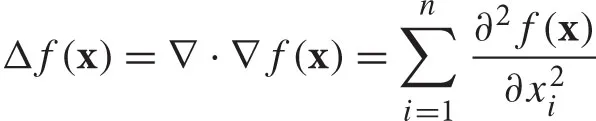
In this equation, u(x, t) is the temperature in a homogeneous heat-conducting material, the parameter k > 0 is constant, and the Laplacian Δ is defined by
Image
in Cartesian coordinates. The heat equation, also known as the diffusion equation, models diffusion in other contexts, such as the diffusion of a dye in a clear liquid. In such cases, u represents the concentration of the diffusing quantity.
The Wave Equation:
Image
As the name suggests, the wave equation models wave propagation. The parameter c is th...
Table of contents

  1. Cover Page
  2. Title Page
  3. Copyright Page
  4. Contents
  5. Preface
  6. 1. Introduction
  7. 2. Beginnings
  8. 3. First-Order PDE
  9. 4. The Wave Equation
  10. 5. The Heat Equation
  11. 6. Separation of Variables and Fourier Series
  12. 7. Eigenfunctions and Convergence of Fourier Series
  13. 8. Laplace’s Equation and Poisson’s Equation
  14. 9. Green’s Functions and Distributions
  15. 10. Function Spaces
  16. 11. Elliptic Theory with Sobolev Spaces
  17. 12. Traveling Wave Solutions of PDE
  18. 13. Scalar Conservation Laws
  19. 14. Systems of First-Order Hyperbolic PDE
  20. 15. The Equations of Fluid Mechanics
  21. Appendix A. Multivariable Calculus
  22. Appendix B. Analysis
  23. Appendix C. Systems of Ordinary Differential Equations
  24. References
  25. Index