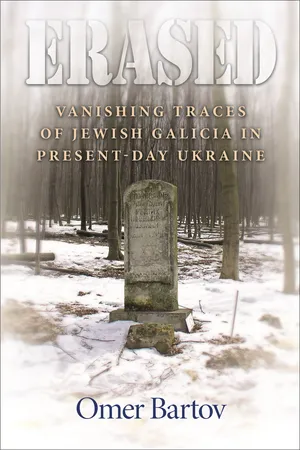
In Erased, Omer Bartov uncovers the rapidly disappearing vestiges of the Jews of western Ukraine, who were rounded up and murdered by the Nazis during World War II with help from the local populace. What begins as a deeply personal chronicle of the Holocaust in his mother's hometown of Buchach--in former Eastern Galicia--carries him on a journey across the region and back through history. This poignant travelogue reveals the complete erasure of the Jews and their removal from public memory, a blatant act of forgetting done in the service of a fiercely aggressive Ukrainian nationalism.
Bartov, a leading Holocaust scholar, discovers that to make sense of the heartbreaking events of the war, he must first grapple with the complex interethnic relationships and conflicts that have existed there for centuries. Visiting twenty Ukrainian towns, he recreates the histories of the vibrant Jewish and Polish communities who once lived there-and describes what is left today following their brutal and complete destruction. Bartov encounters Jewish cemeteries turned into marketplaces, synagogues made into garbage dumps, and unmarked burial pits from the mass killings. He bears witness to the hastily erected monuments following Ukraine's independence in 1991, memorials that glorify leaders who collaborated with the Nazis in the murder of Jews. He finds that the newly independent Ukraine-with its ethnically cleansed and deeply anti-Semitic population--has recreated its past by suppressing all memory of its victims.
Illustrated with dozens of hauntingly beautiful photographs from Bartov's travels, Erased forces us to recognize the shocking intimacy of genocide.
- 256 pages
- English
- ePUB (mobile friendly)
- Available on iOS & Android
eBook - ePub
About this book
Trusted by 375,005 students
Access to over 1.5 million titles for a fair monthly price.
Study more efficiently using our study tools.
Information
Publisher
Princeton University PressYear
2015Print ISBN
9780691166551
9780691131214
eBook ISBN
9781400866892
II
TRAVELS IN THE BORDERLAND
L’viv / Lwów / L’vov / Lemberg / Leopolis

FIGURE 1. The former Jewish quarter of L’viv in 2003 with prewar store signs in Polish and Yiddish.
AS WESTERN Ukraine’s Eastern Galician territories begin to stir from decades of war, oppression, and economic decline, let us take a brief journey through this land of memory and oblivion, coexistence and erasure, high hopes and dashed illusions.1 We begin in L’viv, now located some 40 miles southeast of the Polish border. Once a mostly Polish and Jewish city and a thriving cultural, economic, and political center, it is now struggling to emerge from the long years of Soviet neglect and suppressed memories of mass murder, expulsion, and demographic upheaval. Boasting a population of 830,000 people, the city is the capital of the L’viv Oblast’ (region) and is the main urban center of what had been Eastern Galicia.2
Two sites may remind us of this city’s past diversity. The Armenian Cathedral, dating back as far as 1363, is a wellpreserved and moving edifice, testifying to the former presence of an important Armenian community in these parts of Ukraine (then Poland), most of whom eventually assimilated into the local population.3 The Armenians—along with the Karaites and Greeks—were the main competitors with the Jews in commerce and business. Because they were Christian and therefore assimilated more easily into the local population, and because they numbered altogether far fewer people, the Armenian community declined while the Jewish population increased. Indeed, just as Jews could maintain their identity in Christian countries, so, too, Christian Armenians retained a stronger sense of their ethnic and cultural singularity in Muslim lands.4 The Armenian Cathedral in L’viv is interesting not least because it served as the burial ground for some distinguished Polish intellectual and political figures of the nineteenth and twentieth centuries. This testifies both to the assimilation of the Armenians into the hegemonic culture of L’viv, and to the strong Polish presence in a city that defined itself as an inherent part of Poland despite growing pressures from Ruthenian/Ukrainian nationalism and the predominance of Ukrainians in the surrounding countryside.5
The other site is the Golden Rose Synagogue, of which almost nothing remains. A modest plaque at the site carries the following inscription in Ukrainian, English, and Yiddish:
Remnants of the old temple called “Di Goldene Royz.” Built in 1580–1595 by the Nachmanowitch family in the memory of Rabbi Nachman’s wife. The building designed by the Italian architect Pablo Romano, was destroyed by nazis [sic] and burnt in summer 1942.6
The site of the temple seems to be a popular nighttime hangout, as indicated by the empty beer bottles and other garbage strewn in the shallow pit next to the only remaining wall. The synagogue is located in the former Jewish quarter of L’viv, next to the old city wall. But one looks in vain for any explicit mention of the destruction of the Jewish community, let alone of Ukrainian collaboration. Nowhere is it mentioned that in the pogroms that followed immediately on the heels of the German army’s entry into the city on June 30, 1941, somewhere between 7,000 and 10,000 Jews were murdered.7
Jews had already arrived in the region of L’viv in the tenth century, coming mainly from Byzantium and Khazaria, and the earliest Jewish tombstone found in the city dates back to 1348.8 But the first signs of organized Jewish communities in western Poland don’t appear until the eleventh, or more likely the twelfth century. Ashkenazi Jews along with other Central Europeans came to Poland during the following two centuries because of greater economic opportunities there. By 1500 the Jews of Poland numbered between 10,000 and 30,000 people and enjoyed the status of free men within the framework of a highly developed communal autonomy. On the eve of the Cossack-Ruthenian revolt of 1648 led by Bohdan Khmel’nyts’kyi (Bogdan Chmielnicki), Polish Jewry numbered some 450,000 people, and despite the devastation of the following decades the Jewish population grew to 750,000 by 1765. By then Jews constituted about 5.35 percent of the population of the Polish-Lithuanian Commonwealth. Created by the Union of Lublin in 1569, the Commonwealth brought vast areas of Ukraine—inhabited mainly by Ruthenians (later known as Ukrainians)—under Polish rule. Increasing pressure on Jewish settlement and economic rights in western Poland and offers of opportunities further east attracted many Jews to these new territories. By the mid-eighteenth century more than half of the Commonwealth’s Jewish population lived mostly as town dwellers in privately owned latifundia under direct jurisdiction of the nobility; 44 percent of Polish Jewry lived in Ukraine-Ruthenia. Astonishingly, 80 percent of world Jewry today can trace their roots to the eighteenth-century Polish-Lithuanian Commonwealth.9
The three partitions of 1772, 1793, and 1795 terminated the existence of Poland as an independent political entity until after World War I. As the Jews of the newly created province, or crownland, of Galicia found themselves under Austrian Habsburg rule, they lost much of their political and religious autonomy and underwent a progressive economic decline. Yet the Jewish population of Galicia grew rapidly from 250,000 in 1800 to 450,000 in 1857, despite significant emigration to Hungary. Three-quarters of this population was concentrated in Eastern Galicia, much of it in smaller towns and villages. In a poverty-stricken province, up to 80 percent of the Jews depended on the meager profits of trade for a living; especially among the poor, Hasidism became increasingly popular. That as late as 1910 some 60 percent of the Poles and 92 percent of the Ruthenians were engaged in agriculture exemplifies Galicia’s backward economy. Indeed, by and large the gentile population was even poorer than the Jews, whose numbers reached 575,000 in 1869, just two years before the empire granted the Poles political dominance in the province. The following decades saw growing nationalism among all three main ethnic groups, with Jews responding to increasing anti-Semitism and grinding poverty by mass emigration: 85 percent of the 320,000 Jews who emigrated from Austria-Hungary to the United States between 1891 and 1914 came from Galicia. Many others moved to the larger cities of Galicia or to Vienna. Those who remained behind were often politically mobilized by socialism, Zionism, and “autonomism,” which sought Jewish political and cultural autonomy in the Diaspora.10
World War I devastated the province. As a consequence of brutalities and destruction by the invading Russian army, some 400,000 East Galician Jews fled to the west, even as others were deported to the east by the Russians. The subsequent fighting between Polish, Ukrainian, and Bolshevik armies was accompanied by such outbreaks of anti-Jewish violence as the pogrom of November 1918 in L’viv, when scores of Jews were murdered by Polish soldiers.11 Under Polish rule in the interwar period the ratio of Jewish inhabitants within the total population of Eastern Galicia declined, and the Jews never recovered from the material and demographic damage of the war and its aftermath. Lack of economic prospects and discriminatory policies by the Polish government contributed to the growing popularity of political Zionism and the socialist Bund. By 1931 growing numbers of children were attending the sixty-five Hebrew language schools in Galicia.12
In 1931 East Galicia’s 639,000 Jews made up 9.3 percent of the total population.13 Most Jews lived in towns, but many of them actually resided in small shtetls (shtetlach, shtetlekh), and close to a quarter lived in villages. While the Jews increasingly identified with Polish culture, they found themselves caught between competing national claims by Poles and Ukrainians. Thus an urge to assimilate into Polish culture was accompanied by a growing attraction to Zionism, also fueled by postwar American restrictions on immigration and, especially in the last four years of the Polish republic, a surge in official and popular anti-Semitism. Ironically, during the interwar years Polish Jewry underwent a drastic transformation manifested in greatly accelerated acculturation, secularization, and modernization. This makes the fate of this community all the more tragic, as it found itself trapped between rival radical nationalists domestically and murderous totalitarian regimes across the borders, just as the gates of emigration either to the United States or to Palestine had virtually slammed shut.14
Walking the streets of the beautiful old part of town where the Golden Rose Synagogue is located, one still encounters the marks of mezuzahs on some of the doorways in Staroievreis’ka and Fedorov Streets.15 Proceeding a short way further north from the center we reach the area of the oldest settlement of Jews in the so-called Cracow suburb, where the Great Synagogue of the Suburb (built in 1632) once stood. This was also a busy Jewish commercial district, and the peeling façades of the handsome nineteenth-century buildings reveal Polish and Yiddish store signs that were painted over after the original owners were murdered or expelled. One may assume that as the city modernizes, and its current inhabitants come into more money and renovate their houses, these last remaining traces of a vanished world will be erased. For now, very few people seem to notice them.

FIGURE 2. Doorway with mezuzah marking in L’viv, 2004.
Nearby in Staryi Rynok (Old Market) stood the extraordinary edifice of the Reform Synagogue, also known as the Temple or the German-Israelite House of Prayer, of which nothing remains. It is now commemorated with a rough stone, about three feet high, to which a small plaque in Ukrainian and English is attached. The text reads: “This is the site of the Synagogue of the progressive Jews called the ‘temple’ which served Lvov’s intelligentsia. It was built during 1844–1845 and was destroyed by German soldiers on entering to [sic] Lvov on July 1941.”16 The city has provided no other indication as to where the synagogue stood, and the site is therefore difficult to locate.17 A couple of blocks away in St. Theodore Square still stands the former Hasidic Jakob (Yankl) Glazner Shul, built in 1842–44, which has housed the Sholem Aleichem Jewish Culture Society since 1991.

FIGURE 3. The Jewish hospital in L’viv, 2003.
Most passersby presumably have little inkling of the significance of a plaque installed at the corner of the nearby Shpytal’na and Kotliars’ka Streets. Designed by the sculptor Pesach (Peter) Palit, who has meanwhile immigrated to Israel, the sign proclaims in Yiddish and Ukrainian: “In this house lived in 1906 the classical author of Yiddish literature Sholem Aleichem.”18 As its name indicates, Shpytal’na Street leads one to the vast Jewish hospital, built in striking oriental style at the turn of the previous century. While it cannot be mistaken for anything other than Jewish, since its tricolor tiled dome is decorated with Stars of David, no indication is given of its history. Behind the hospital was the old Jewish cemetery, first mentioned in archival documents in 1411 but known to have had tombstones dating back to the mid-fourteenth century. While its ancient stones were photographed before the war, the cemetery was destroyed by the Nazis, paved over by the Soviets, and now serves as the town’s main open market, offering the kind of ragtag merchandise that clearly locates Ukraine on the periphery of Europe and in another historical time.19

FIGURE 4. The open market in L’viv, site of the old Jewish cemetery, 2003.
As we ...
Table of contents
- Cover Page
- Title Page
- Copyright Page
- Contents
- Introduction
- Maps
- I. The Borderland
- II. Travels in the Borderland
- III. Return
- Acknowledgments
- Additional Readings
- About the Author
- Index of Names
- Index of Place-Names
Frequently asked questions
Yes, you can cancel anytime from the Subscription tab in your account settings on the Perlego website. Your subscription will stay active until the end of your current billing period. Learn how to cancel your subscription
No, books cannot be downloaded as external files, such as PDFs, for use outside of Perlego. However, you can download books within the Perlego app for offline reading on mobile or tablet. Learn how to download books offline
Perlego offers two plans: Essential and Complete
- Essential is ideal for learners and professionals who enjoy exploring a wide range of subjects. Access the Essential Library with 800,000+ trusted titles and best-sellers across business, personal growth, and the humanities. Includes unlimited reading time and Standard Read Aloud voice.
- Complete: Perfect for advanced learners and researchers needing full, unrestricted access. Unlock 1.5M+ books across hundreds of subjects, including academic and specialized titles. The Complete Plan also includes advanced features like Premium Read Aloud and Research Assistant.
We are an online textbook subscription service, where you can get access to an entire online library for less than the price of a single book per month. With over 1.5 million books across 990+ topics, we’ve got you covered! Learn about our mission
Look out for the read-aloud symbol on your next book to see if you can listen to it. The read-aloud tool reads text aloud for you, highlighting the text as it is being read. You can pause it, speed it up and slow it down. Learn more about Read Aloud
Yes! You can use the Perlego app on both iOS and Android devices to read anytime, anywhere — even offline. Perfect for commutes or when you’re on the go.
Please note we cannot support devices running on iOS 13 and Android 7 or earlier. Learn more about using the app
Please note we cannot support devices running on iOS 13 and Android 7 or earlier. Learn more about using the app
Yes, you can access Erased by Omer Bartov in PDF and/or ePUB format, as well as other popular books in History & Eastern European History. We have over 1.5 million books available in our catalogue for you to explore.