According to the Marxist interpretation still dominant in Japanese studies, the last century and a half of the Tokugawa period was a time of economic and demographic stagnation. Professors Hanley and Yamamura argue that a more satisfactory explanation can be provided within the framework of modem economic theory, and they advance and test three important new hypotheses in this book.
The authors suggest that the Japanese economy grew throughout the Tokugawa period, though slowly by modern standards and unevenly. This growth, they show, tended to exceed the rate of population increase even in the poorer regions, thus raising the living standard despite major famines. Population growth was controlled by a variety of methods, including abortion and infanticide, for the primary purpose of raising the standard of living.
Contrary to the prevailing view of scholars, thus, the conclusions advanced here indicate that the basis for Japan's rapid industrialization in the Meiji period was in many ways already established during the latter part of the Tokugawa period. The authors' analysis combines original fieldwork with study of data based on findings of the postwar years.
Originally published in 1978.
The Princeton Legacy Library uses the latest print-on-demand technology to again make available previously out-of-print books from the distinguished backlist of Princeton University Press. These editions preserve the original texts of these important books while presenting them in durable paperback and hardcover editions. The goal of the Princeton Legacy Library is to vastly increase access to the rich scholarly heritage found in the thousands of books published by Princeton University Press since its founding in 1905.
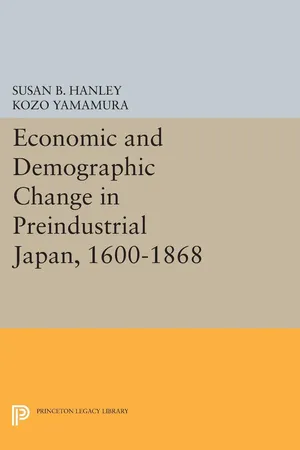
eBook - PDF
Economic and Demographic Change in Preindustrial Japan, 1600-1868
- 425 pages
- English
- PDF
- Available on iOS & Android
eBook - PDF
Economic and Demographic Change in Preindustrial Japan, 1600-1868
About this book
Information
Publisher
Princeton University PressYear
2015Print ISBN
9780691616506
9780691031118
eBook ISBN
9781400869374
Table of contents
- Cover
- Contents
- List of Tables and Figures
- Preface
- 1. Introduction
- 2. The Framework of Analysis
- 3. Aggregate Demographic Data: An Assessment
- 4. Economic Growth: A General Perspective
- 5. The Kinai
- 6. Morioka
- 7. Okayama
- 8. Fertility, Mortality, and Life Expectancy in Four Villages
- 9. Population Control in Tokugawa Japan
- 10. The Village of Fujito: A Case Study
- 11. A Comparison of Population Trends
- 12. Conclusion
- Glossary of Japanese Terms
- Notes
- Bibliography
- Index
Trusted by 375,005 students
Access to over 1.5 million titles for a fair monthly price.
Study more efficiently using our study tools.
Frequently asked questions
Yes, you can cancel anytime from the Subscription tab in your account settings on the Perlego website. Your subscription will stay active until the end of your current billing period. Learn how to cancel your subscription
No, books cannot be downloaded as external files, such as PDFs, for use outside of Perlego. However, you can download books within the Perlego app for offline reading on mobile or tablet. Learn how to download books offline
Perlego offers two plans: Essential and Complete
- Essential is ideal for learners and professionals who enjoy exploring a wide range of subjects. Access the Essential Library with 800,000+ trusted titles and best-sellers across business, personal growth, and the humanities. Includes unlimited reading time and Standard Read Aloud voice.
- Complete: Perfect for advanced learners and researchers needing full, unrestricted access. Unlock 1.5M+ books across hundreds of subjects, including academic and specialized titles. The Complete Plan also includes advanced features like Premium Read Aloud and Research Assistant.
We are an online textbook subscription service, where you can get access to an entire online library for less than the price of a single book per month. With over 1.5 million books across 990+ topics, we’ve got you covered! Learn about our mission
Look out for the read-aloud symbol on your next book to see if you can listen to it. The read-aloud tool reads text aloud for you, highlighting the text as it is being read. You can pause it, speed it up and slow it down. Learn more about Read Aloud
Yes! You can use the Perlego app on both iOS and Android devices to read anytime, anywhere — even offline. Perfect for commutes or when you’re on the go.
Please note we cannot support devices running on iOS 13 and Android 7 or earlier. Learn more about using the app
Please note we cannot support devices running on iOS 13 and Android 7 or earlier. Learn more about using the app
Yes, you can access Economic and Demographic Change in Preindustrial Japan, 1600-1868 by Susan B. Hanley,Kozo Yamamura in PDF and/or ePUB format, as well as other popular books in History & Japanese History. We have over 1.5 million books available in our catalogue for you to explore.