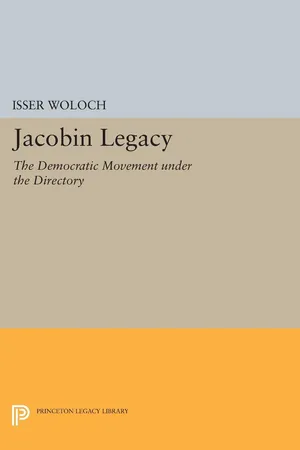
Professor Woloch shows that Jacobinism survived and forcefully developed into a constitutional party under the conservative Directorial republic. The Jacobin legacy was a mode of political activism—the local political club—and a constellation of attitudes which might be called the "democratic persuasion." By focusing on the nature of this persuasion and the way that it was articulated in the Neo-Jacobin clubs, the author provides a fresh perspective on the history of Jacobinism, and on the fate of the Directorial republic.
Originally published in 1970.
The Princeton Legacy Library uses the latest print-on-demand technology to again make available previously out-of-print books from the distinguished backlist of Princeton University Press. These editions preserve the original texts of these important books while presenting them in durable paperback and hardcover editions. The goal of the Princeton Legacy Library is to vastly increase access to the rich scholarly heritage found in the thousands of books published by Princeton University Press since its founding in 1905.
- 472 pages
- English
- PDF
- Available on iOS & Android
eBook - PDF
About this book
Information
Publisher
Princeton University PressYear
2015Print ISBN
9780691621388
9780691061832
eBook ISBN
9781400871896
Table of contents
- Cover
- Contents
- Preface
- Acknowledgments
- Concordance of the Republican and Gregorian Calendars
- Part 1: Origins and Testing
- Part 2: Resurgence
- Part 3: Confrontation: The Elections of 1798
- Part 4: Towards Brumaire
- Appendices
- Note on Sources and Bibliography
- Index
Trusted by 375,005 students
Access to over 1.5 million titles for a fair monthly price.
Study more efficiently using our study tools.
Frequently asked questions
Yes, you can cancel anytime from the Subscription tab in your account settings on the Perlego website. Your subscription will stay active until the end of your current billing period. Learn how to cancel your subscription
No, books cannot be downloaded as external files, such as PDFs, for use outside of Perlego. However, you can download books within the Perlego app for offline reading on mobile or tablet. Learn how to download books offline
We are an online textbook subscription service, where you can get access to an entire online library for less than the price of a single book per month. With over 1.5 million books across 990+ topics, we’ve got you covered! Learn about our mission
Look out for the read-aloud symbol on your next book to see if you can listen to it. The read-aloud tool reads text aloud for you, highlighting the text as it is being read. You can pause it, speed it up and slow it down. Learn more about Read Aloud
Yes! You can use the Perlego app on both iOS and Android devices to read anytime, anywhere — even offline. Perfect for commutes or when you’re on the go.
Please note we cannot support devices running on iOS 13 and Android 7 or earlier. Learn more about using the app
Please note we cannot support devices running on iOS 13 and Android 7 or earlier. Learn more about using the app
Yes, you can access Jacobin Legacy by Isser Woloch in PDF and/or ePUB format, as well as other popular books in History & French History. We have over 1.5 million books available in our catalogue for you to explore.