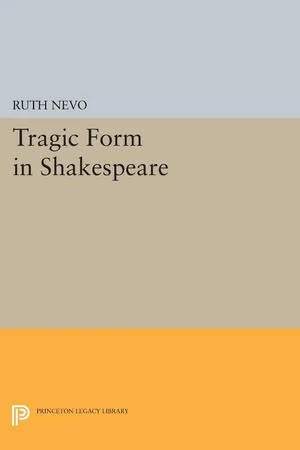
A "symbolist" approach has dominated Shakespearean criticism for many years, but Ruth Nevo believes that the emphasis on static and pictorial aspects has obscured the essentially dynamic nature of dramatic expression and this study of the development of Shakespeare's tragic form is offered to correct the imbalance.
From detailed analyses of each of Shakespeare's ten tragedies emerges a characteristic structure—a five-phased movement of discovery—that articulates and orders the traditional components of tragedy. This sequence is one of predicament, psychomachia, peripeteia, perspectives of irony and pathos, and catastrophe. It is a continuous, accumulative, and consummatory one, rather than a simple up-down movement or even a more complex thesis-antithesis-synthesis. Inheriting a five-act model and its developed rationale, Shakespeare used it to express an ever richer and more complex tragic experience. As the protagonist's life unfolds before us, the development of his tragic recognition is coextensive with the whole of the action.
Originally published in 1972.
The Princeton Legacy Library uses the latest print-on-demand technology to again make available previously out-of-print books from the distinguished backlist of Princeton University Press. These editions preserve the original texts of these important books while presenting them in durable paperback and hardcover editions. The goal of the Princeton Legacy Library is to vastly increase access to the rich scholarly heritage found in the thousands of books published by Princeton University Press since its founding in 1905.
eBook - PDF
Tragic Form in Shakespeare
About this book
Information
Publisher
Princeton University PressYear
2015Print ISBN
9780691619507
9780691646381
eBook ISBN
9781400872602
Table of contents
- Cover
- Contents
- Preface
- I The Tragic Progress
- II Romeo and Juliet
- III Richard II
- IV Julius Caesar
- V Hamlet
- VI Othello
- VII Macbeth
- VIII King Lear
- IX Antony and Cleopatra
- X Coriolanus
- Index
Trusted by 375,005 students
Access to over 1.5 million titles for a fair monthly price.
Study more efficiently using our study tools.
Frequently asked questions
Yes, you can cancel anytime from the Subscription tab in your account settings on the Perlego website. Your subscription will stay active until the end of your current billing period. Learn how to cancel your subscription
No, books cannot be downloaded as external files, such as PDFs, for use outside of Perlego. However, you can download books within the Perlego app for offline reading on mobile or tablet. Learn how to download books offline
Perlego offers two plans: Essential and Complete
- Essential is ideal for learners and professionals who enjoy exploring a wide range of subjects. Access the Essential Library with 800,000+ trusted titles and best-sellers across business, personal growth, and the humanities. Includes unlimited reading time and Standard Read Aloud voice.
- Complete: Perfect for advanced learners and researchers needing full, unrestricted access. Unlock 1.5M+ books across hundreds of subjects, including academic and specialized titles. The Complete Plan also includes advanced features like Premium Read Aloud and Research Assistant.
We are an online textbook subscription service, where you can get access to an entire online library for less than the price of a single book per month. With over 1.5 million books across 990+ topics, we’ve got you covered! Learn about our mission
Look out for the read-aloud symbol on your next book to see if you can listen to it. The read-aloud tool reads text aloud for you, highlighting the text as it is being read. You can pause it, speed it up and slow it down. Learn more about Read Aloud
Yes! You can use the Perlego app on both iOS and Android devices to read anytime, anywhere — even offline. Perfect for commutes or when you’re on the go.
Please note we cannot support devices running on iOS 13 and Android 7 or earlier. Learn more about using the app
Please note we cannot support devices running on iOS 13 and Android 7 or earlier. Learn more about using the app
Yes, you can access Tragic Form in Shakespeare by Ruth Nevo in PDF and/or ePUB format, as well as other popular books in Literature & Shakespeare Drama. We have over 1.5 million books available in our catalogue for you to explore.