Now the subject of the Netflix documentary The Devil Next Door
The incredible story of the most convoluted legal odyssey involving Nazi war crimes
In 2009, Harper's Magazine sent war-crimes expert Lawrence Douglas to Munich to cover the last chapter of the lengthiest case ever to arise from the Holocaust: the trial of eighty-nine-year-old John Demjanjuk. Demjanjuk’s legal odyssey began in 1975, when American investigators received evidence alleging that the Cleveland autoworker and naturalized US citizen had collaborated in Nazi genocide. In the years that followed, Demjanjuk was stripped of his American citizenship and sentenced to death by a Jerusalem court as "Ivan the Terrible" of Treblinka—only to be cleared in one of the most notorious cases of mistaken identity in legal history. Finally, in 2011, after eighteen months of trial, a court in Munich convicted the native Ukrainian of assisting Hitler’s SS in the murder of 28,060 Jews at Sobibor, a death camp in eastern Poland.
An award-winning novelist as well as legal scholar, Douglas offers a compulsively readable history of Demjanjuk’s bizarre case. The Right Wrong Man is both a gripping eyewitness account of the last major Holocaust trial to galvanize world attention and a vital meditation on the law’s effort to bring legal closure to the most horrific chapter in modern history.
eBook - ePub
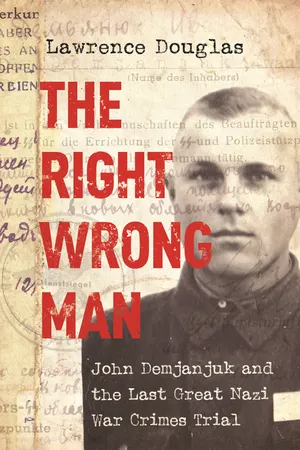
The Right Wrong Man
John Demjanjuk and the Last Great Nazi War Crimes Trial
- 352 pages
- English
- ePUB (mobile friendly)
- Available on iOS & Android
eBook - ePub
About this book
Information
Publisher
Princeton University PressYear
2016Print ISBN
9780691178257
9780691125701
eBook ISBN
9781400873159
Topic
HistoriaSubtopic
Historia del Holocausto1
The Beginning of the End of Something
Munich, November 30, 2009, 7:00 AM. The city is quiet and the early morning sky still dark, but the plaza in the Nymphenburgerstrasse teems with TV and radio trucks, their generators humming. Hundreds of journalists and spectators stand waiting outside the courthouse, all of us bundled against the late November cold. Yesterday’s Süddeutsche Zeitung reported that press accreditations have been issued far in excess of what the courtroom can accommodate, and as the crowd swells, the jostling begins.1 A man in a tuxedo and kipah walks along the perimeter of the crowd, silently handing out candles; Noah Klieger, a retired Israeli journalist and Auschwitz survivor, turns to me and dryly observes, “These trials bring out the crazies.”
A press release issued by the court announced that doors will open for accredited journalists at 8 AM, but a Polizist who is handed the statement stares at it blankly, as if seeing it for the first time. Another policeman shouts inaudible instructions. Although the police have had six months to prepare for this day, they appear utterly unprepared and bewildered, improvising on the spot. Soon the only topic of conversation among the journalists is not the trial about to get underway, but the staggering absence of organization. A letter of protest, hastily drafted, is passed through the crowd. “We, the undersigned, regret the absence of professionalism.” But to no avail. Two hours pass. A correspondent for Bavarian radio calls out, “As of 9:45 we will return fire!”—an allusion to Hitler’s words announcing the start of the Second World War.
Instead of creating cordons and an orderly queue, the police now inexplicably herd the crowd into a crude funnel, its mouth leading to a single courthouse doorway. A sign marks off the Demjanjuk Sammelzone—the Demjanjuk Collection Zone. Is this someone’s idea of a joke? The Nazi era left the German language contaminated, infected with dreaded associations, and Sammelzone suggests the collection areas where Jews were sent to be packed off to the killing centers. “The only thing missing,” comments one observer stuck in the throng, “are the train tracks.”2 For some, the fact that a crowd containing numerous Jewish journalists and several Holocaust survivors is being shoved toward a single narrow portal creates resonances that cannot be ignored. But others, and perhaps especially the Germans themselves, find reassurance in the disorganization. The SS, after all, was terrifyingly efficient. Not so the Munich police. See, we have changed.
After fours hours of delay—first the interminable wait in line, then screenings and pat-downs—I finally manage to enter Gerichtssaal 101. Considered the most secure in Munich, Courtroom 101 was built in the 1970s to accommodate the sensitive high-profile trials of the Baader-Meinhof terrorist group, though it was never much used for its intended purpose. A windowless octagon with seats for 147 observers, it is part shabby seminar room, part drab Lutheran chapel, part air-raid shelter. The vaulted ceiling bears a Brutalist touch: massive decorative blocks of poured concrete loom overhead, seemingly ready at any instant to jar loose and crush anyone sitting below. Curiously, at least to an American observer, one sees no flags anywhere, either national or municipal, and no scales-of-justice iconography to indicate a court of law. Nothing adorns the walls but a simple wooden cross.
Still, the atmosphere in the room is festive, perhaps because we who have made it in know we’re the lucky ones; half of those seeking admission remain stuck outside. Plans for an overflow room with a video hookup have been scrapped amid constitutional concerns. German law holds that televising trials invades the privacy rights of defendants. These privacy laws also account for the quaint practice in German newspapers of referring to defendants by an anonymous initial—“John (Ivan) D. was arraigned today.” The high profile of this trial renders that protocol moot, yet the matter of the video hookup raises thorny interpretive questions. Is connecting a live video feed to an adjacent room simply a matter of extending the physical space of the court, or is it akin to broadcasting the trial on primetime to the Bavarian hinterland?
Reluctant to deliver grounds for appeal before the trial has even begun, the Munich court errs on the side of caution. There will be no special accommodations, a decision that provokes the ire of Michel Friedman, TV pundit and former president of the European Jewish Congress. With his camel-hair coat, out-of-season tan and black suit, shirt, and tie, Friedman could pass as a Las Vegas singer or worse, and he angrily denounces the court’s decision to a gaggle of eager journalists. The courtroom is abuzz with correspondents from around the globe hustling to interview Nazi-hunting luminaries and other leading members of the European Jewish community. Serge Klarsfeld, the Frenchman who helped capture and prosecute Klaus Barbie, chats with Efraim Zuroff, director of the Simon Wiesenthal Center’s Jerusalem office, the world’s leading organization for tracking Nazi fugitives, which had listed Demjanjuk at the top of its most-wanted list.3 Journalists hover close by, scribbling down snippets of their conversation.
All at once the chatter in Gerichtssaal 101 dies down as a door at the side of the chamber swings open. Flanked by two medical orderlies and a court-appointed doctor, the defendant is maneuvered into the courtroom in a wheelchair. A sky blue blanket drawn all the way up to his chin covers his legs and body, and a blue baseball cap juts low over his brow. His eyes are closed, and it’s unclear whether he is asleep or just fending off the explosion of camera flashes. Photographers, cameramen, and videographers clamor in front of the wheelchair, shooting away in a frenzy, as if Gisele Bundchen had just sashayed into the Munich courtroom. Demjanjuk’s mouth hangs open; he appears to mutter words or moan in pain. Cameras flash. A helpless octogenarian, wheelchair-bound, grimacing before a relentless onslaught of publicity: it is not a sight to burnish the criminal justice system’s reputation. The blanket briefly slips from Demjanjuk’s feet, revealing a pair of incongruously jaunty Puma sneakers.
At 11:15 three robed judges, accompanied by two “jurors” and two alternatives, shuffle into the courtroom and find their places behind a raised semicircular table of dark walnut. We are instructed to take our seats, and the presiding judge, a bald sixty-year-old jurist named Ralph Alt, politely calls the court to order. “I apologize in advance for the delay,” he begins. “We were unable to calculate the length of the entrance procedure.” Derisive laughter ripples through the audience. (The head of the court later concedes that “there were organizational problems” and that the preparation was “not optimal.”)4 Bald, bearded, and bespectacled, Alt is soft-spoken and seemingly unaccustomed to speaking into a microphone, pressing the on button with needless vigor. A passionate chess player, he is known as a thorough, intelligent jurist with a strong understanding of white-collar crime.5 But he has never before presided over a trial involving Nazi-era crimes, least of all one attracting international attention. Through the entirety of the Demjanjuk trial, he will remain intent on treating it like any other criminal case before an ordinary German court. Whatever the shortcomings of such an approach—shortcomings revealed in the court’s very failure to plan for the first day’s throngs—they can hardly be described as idiosyncratic. Since the Federal Republic’s assumption of sovereignty, its legal system has tenaciously insisted that Nazi atrocities be treated as ordinary crimes, requiring no special courts, procedures, or laws to bring their perpetrators to justice.
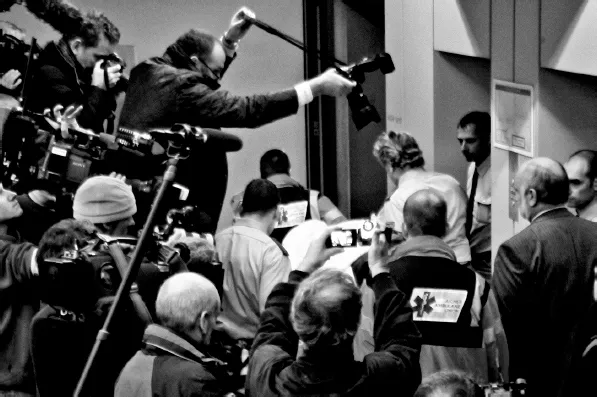
1.1. The media throng. Photo by Thomas Hauzenberger.
It is an approach that will be tested, challenged, and attacked at every turn by Demjanjuk’s defense. No sooner has Judge Alt apologized for the logistical snafu than Demjanjuk’s chief counsel, a towering, bearded, and choleric criminal defense lawyer from Ratingen (on the outskirts of Düsseldorf) named Ulrich Busch, is on his feet. Busch seeks to dismiss the case on the grounds of Befangenheit—prejudice. While motions alleging prejudice typically are brought against a specific judge for harboring a personal bias against the defendant, Busch’s opening salvo is directed against the entire German judicial system. It is an accusation he will repeat over and over: the German legal system is trying to make good on its pathetic record of dealing with Nazis by trying a man who is not a German and was never a Nazi. The charges against his client, Busch angrily declaims, represent a moral and legal double standard, a distortion of history, and a bald violation of the German constitution. What of all the SS higher-ups who were either acquitted or never even charged in the first place? Let us not forget, Busch cries, that his client was taken as a prisoner of war by the Wehrmacht. The killing of Red Army POWs was the first Holocaust! Ukrainian auxiliaries and death camp guards had no more freedom of action than the Jews themselves! A victim of forced deportation, his client was never on the radar of German prosecutors until Americans forced them to take the case. New standards are being used against his client. The rules of the game are being changed.
Busch’s words tumble forth in seemingly tone-deaf fashion, and the parallel he draws between his client and the Jewish victims of genocide leaves spectators and journalists alike murmuring their disapproval. But his opening barrage clearly outlines the defense’s strategy, which is to challenge the very legitimacy of the proceeding at the most fundamental level. In normal criminal trials, the law operates in a safe zone in which the motives and purposes of the prosecution and the rationale for the imposition of a sanction remain beyond the terms of dispute. Criminal law draws a line between violence permitted by the state in the form of a punishment and violence prohibited by the state as a delict; and in the overwhelming majority of criminal cases, this distinction is never called into question—nor is the state’s authority to draw it. Not so with political trials. Political trials blur the distinction between state-authorized and state-prohibited force; they interrogate the purposes and procedures of prosecution.6 Busch will seek to unmask the proceeding as a political trial, attacking at every turn the motives, purpose, justification, and fairness of the case.
It is 11:50 AM. Little more than half an hour old, the trial has already delivered exactly what a global news cycle craves from a legal spectacle: clamorous disorder—the dramatic entrance of a suffering, wheelchair-bound defendant; and an inflammatory opening challenge by the defense. Out on Nymphenburgerstrasse, film crews position themselves before the court building to tape their correspondents’ first impressions, while wire service journalists, notes spread on the corridor floor outside the courtroom, bang out stories on laptops connected to portable satellite hookups.
Demjanjuk’s reentry into the courtroom after the midday lunch break only adds to the carnivalesque atmosphere. Gone is the wheelchair, replaced by a monstrous orange ambulance gurney. Demjanjuk lies flat on his back, a white blanket drawn—so it appears from my vantage point—over his head. It seems that the defendant has died during lunch. A corpse has been wheeled in to stand trial.
Clearly the defense is seeking to deploy images of the defendant as a principal weapon in its attack on the legitimacy of the proceeding. Journalists viewing this apparition scribble furiously in their notebooks as Cornelius Nestler, a professor of criminal law representing relatives of persons murdered at Sobibor, jumps to his feet. Like Busch, Nestler is keenly aware that the prosecution of Demjanjuk is more than a colloquy over evidence and law; it is a competition over images that will be transmitted around the world. Indeed, this battle started well before Demjanjuk’s arrival in Germany. In an attempt to challenge the American deportation order, Demjanjuk’s family posted online a video purporting to document the medical exam of an enfeebled and dying Demjanjuk. Responding in kind, special agents in the office of Immigration and Customs Enforcement, a branch of the US Department of Homeland Security, covertly videotaped a seemingly able-bodied Demjanjuk walking unassisted and climbing into his daughter’s car.7
“Excuse me,” Nestler says, “I’d like to know why he’s positioned like that.”
A team of three doctors briefly confers and announces that the defendant has said he’s uncomfortable sitting. Then would it be possible, Nestler asks, at least to raise him? Through a Ukrainian interpreter, the lead doctor confers with Demjanjuk, who appears to reject the suggestion. Now a second lawyer representing victims’ families rises and gestures at the gurney with a look of dismay.
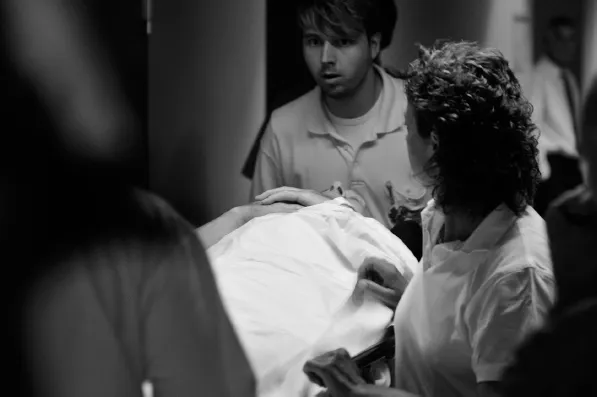
1.2. The corpse in the courtroom. Photo by Thomas Hauzenberger.
“The picture this projects,” he says, “is most disconcerting.”
The court announces a recess to discuss the matter, and soon a compromise is reached: the defendant may remain on the gurney, but propped up at a 45-degree angle.
Appropriately enough, the rest of this first day of what will turn out to be a punishingly long trial is devoted to medical testimony concerning Demjanjuk’s fitness to stand trial. Three physicians take their turns describing his various ailments, which include gout; gallstones; Myeledysplastic Syndrome, a preleukemia bone marrow disease; and spinal stenosis, a narrowing of the spinal cord. Of the trio of doctors, one—Dr. Albrecht Stein, an adjunct professor of medicine—will remain responsible for monitoring Demjanjuk’s health in the months to come, emerging as one of the trial’s most crucial actors. Decked out in his 1980s-style three-piece, double-breasted suit and jewel-studded, emerald green watch with matching green watchband, Dr. Stein could pass for a dandified quack in a Fassbinder film. In a squeaky, exuberant voice, he delivers his opinion that despite the defendant’s numerous chronic conditions, Demjanjuk is physically and psychologically able to stand trial. The three physicians are in agreement on this; nonetheless, they recommend that, in light of the defendant’s advanced age and preexisting conditions, the court should operate on an abbreviated schedule: no more than three sessions per week, and no more than three hours per session.
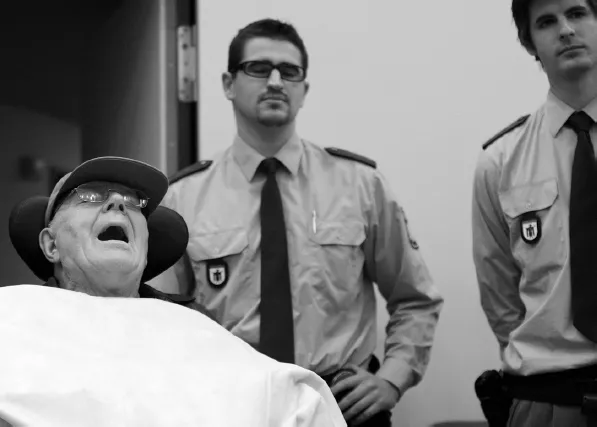
1.3. The performance of pain. Miguel Villagran / Getty Images.
The physicians’ testimony concerning the defendant’s medical state would seem completely unremarkable were it not for the grotesque pantomime playing itself out as a backdrop. While the doctors sob...
Table of contents
- Cover Page
- Title Page
- Copyright Page
- Dedication Page
- Contents
- Introduction
- 1 / The Beginning of the End of Something
- 2 / John in America
- 3 / Ivan in Israel
- 4 / Demjanjuk Redux
- 5 / Demjanjuk in Munich
- 6 / Was damals Recht war …
- 7 / Memory into History
- 8 / The Trial by History
- 9 / The Right Wrong Man
- Postscript
- Acknowledgments
- Notes
- Sources
- Index
Trusted by 375,005 students
Access to over 1.5 million titles for a fair monthly price.
Study more efficiently using our study tools.
Frequently asked questions
Yes, you can cancel anytime from the Subscription tab in your account settings on the Perlego website. Your subscription will stay active until the end of your current billing period. Learn how to cancel your subscription
No, books cannot be downloaded as external files, such as PDFs, for use outside of Perlego. However, you can download books within the Perlego app for offline reading on mobile or tablet. Learn how to download books offline
Perlego offers two plans: Essential and Complete
- Essential is ideal for learners and professionals who enjoy exploring a wide range of subjects. Access the Essential Library with 800,000+ trusted titles and best-sellers across business, personal growth, and the humanities. Includes unlimited reading time and Standard Read Aloud voice.
- Complete: Perfect for advanced learners and researchers needing full, unrestricted access. Unlock 1.5M+ books across hundreds of subjects, including academic and specialized titles. The Complete Plan also includes advanced features like Premium Read Aloud and Research Assistant.
We are an online textbook subscription service, where you can get access to an entire online library for less than the price of a single book per month. With over 1.5 million books across 990+ topics, we’ve got you covered! Learn about our mission
Look out for the read-aloud symbol on your next book to see if you can listen to it. The read-aloud tool reads text aloud for you, highlighting the text as it is being read. You can pause it, speed it up and slow it down. Learn more about Read Aloud
Yes! You can use the Perlego app on both iOS and Android devices to read anytime, anywhere — even offline. Perfect for commutes or when you’re on the go.
Please note we cannot support devices running on iOS 13 and Android 7 or earlier. Learn more about using the app
Please note we cannot support devices running on iOS 13 and Android 7 or earlier. Learn more about using the app
Yes, you can access The Right Wrong Man by Lawrence Douglas in PDF and/or ePUB format, as well as other popular books in Historia & Historia del Holocausto. We have over 1.5 million books available in our catalogue for you to explore.