The love of God is perhaps the most essential element in Judaism—but also one of the most confounding. In biblical and rabbinic literature, the obligation to love God appears as a formal commandment. Yet most people today think of love as a feeling. How can an emotion be commanded? How could one ever fulfill such a requirement? The Love of God places these scholarly and existential questions in a new light.
Jon Levenson traces the origins of the concept to the ancient institution of covenant, showing how covenantal love is a matter neither of sentiment nor of dry legalism. The love of God is instead a deeply personal two-way relationship that finds expression in God's mysterious love for the people of Israel, who in turn observe God's laws out of profound gratitude for his acts of deliverance. Levenson explores how this bond has survived episodes in which God's love appears to be painfully absent—as in the brutal persecutions of Talmudic times—and describes the intensely erotic portrayals of the relationship by biblical prophets and rabbinic interpreters of the Song of Songs. He examines the love of God as a spiritual discipline in the Middle Ages as well as efforts by two influential modern Jewish thinkers—Martin Buber and Franz Rosenzweig—to recover this vital but endangered aspect of their tradition.
A breathtaking work of scholarship and spirituality alike that is certain to provoke debate, The Love of God develops fascinating insights into the foundations of religious life in the classical Jewish tradition.
eBook - ePub
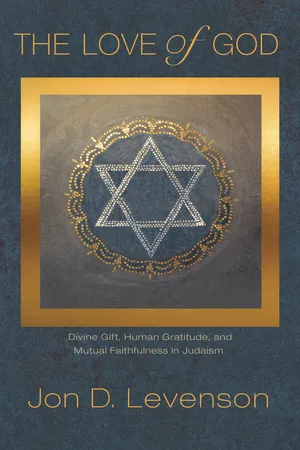
The Love of God
Divine Gift, Human Gratitude, and Mutual Faithfulness in Judaism
- 264 pages
- English
- ePUB (mobile friendly)
- Available on iOS & Android
eBook - ePub
About this book
Information
Publisher
Princeton University PressYear
2015Print ISBN
9780691202501
9780691164298
eBook ISBN
9781400873395
THREE
The Once and Future Romance
Whenever Israel would make a festival pilgrimage, they would roll back the curtain [of the Holy of Holies] for them and show them the Cherubim—who were embracing each other—and say to them, “Look! God’s love for you is as the love of a man and a woman.”
Talmud1
In our discussion so far, I have been at pains to offer scant comment on the erotic understanding of the love of God, that is, the interpretation that places it in the category of love that is most familiar to people today, with sexuality at the very center. The reason for my reticence bears restatement: the sexual is but one variety of love, and it is not the one that is most central to the Torah (in the sense of the Five Books of Moses), nor does it today convey adequately key elements of the love of God in that most foundational and authoritative of Jewish texts.2 These are the elements that I have been calling obedience, service, law, and the like, though really all such terms simply refer to various aspects of what is actually the same dimension in the God-Israel relationship.
To speak of God and Israel as the lover and the beloved (in either order) in the familiar, sexual sense too easily causes us to miss other key metaphors, some of which, in fact, are at least equally prominent in the Hebrew Bible—the metaphors of king and subject, for example, father and son, shepherd and flock, master and servant, or vineyard-keeper and vineyard. It is not the case, of course, that these other metaphors convey only dry, formal relationships and lack any emotional intensity. Far from it. In chapter 1, I argued that the love owed by the covenantal vassal to his lord (or by the subject to his king) is both active and affective: the fact that it denotes specific deeds of service and a general stance of obedience in no way precludes, or even diminishes, its emotional dimension. In the Hebrew Bible, the love of God and the fear of God (understood as keen recognition of his infinite majesty and taut attentiveness to his will) are not at odds; they work in tandem.
By contrast, where love is understood as primarily a sentiment, the dimension of deeds and of the service that the deeds bespeak is lost or radically transformed. And when that happens to any form of love, love is eviscerated and lightened beyond recognition, and its days become numbered. When it happens to the love of God in particular, the result is the perception that all talk of God’s love or of loving God is, at base, a treacly thing that appeals only to the emotionally weak—a crutch, perhaps, to help them avoid facing the lovelessness, or some kindred deficiency, in their own lives.
And yet, precisely because it is manifestly artificial to sever the two dimensions, the active and the affective, in the Hebrew Bible, we have already, in fact, heard the note of eros (again in the sense of the sexuality) in our discussion of covenant. We saw it, for example, in chapter 1 when we examined Deuteronomy 7, which speaks of God’s having “set His heart” (ḥašaq) on Israel in language that can be reasonably interpreted as connoting an erotic passion and not simply a platonic favoring (v. 7). The same verb appears in the account of Shechem’s crush on Dinah in Genesis 34:8 and in the law of the beautiful captive whom the Israelite warrior desires to wed in Deuteronomy 21:11. In rabbinic theology, this erotic language becomes more prominent, so much so that, as we shall see at length, the great biblical chanson d’amour, the highly erotic Song of Songs, becomes a central vehicle for rendering the relationship of God and Israel.
This change, this movement of erotic language from the periphery to the center, may seem to have come out of the blue, as it were. But if we turn our attention away from the Torah and to the prophets, we shall find that it has a long prehistory—and a deeper resonance in the Torah than at first seems the case.
A FAMILY RUINED AND RENEWED
We begin with the opening oracle of God to Hosea, a prophet active in the northern kingdom (Israel, as distinguished from Judah) in the eighth century BCE:
2When the LORD first spoke to Hosea, the LORD said to Hosea, “Go, get yourself a wife of whoredom and children of whoredom; for the land has been straying from following the LORD.” 3So he went and married Gomer daughter of Diblaim. She conceived and bore him a son, 4and the LORD instructed him, “Name him Jezreel; for, I will soon punish the House of Jehu for the bloody deeds at Jezreel and put an end to the monarchy of the House of Israel. 5In that day, I will break the bow of Israel in the Valley of Jezreel.”
6She conceived again and bore a daughter; and He said to him, “Name her Lo-ruhamah, for I will no longer accept the House of Israel or pardon them …”
8After weaning Lo-ruhamah, she conceived and bore a son. 9Then He said, “Name him Lo-ammi, for you are not My people and I will not be your [God].” (Hos 1:2–9)3
Words from the root of the Hebrew term translated as “whoredom” in verse 2 (zenunim) refer in their primary sense to “sexual activities conducted outside marriage, mainly by women.”4 Adultery (that is, marital infidelity), too, can therefore fall within the semantic range of that root. It is therefore not surprising that, two chapters later, in what is evidently a variant of the same text, we find an oracle in which the prophet is instructed to love an adulterous woman (menaʾephet, Hos 3:1).
In this context, the difference between a prostitute and an adulteress is not so great as it may appear. In fact, “harlotry” and “adultery” appear in synonymous parallelism in Hosea 2: “And let her put away her harlotry (zenuneyha) from her face / And her adultery (naʾaphupheyha) from between her breasts” (v. 4). Although in ancient Israel prostitution did not carry the stigma it was to acquire later, a married woman who acted like a prostitute was morally objectionable in the extreme. And yet it is just such a woman whom the prophet is instructed to wed: one who continually misdirects her own love and thus abuses the love shown to her.
Although it is sometimes said that Hosea inferred his message to Israel from his own failed marriage,5 the direction represented in the text is the reverse: he marries the unfaithful women as a dramatization of the problematic relationship between the LORD and Israel. We are dealing, in other words, with what scholars call a “prophetic sign-act,” in which the prophet embodies and acts out key aspects of his message, often in ways calculated to shock his audience. Isaiah, for example, who preached slightly later than Hosea and in the southern kingdom (Judah), is said to have gone naked and barefoot for three years at the LORD’s command in order to depict the coming treatment of Egypt and Nubia at the hands of Assyria (Isa 20). In Hosea’s case, as is usual in the prophetic sign-act, the message is explicit: “the land has been straying (zanoh tizneh) from following the LORD” (Hos 1:2). The root of the verb here (z.n.h.) is the same as the one in the noun translated above variously as “whoredom” and “harlotry,” and the doubled form adds intensity to the act portrayed. The clause would be more accurately (if less elegantly) rendered, “instead of following the LORD, the land has been whoring it up outrageously.”
The children to whom Hosea’s meretricious wife gives birth are to bear names that reflect her character, which is, of course, the character of the people Israel in their defection from their God. The name of the first son, Jezreel, may have had a meaning for the original hearers that we cannot recover. The only event in the Hebrew Bible to which it might refer is the revolution reported in 2 Kings 9:15b–37, which resulted, among other things, in the death by defenestration of the corrupt, idolatrous, and violent queen Jezebel, her flesh then devoured by dogs, “just as the LORD spoke through His servant Elijah the Tishbite” (v. 36). Here, the reference is to the great prophet’s prediction that “the dogs shall devour Jezebel in the field of Jezreel” (1 Kgs 21:23).
The leader of the bloody revolution was Jehu, the very figure whose own dynasty is about to be punished according to Hosea 1:4. And, indeed, the last king of the House of Jehu with a reign of any significant duration was none other than Jeroboam II (ca. 786–746 BCE), the king of Israel at the time of Hosea’s oracles, according to the superscription in Hosea 1:1. As is usual for the prophets of Israel, events in the political realm are taken as indications of the pleasure or (as in this case) the displeasure of the LORD with the doings of his people. Meaning: the line of the sanguinary revolutionary is fast coming to an end.
The symbolic names of the prophet’s other children are more transparent (Hos 1:6–9). “Lo-ruhamah” means “Unloved,” “Unpitied,” or the like. Speakers of Modern Hebrew may be inclined to prefer “Unpitied” because the root of this girl’s name (r.ḥ.m.) is different from the one that today is associated more readily with love (ʾ.h.v.), but, if so, their instinct would be mistaken. The root r.ḥ.m. usually means “love” in languages related to Hebrew. In fact, the Targum Onqelos, an Aramaic translation of the Torah, renders “You shall love” (veʾahavta, Deut 6:5) in the Shema with vetirḥam (from r.ḥ.m.), and “love” rather than “pity” or “mercy” is the more natural rendering of some instances of the root r.ḥ.m in the Hebrew Bible as well. The difference is not great and may be artificial in any event, for, either way, Hosea is instructed to give his daughter a name that signals the end of God’s love for Israel, his refusal to accept them or to pardon them (here the notions of pity and mercy come to the fore) for their massive infidelity. Having abused its love and directed it toward a host of improper recipients, Israel now finds itself not more loved than ever but less—in fact, Unloved.
Finally, Lo-ammi means “Not-My-People,” just as verse 9 indicates. The process of naming Hosea’s three children ends in a crescendo: the last name symbolizes the end of the relationship of the LORD and Israel. No longer are they his people. Betrayal has, to all appearances, canceled the covenant arrangement. “Now then, if you will obey Me faithfully and keep My covenant, you shall be My treasured possession among all the peoples,” God had proclaimed in Exodus 19:5. But now Israel has strayed from him, violated the covenant, and become Not-My-People. The nation God once lovingly adopted into sonship through covenant now finds itself disowned, its covenant annulled. Israel is now unloved, no longer his people.
In contemporary society, at least in America, an unhappy situation like this would have an obvious remedy: divorce. The promiscuous wife and her cuckolded husband would go their separate ways by mutual consent, probably to seek fulfillment with other partners more to their liking. In ancient Israel, this option would not come to mind for several reasons. The first is simply that in Israelite law, the wife becomes a member of her husband’s household.6 If there is to be a divorce, it must therefore be at his instigation, not hers. And, in ancient Israel, unlike mode...
Table of contents
- Cover Page
- Title Page
- Copyright Page
- Dedication Page
- Contents
- A Note on Transliteration from Hebrew
- Preface
- Acknowledgments
- Abbreviations
- One: A Covenantal Love
- Two: Heart, Soul, and Might
- Three: The Once and Future Romance
- Four: The Consummation of the Spiritual Life
- Five: “Because He has sold Himself to us with the Torah”
- Notes
- Index of Primary Sources
- Index of Modern Authors
Trusted by 375,005 students
Access to over 1.5 million titles for a fair monthly price.
Study more efficiently using our study tools.
Frequently asked questions
Yes, you can cancel anytime from the Subscription tab in your account settings on the Perlego website. Your subscription will stay active until the end of your current billing period. Learn how to cancel your subscription
No, books cannot be downloaded as external files, such as PDFs, for use outside of Perlego. However, you can download books within the Perlego app for offline reading on mobile or tablet. Learn how to download books offline
We are an online textbook subscription service, where you can get access to an entire online library for less than the price of a single book per month. With over 1.5 million books across 990+ topics, we’ve got you covered! Learn about our mission
Look out for the read-aloud symbol on your next book to see if you can listen to it. The read-aloud tool reads text aloud for you, highlighting the text as it is being read. You can pause it, speed it up and slow it down. Learn more about Read Aloud
Yes! You can use the Perlego app on both iOS and Android devices to read anytime, anywhere — even offline. Perfect for commutes or when you’re on the go.
Please note we cannot support devices running on iOS 13 and Android 7 or earlier. Learn more about using the app
Please note we cannot support devices running on iOS 13 and Android 7 or earlier. Learn more about using the app
Yes, you can access The Love of God by Jon D. Levenson in PDF and/or ePUB format, as well as other popular books in Social Sciences & Jewish Theology. We have over 1.5 million books available in our catalogue for you to explore.